
Can a single inspection really make or break the quality of mass production? We explore the critical role of First Article Inspection (FAI) in ensuring that the first pieces produced meet all design specifications, setting the stage for successful mass production.
FAI serves as a crucial quality assurance process that verifies the initial production results against product design requirements. By doing so, it identifies potential manufacturing issues early on, saving companies from costly reworks and production delays.
As we delve into the world of FAI, we will examine its workflow, the significance of First Article Inspection Reports (FAIR), and its importance in industries requiring high-precision components.
Key Takeaways
- Understanding the fundamental differences between FAI and standard quality control processes.
- The role of FAI in identifying potential manufacturing issues early.
- The importance of FAI in industries requiring high-precision components.
- The complete FAI workflow from sample selection to documentation.
- The critical role of First Article Inspection Reports (FAIR) in maintaining quality standards.
Understanding First Article Inspection
At the start of a production run, First Article Inspection (FAI) is conducted to verify that the manufacturing process meets the required specifications. This inspection is crucial for ensuring that the production process is capable of producing parts that meet the design requirements.
Definition and Purpose of FAI
First Article Inspection involves examining one to three pieces from the initial production run to validate the manufacturing process. These pieces are typically selected from the start of the production batch, and it’s essential to note that they don’t necessarily have to be the very first pieces produced. The primary purpose of FAI is to provide documented evidence that the production process can meet the design specifications, thereby creating a baseline for future quality control activities.
Difference Between FAI and Regular Quality Control
While both FAI and regular quality control are essential for maintaining product quality, they serve different purposes. Regular quality control involves sampling throughout the production process to ensure consistency, whereas FAI focuses on the initial production pieces to verify the manufacturing capability. Key differences include:
- FAI is a preventive measure that occurs before full production, whereas regular quality control is both preventive and detective, continuing throughout the manufacturing process.
- FAI examines every dimension and specification against engineering requirements, whereas regular quality control may focus only on critical characteristics.
- For more information on quality control measures, including FAI, visit https://espcba.com/pcb-tests-inspections/.
When First Article Inspection Is Required
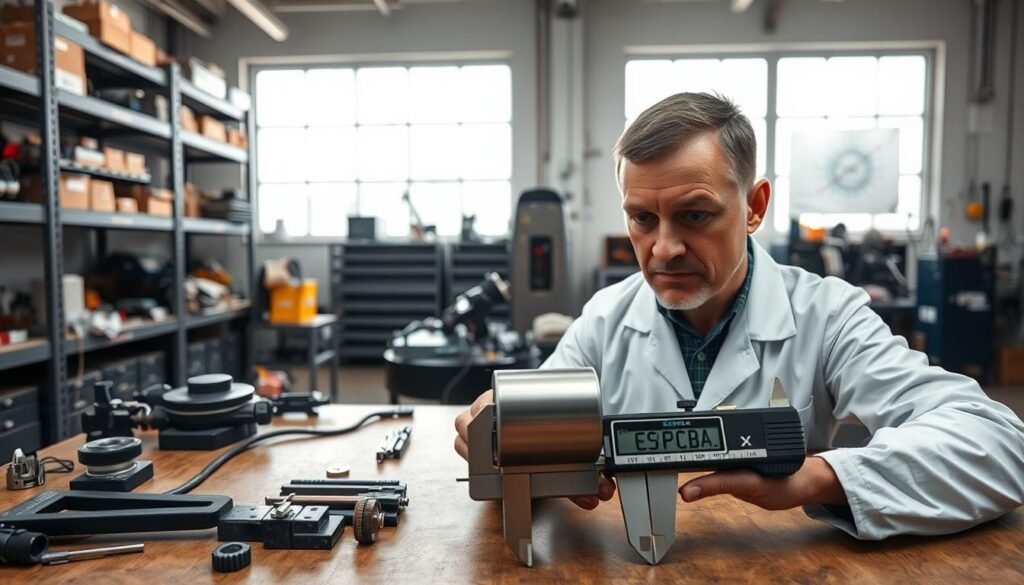
Understanding when to conduct a First Article Inspection is crucial for maintaining high-quality standards in manufacturing. Several factors determine the necessity of such inspections.
New Product Introduction
When a product is being produced for the first time, a First Article Inspection is essential to verify that it meets all the specified requirements and design intent.
Design or Process Changes
Any changes to a product’s design or production process necessitate an FAI to ensure that the modifications have not adversely affected the product’s quality.
New Supplier or Manufacturing Location
A change in the manufacturing location or supplier requires an FAI to validate that the new environment or entity can meet the required production standards.
Production Resumption After Hiatus
After a significant hiatus (typically two years or more), First Article Inspections are required to verify that manufacturing capabilities remain consistent with specifications. This is crucial because during the hiatus, equipment may have changed, materials may have varied, or there may have been personnel turnover, all of which can affect product quality.
- FAI after a production hiatus helps identify any degradation in manufacturing capabilities.
- This verification ensures the first new production run meets quality standards.
- Production resumption FAI provides confidence to manufacturers and customers alike.
The First Article Inspection Process
The FAI process involves a thorough examination of the first parts produced to ensure they align with the design specifications. This process is crucial for verifying that the production results meet all customer requirements.
Sample Selection Criteria
We select samples for FAI based on specific criteria to ensure they are representative of the production process. This involves choosing parts from the initial production run.
Inspection Parameters and Measurements
During FAI, we inspect various parameters, including measurements and dimensions, to verify that they meet the specified requirements. Manufacturers examine factors such as equipment, design, and materials.
Evaluation Against Design Specifications
We evaluate the inspected part against the design specifications to ensure compliance. This involves comparing measured characteristics against the specifications and documenting the results. Key aspects of the evaluation include:
- Comparing every measured characteristic against the design specifications.
- Documenting specification requirements and actual measured results side by side.
- Evaluating each characteristic against its specific tolerance requirements.
- Considering material properties, surface finishes, and functional characteristics.
- Investigating any non-conforming characteristics to determine root cause and corrective actions.
The Role of First Article Inspection (FAI) in Mass Production

The significance of First Article Inspection (FAI) in mass production cannot be overstated, as it directly impacts product quality and production efficiency. By conducting a thorough FAI, manufacturers can identify and address potential issues early on, preventing costly rework and ensuring compliance with customer specifications.
Preventing Defects Before Full Production
FAI is instrumental in detecting errors in the manufacturing process before full-scale production begins. This pre-production inspection enables manufacturers to rectify issues, thereby avoiding the production of defective parts that would otherwise require expensive rework or scrapping. By doing so, FAI helps optimize production processes from the outset, potentially increasing overall manufacturing efficiency and reducing waste throughout production.
Cost and Time Savings Benefits
The benefits of FAI extend to significant cost savings and reduced production timelines. By identifying issues early, manufacturers can minimize production delays, avoid costly rework, and reduce the likelihood of customer rejections and potential warranty claims. The time invested in conducting thorough FAI pays dividends by ensuring that products are manufactured correctly from the start, thereby maintaining production schedules and meeting delivery commitments to customers.
- FAI delivers significant cost savings by preventing the production of defective parts.
- Identifying issues early through FAI minimizes production delays.
- The time invested in FAI reduces the likelihood of production stoppages and customer rejections.
First Article Inspection Reports (FAIR)
The First Article Inspection Report (FAIR) is a comprehensive document that ensures the conformity of manufactured parts to design specifications. It is a critical component of the quality control process, providing detailed information about the inspection results.
Form1: Part Number Accountability
Form1 is designed to ensure part number accountability, capturing essential details such as part numbers, revisions, and other identifying information. This form helps in maintaining traceability and verifying that the correct parts are being inspected.
Form2: Product Accountability
Form2 focuses on product accountability, documenting information that links the product to its manufacturing process, including supplier details and production dates. This ensures that the product can be traced back to its source and production conditions.
Form3: Characteristic Accountability
Form3 is a detailed document that summarizes each design characteristic of the FAI parts, including dimensions, tolerances, drawing notes, measurements, and results. A balloon drawing is also required on this form to provide a visual reference.
- Documents every individual design characteristic, recording both the requirement and the actual measured result for each characteristic.
- Organized to correspond with numbered characteristics on the ballooned drawing, creating clear traceability between drawings and inspection results.
- Captures all dimensional measurements, geometric tolerances, surface finishes, and any notes or specifications from the engineering drawings.
- Indicates whether each characteristic conforms to requirements and documents any non-conformances that require resolution.
For more detailed information on FAIR, you can refer to our article on First Article Inspection Reports.
| Form | Purpose | Key Information |
|---|---|---|
| Form1 | Part Number Accountability | Part numbers, revisions |
| Form2 | Product Accountability | Supplier details, production dates |
| Form3 | Characteristic Accountability | Dimensions, tolerances, measurements |
Ballooned Drawings in FAI Documentation
Ballooned drawings are a critical component of FAI documentation, providing a clear and direct link between engineering requirements and inspection results. These drawings, sometimes referred to as “bubble drawings,” are annotated with numbers that correspond to specific design characteristics listed in Form 3 of the inspection report.
Purpose and Creation of Ballooned Drawings
The primary purpose of ballooned drawings is to establish a one-to-one relationship between the numbered balloons on the drawing and the corresponding line items in the inspection report. This is achieved through an auto ballooning feature that not only adds balloons next to all dimensions but also extracts selected dimensions and GD&T feature control frames, exporting the data to an Excel file for the first article inspection report.
Linking Drawings to Inspection Reports
The linking system between ballooned drawings and inspection reports ensures that every characteristic on the drawing is accounted for, preventing omissions during verification. The benefits of this system include:
- Direct Traceability: Consistent numbering systems across documentation create direct traceability between engineering requirements and inspection results.
- Efficient Review: The numbered system facilitates efficient review of inspection results by allowing quick reference between the drawing and the corresponding measurement data.
- Automated Process: Modern FAI software can automate the linking process, extracting dimensional data from drawings and populating inspection reports while maintaining numbering correlation.
By utilizing ballooned drawings in FAI documentation, we can significantly enhance the accuracy and efficiency of the inspection process, ultimately contributing to the production of high-quality products.
FAI Software Solutions

To enhance the accuracy and speed of first article inspections, companies are turning to advanced FAI software solutions. These systems are designed to automate and streamline the inspection process, reducing manual errors and increasing efficiency.
Benefits of Automated FAI Systems
Automated FAI systems offer several benefits, including improved quality control and reduced inspection times. By leveraging advanced software, businesses can ensure that their products meet the required specifications and standards.
Features to Look for in FAI Software
When selecting FAI software, there are several key features to consider:
- Automated ballooning capabilities that can identify and number characteristics on engineering drawings with minimal manual intervention.
- The ability to extract dimensional data directly from CAD files or PDF drawings to populate inspection reports automatically.
- Robust reporting capabilities that generate compliant documentation formats for various industry standards (AS9102, PPAP, etc.).
- Integration capabilities with measurement equipment and quality management systems to streamline the overall inspection and documentation process.
- Revision control features that track changes to parts and documentation, maintaining a complete history of the FAI process across product lifecycles.
By adopting the right FAI software solution, businesses can improve the quality of their products, reduce costs associated with manual inspections, and enhance their overall order fulfillment process. This is particularly beneficial for importers who need to ensure that their products comply with international standards and regulations.
Conclusion: Implementing Effective FAI Practices
To ensure product quality and reduce issues, importers must prioritize effective First Article Inspection (FAI) practices. Implementing FAI requires a systematic approach that begins with clear documentation of requirements for both internal teams and suppliers. Industries requiring high-precision components, such as aerospace and automotive, benefit significantly from rigorous FAI practices. For importers working with overseas suppliers, establishing clear FAI requirements is essential to ensuring product quality before mass production.
Effective FAI implementation creates a foundation for ongoing quality control throughout mass production. Pre-production planning should include detailed FAI requirements, and factory audits before placing orders help verify that suppliers have adequate quality management systems. By investing in comprehensive FAI processes, importers can reduce quality issues, minimize production delays, and improve customer satisfaction.
FAQ
What is the primary purpose of conducting a First Article Inspection (FAI)?
How often should FAI be performed during mass production?
What are the key elements that are typically inspected during an FAI?
What is the difference between FAI and regular quality control?
How do automated FAI software solutions benefit the inspection process?
What information is typically included in a First Article Inspection Report (FAIR)?
Why are ballooned drawings important in FAI documentation?
Can FAI be applied to both simple and complex products?
About The Author
