As electronic systems become increasingly powerful, the demand for circuit boards that can handle higher currents and dissipate heat effectively has grown. Heavy copper PCBs have emerged as a crucial solution, featuring significantly thicker copper layers than standard PCBs.
These specialized boards start at 3 oz/ft² and can go up to 20 oz/ft² or more, enabling them to manage high current loads and thermal management in power-intensive applications. We will explore how heavy copper PCBs provide increased durability, superior thermal performance, and enhanced reliability under extreme conditions.
Key Takeaways
- Heavy copper PCBs offer increased durability and reliability.
- They provide superior thermal performance in high-power applications.
- The manufacturing process for heavy copper PCBs is specialized.
- Proper copper thickness selection is crucial for optimal performance.
- Heavy copper PCBs are essential in power electronics and automotive systems.
What Are Heavy Copper PCBs?
Heavy Copper PCBs are a type of printed circuit board that features significantly thicker copper layers than standard PCBs. While typical PCBs have copper layers ranging from 1 to 2 ounces per square foot (oz/ft²), Heavy Copper PCBs start at 3 oz/ft² and can go up to 20 oz/ft² or more.
Definition and Specifications
Heavy Copper PCBs are defined by their copper weight and thickness. The industry specifications categorize anything above 3 oz/ft² as heavy copper and above 20 oz/ft² as extreme copper.
Copper Weight and Thickness Standards
The copper weight and thickness standards for Heavy Copper PCBs are precisely defined. Copper weights above 20 oz/ft² and up to 200 oz/ft² are referred to as EXTREME Copper.
Comparison to Standard PCBs
When comparing Heavy Copper PCBs to standard PCBs, we observe substantial differences in current-carrying capacity, thermal performance, and mechanical durability. Heavy Copper PCBs are suitable for applications where standard boards would fail.
Key Characteristics
The key characteristics of Heavy Copper PCBs include superior current handling, enhanced thermal management, increased mechanical strength, and improved reliability during thermal cycling. These characteristics make Heavy Copper PCBs particularly valuable in environments subject to vibration, physical shock, or extreme temperature variations.
- Heavy Copper PCBs feature straight sidewalls and negligible undercut due to advanced manufacturing techniques.
- The increased copper thickness affects the electrical properties of the circuit, including reduced resistance and impedance.
- Understanding the fundamental specifications and characteristics of Heavy Copper PCBs is essential for determining their appropriateness and cost-effectiveness for high-power applications.
By leveraging the benefits of Heavy Copper PCBs, manufacturers can create more reliable and efficient electronic systems. As we continue to explore the advantages and applications of Heavy Copper PCBs, it becomes clear that they play a critical role in advancing high-power electronics.
Advantages of Heavy Copper PCBs for High-Power Applications
Heavy Copper PCBs are engineered to provide superior performance in high-power applications, offering several key advantages over standard PCBs. These benefits stem from the unique characteristics of heavy copper, which enable it to handle demanding electrical and thermal requirements.
Increased Current-Carrying Capacity
One of the most significant advantages of Heavy Copper PCBs is their ability to carry higher currents without overheating. The thicker copper traces and planes can handle current loads that would cause standard PCBs to fail. For instance, a 1 oz copper trace might safely carry around 1-2 amps per 10 mils of width, while a 6 oz copper trace can manage up to 6-12 amps for the same width, depending on thermal conditions.
Superior Thermal Management
Heavy Copper PCBs excel in thermal management by acting as a heat sink. The thicker copper layers spread heat more evenly across the board, reducing hot spots that could damage components or degrade performance. This capability is crucial in high-power designs where heat dissipation is a major concern.
Enhanced Mechanical Strength
The added copper weight in Heavy Copper PCBs provides structural integrity, making them more resistant to mechanical stress, vibration, and physical shock. This enhanced mechanical strength is a critical benefit, particularly in applications where the PCB may be subject to harsh environmental conditions.
Improved Reliability for Repeated Thermal Cycles
In high-power applications, components often undergo repeated heating and cooling cycles during operation. Heavy Copper PCBs are designed to endure these thermal stresses without warping or losing conductivity. Our observations have shown that heavy copper PCBs demonstrate improved reliability during repeated thermal cycles.
| PCB Type | Copper Weight | Failure Rate after 8 Thermal Cycles |
|---|---|---|
| Standard PCB | 1 oz | 32% |
| Heavy Copper PCB | At least 2.5 mil (6 oz) | 0.57% |
By leveraging these advantages, Heavy Copper PCBs offer a robust solution for high-power applications, including motor controllers, power supplies, and inverters. Their ability to reduce I²R losses and provide a low-resistance pathway for current enhances the overall efficiency of power distribution systems.
Heavy Copper PCB Design Guidelines
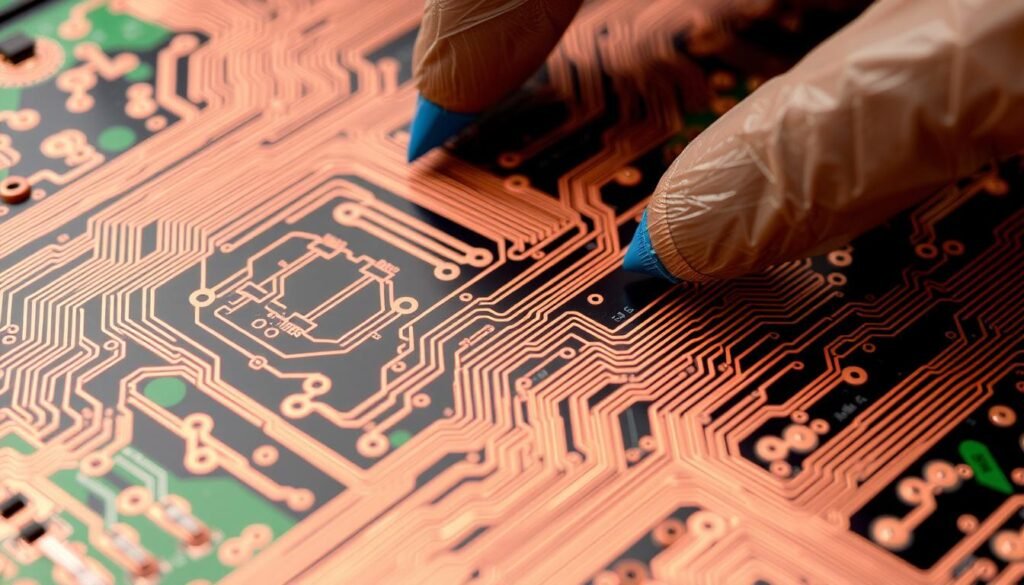
To maximize the potential of heavy copper PCBs, designers must adhere to specific guidelines. We emphasize that careful planning is crucial to avoid common pitfalls and ensure that the PCB can handle high currents without excessive heat buildup.
Trace Width and Spacing Considerations
Given the high currents involved in heavy copper PCBs, trace widths must be calculated to handle the expected load. A general rule of thumb is to increase trace width proportionally with copper thickness. For instance, a 3 oz copper layer might require traces at least 20-30% wider than a 1 oz layer for the same current. Additionally, spacing between traces should be increased to prevent arcing or short circuits, especially in high-voltage designs.
Current-Carrying Capacity Calculations
For current-carrying capacity calculations, we recommend following the IPC-2221 standard, which provides formulas for determining appropriate trace dimensions based on expected current loads and acceptable temperature rise. The formula for external traces is given by: W = (I / (K * ΔT^0.44))^(1/0.725), where K is a constant that depends on the trace location.
Thermal Management Techniques
Effective thermal management techniques for heavy copper PCBs include incorporating thermal vias near high-power components, using large copper pours on outer layers, and integrating heat sinks directly into the board design. These techniques help to dissipate heat efficiently and maintain the reliability of the PCB.
Material Selection
Material selection is crucial for heavy copper PCBs, with high-Tg (glass transition temperature) substrates like FR-4 or polyimide recommended for better thermal stability in high-power applications. We advise designers to balance copper distribution across the board to prevent warping during manufacturing due to differential thermal expansion.
Key considerations for designing heavy copper PCBs include:
– Increasing trace width proportionally with copper thickness to handle high currents.
– Following the IPC-2221 standard for current-carrying capacity calculations.
– Implementing effective thermal management techniques, such as thermal vias and copper pours.
– Selecting materials with high thermal stability, like FR-4 or polyimide.
– Balancing copper distribution to prevent warping during manufacturing.
– Collaborating with your fabrication partner early in the design phase to ensure a successful outcome.
The Heavy Copper PCB Manufacturing Process
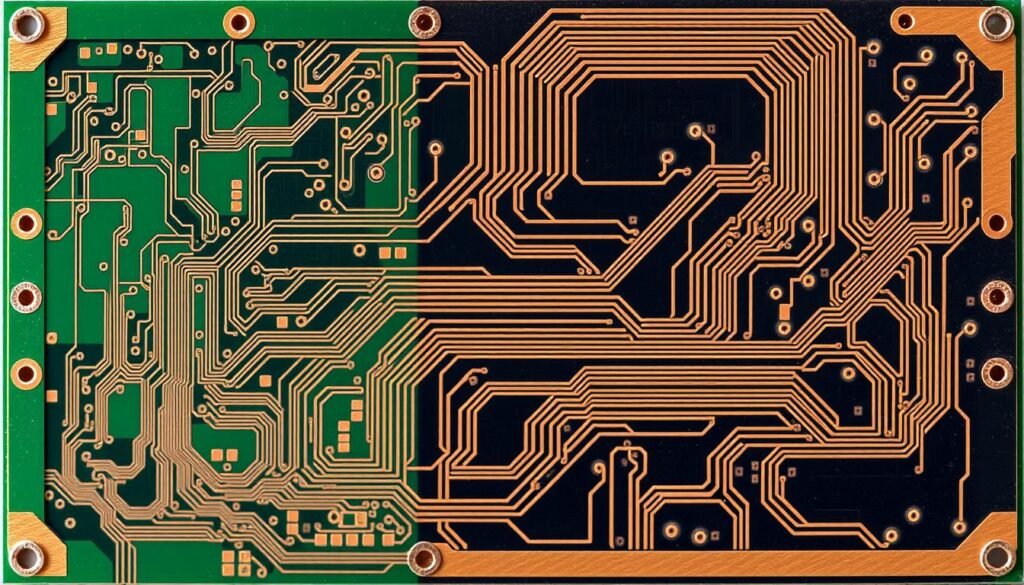
We employ a distinct manufacturing process for heavy copper PCBs, tailored to their specific requirements. The process begins with careful material selection and preparation, choosing high-quality substrates like FR-4 or high-Tg materials that can withstand the thermal stresses associated with heavy copper applications.
Material Selection and Preparation
The substrate material is crucial for the performance of heavy copper PCBs. We select materials that offer excellent thermal stability, ensuring that the PCB can operate reliably under various conditions. Copper foil, ranging from 3 oz/ft² to 20 oz/ft², is laminated onto the substrate.
Specialized Etching and Plating Techniques
Our specialized etching and plating techniques are essential for creating precise heavy copper features. We’ve developed methods that produce straight sidewalls and negligible undercut, unlike older techniques that resulted in uneven trace profiles. For boards requiring copper beyond the initial foil thickness, we employ electrolytic plating processes.
Via Formation and Plating
Via formation and plating in heavy copper PCBs require special attention. Via walls often need thicker plating (up to 2-3 mils) compared to standard boards (0.5-1 mil) to ensure they can handle high currents without failure. This is critical for maintaining the reliability and performance of the PCB.
Quality Control and Testing
Quality control and testing are rigorous for heavy copper PCBs. We include microsectioning to inspect via plating thickness, copper uniformity checks, and thermal performance verification to ensure boards meet strict tolerances. Our advanced manufacturing capabilities allow us to produce heavy copper PCBs with copper weights ranging from 3 oz/ft² to 20 oz/ft².
The manufacturing process often involves differential etching techniques that allow for varying copper thicknesses on the same layer, enabling the integration of both control circuits and power circuits on a single board. The solder mask application for heavy copper PCBs may require multiple coats to achieve full coverage due to the uneven surface created by thick copper features.
Applications of Heavy Copper PCBs
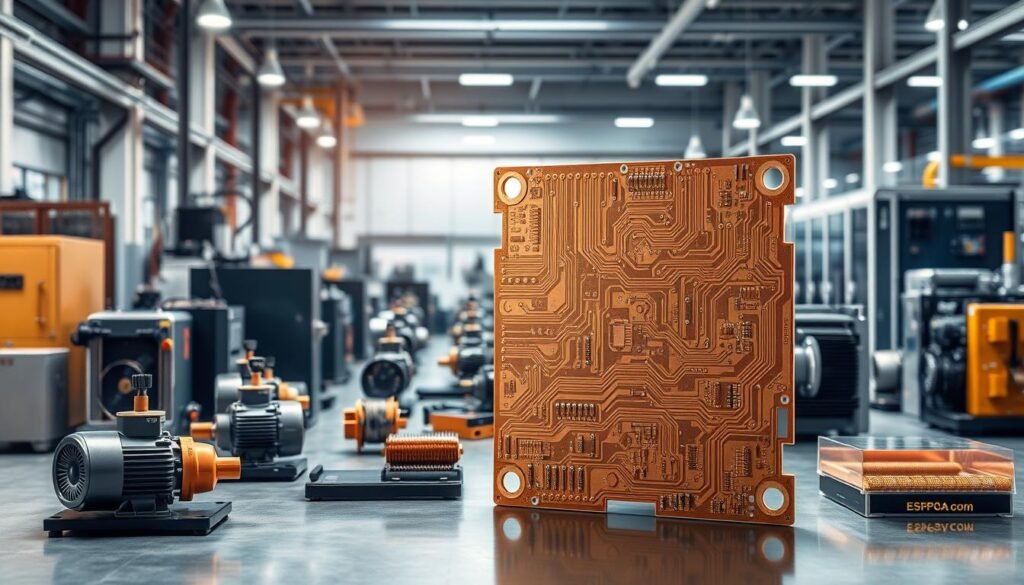
Heavy Copper PCBs are crucial in applications where high current and thermal stability are paramount. Their unique characteristics make them indispensable in various industries.
Power Electronics and Distribution Systems
Heavy Copper PCBs excel in managing high currents and voltages while maintaining thermal stability in power supplies, converters, and inverters. They are essential for efficient power distribution and reliability in demanding applications.
- High current-carrying capacity
- Superior thermal management
- Enhanced reliability
Automotive and Electric Vehicle Applications
The automotive and electric vehicle sector relies heavily on Heavy Copper PCBs for battery management systems and motor controllers. These PCBs withstand harsh environmental conditions, including vibration and extreme temperatures.
- Robust battery management systems
- High-performance motor controllers
Renewable Energy Systems
Renewable energy systems benefit significantly from Heavy Copper PCBs, which provide the necessary durability and current-handling capabilities for solar inverters, wind turbine controls, and energy storage systems.
- High-current connections
- Efficient thermal management
Military and Aerospace Applications
Military and aerospace applications demand the highest reliability standards, making Heavy Copper PCBs ideal for use in weapons control systems, radar power supplies, and critical power distribution panels.
- Weapons control systems
- Radar power supplies
- Critical power distribution panels
In conclusion, Heavy Copper PCBs are versatile and find applications in various industries where high power and reliability are critical. Their ability to manage high currents and maintain thermal stability makes them indispensable in modern electronics.
Heavy Copper vs. Standard PCBs: Key Differences
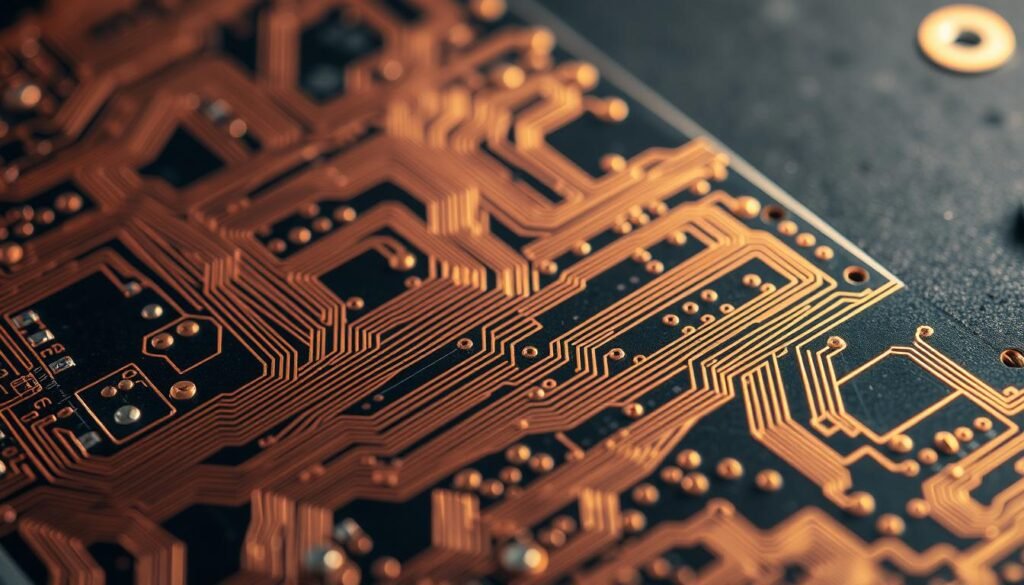
Heavy copper PCBs differ from standard PCBs in several critical aspects, including structural differences, performance, and cost. Understanding these differences is crucial for selecting the appropriate PCB for high-power applications.
Structural Differences
The most notable structural difference lies in the copper weight. Heavy copper PCBs feature copper weights ranging from 3 oz/ft² to 20 oz/ft² or more, whereas standard PCBs typically have copper weights between 0.5 oz/ft² and 1 oz/ft². This significant difference in copper thickness affects the current-carrying capacity and thermal management of the PCBs.
Performance Comparison
Heavy copper PCBs dramatically outperform standard PCBs in terms of current-carrying capacity, thermal management, and mechanical durability. For instance, a 6 oz copper trace can handle up to six times the current of a 1 oz trace. This makes heavy copper PCBs ideal for high-power applications.
Cost Considerations
The increased material usage and specialized manufacturing processes make heavy copper PCBs more expensive than standard boards. A 6 oz copper board might cost 2-3 times more than a 1 oz board of the same size.
Environmental Impact
The environmental impact of heavy copper PCBs is mixed. While their manufacturing process uses more resources and chemicals, their extended lifespan and reduced replacement needs offer sustainability benefits over time.
| Feature | Heavy Copper PCBs | Standard PCBs |
|---|---|---|
| Copper Weight | 3 oz/ft² to 20 oz/ft² | 0.5 oz/ft² to 1 oz/ft² |
| Current-Carrying Capacity | Higher | Lower |
| Cost | 2-3 times more expensive | Standard cost |
Conclusion
As we’ve explored throughout this guide, heavy copper PCBs offer unparalleled benefits for demanding applications, providing unmatched current-carrying capacity, thermal management, and durability. By following heavy copper PCB design guidelines, engineers can create boards that meet the rigorous demands of industries like automotive, renewable energy, and industrial automation.
The manufacturing process for heavy copper PCBs is specialized, requiring careful consideration to ensure that designs are aligned with fabrication capabilities. This results in reliable, high-performance products that are essential for tackling today’s most challenging electronic designs. We encourage engineers to consider heavy copper PCB technology early in the design process, collaborating with experienced fabricators to leverage these boards’ full potential.
By implementing the knowledge shared in this guide, designers can create more efficient, reliable, and compact high-power electronic systems. Heavy copper PCBs represent a strategic design decision that can fundamentally enhance the performance and reliability of power-intensive electronic systems, making them an essential tool for engineers seeking to balance performance, reliability, and thermal management in their designs.
FAQ
What is the maximum copper thickness available for Heavy Copper PCBs?
How do I design my PCB to take advantage of Heavy Copper technology?
What are the benefits of using Heavy Copper PCBs in power electronics applications?
Are Heavy Copper PCBs more expensive than standard PCBs?
Can I use Heavy Copper PCBs in high-frequency applications?
What kind of quality control measures are in place for Heavy Copper PCB manufacturing?
About The Author
