Are you looking to harness the versatility of flexible heating solutions in your next project? As technology advances, the demand for efficient, adaptable, and compact heating elements has skyrocketed, making flexible heater circuits a crucial component in various industries.
We explore the intricacies of flexible circuit design and the considerations necessary for optimal performance. From material selection to manufacturing techniques, we delve into the factors that influence the efficacy of these heating solutions.
By understanding the principles behind flexible heater technology, engineers and designers can make informed decisions about implementing these solutions in their products, whether for aerospace, medical, or consumer electronics applications.
Key Takeaways
- Understanding the unique design requirements for flexible heater circuits.
- The importance of material selection in flexible heater performance.
- Optimizing circuit layout for efficient heat distribution.
- Considerations for manufacturing techniques that impact flexible heater efficacy.
- Applications of flexible heaters in various industries.
Understanding Flexible Heater Circuits
Flexible heater circuits are revolutionizing the way we approach heating in electronic designs. We are witnessing a significant shift towards more compact and efficient heating solutions in modern electronics.
What Are Flexible Heater Circuits?
Flexible heater circuits are designed to provide heat in a flexible format, allowing them to be integrated into complex electronic designs. These circuits are made from materials that can withstand various environmental conditions while maintaining their heating functionality. The flexibility of these circuits enables designers to create innovative products with enhanced thermal management.
How Flexible Heaters Work
Flexible heaters work by converting electrical energy into heat. This is achieved through resistive heating elements that are integrated into the flexible circuit. When an electric current flows through these elements, they generate heat, which is then distributed across the circuit. The design of the heating elements and the materials used can be tailored to achieve specific temperature profiles and heating patterns.
Advantages of Flexible Heater Circuits
The advantages of flexible heater circuits are numerous. They offer significant space and weight savings, with reductions of up to 60% in certain applications. Their ability to conform to irregular surfaces ensures maximum thermal contact and efficient heat transfer. Additionally, flexible heater circuits simplify assembly processes, reduce parts count, and improve reliability by eliminating mechanical connections.
| Advantages | Description |
|---|---|
| Space and Weight Savings | Reductions of up to 60% in certain applications |
| Thermal Contact | Maximum thermal contact and efficient heat transfer |
| Simplified Assembly | Simplified assembly processes and reduced parts count |
By leveraging these advantages, designers can create more efficient and compact electronic designs. We believe that flexible heater circuits will play a crucial role in the future of electronics manufacturing.
Flexible Heater Circuits: Design and Assembly Considerations
When designing flexible heater circuits, several key considerations must be taken into account to ensure optimal performance and manufacturability. We work closely with our clients to understand their specific requirements and provide guidance on the design and assembly process.
Layout and Size Optimization
Optimizing the layout and size of flexible heater circuits is crucial for achieving the desired heating performance while minimizing material usage. Efficient design helps reduce production costs and enhances the overall quality of the final product. We consider factors such as the heating element pattern, conductor routing, and overall circuit size to ensure that the design meets the application’s requirements.
Material Selection Factors
The selection of materials for flexible heater circuits plays a significant role in determining their performance, durability, and cost-effectiveness. We evaluate various material properties, including thermal conductivity, electrical resistivity, and flexibility, to choose the most suitable materials for the application. Factors such as operating temperature, environmental conditions, and compatibility with other components are also considered.
Design for Manufacturability (DFM) Principles
Applying DFM principles is essential to ensure that the flexible heater circuit design can be efficiently manufactured with consistent quality. We collaborate with our manufacturing partners to align the design with their capabilities and equipment, streamlining the production process and reducing costs. Key DFM considerations include standardizing feature sizes, maintaining appropriate clearances, and designing for automated assembly processes.
By considering these design and assembly factors, we can create high-quality flexible heater circuits that meet the specific needs of our clients while ensuring efficient and cost-effective production.
Heating Element Design
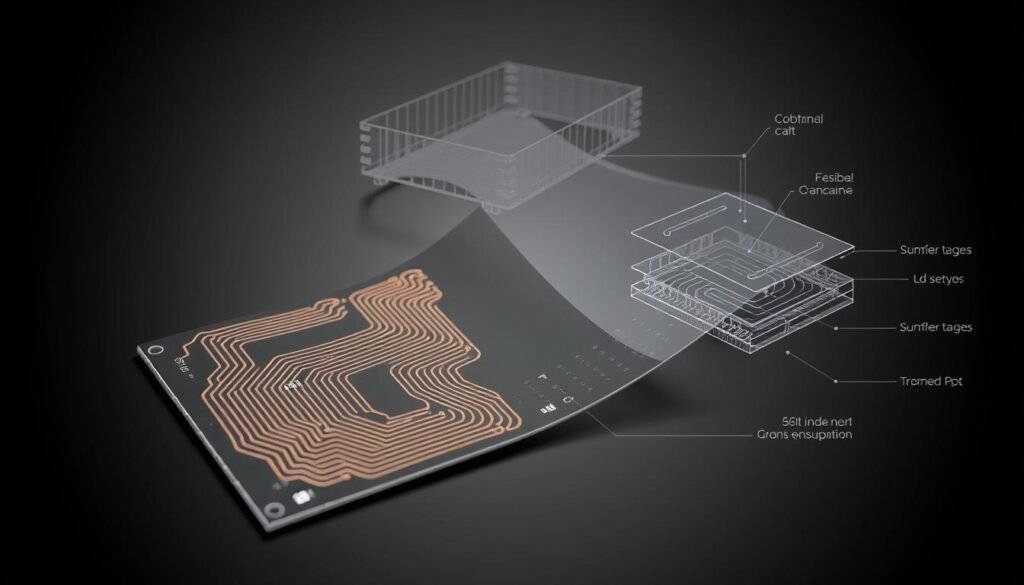
Heating element design plays a pivotal role in determining the overall efficiency and reliability of flexible heaters. We understand that a well-designed heating element is crucial for achieving precise temperature control and uniform heat distribution.
Efficient Heating Element Patterns
Efficient heating element patterns are designed to maximize heat transfer while minimizing energy consumption. We achieve this through careful layout optimization, taking into account the specific thermal requirements of the application. By doing so, we ensure that our flexible heaters provide consistent performance and reliability.
Copper vs. Nickel-Based Materials
The choice between copper and nickel-based materials for heating elements depends on the specific requirements of the application. Copper offers high conductivity and is suitable for applications where high power density is required. Nickel-based materials, on the other hand, provide excellent corrosion resistance and are often used in harsh environments. We carefully select the material to ensure optimal performance and longevity.
Multiple Heating Zones Implementation
Implementing multiple heating zones within a single flexible heater circuit enables precise temperature control across different regions. This is particularly useful in applications where varying thermal requirements exist within the same assembly. We address the challenges associated with multiple heating zones, such as layout and design, power connections, temperature control, and power distribution, to ensure seamless integration and optimal performance.
By understanding the complexities of heating element design and leveraging our expertise, we can create flexible heaters that meet the most demanding application requirements. Our commitment to quality and innovation ensures that our flexible heaters provide reliable performance and efficiency.
Electrical Design Considerations
In the development of flexible heater circuits, electrical design considerations are paramount. We must carefully consider several factors to ensure the heater circuits operate efficiently and safely.
Using Ohm’s Law for Output Wattage Calculation
To determine the output wattage of a flexible heater circuit, we apply Ohm’s Law, which relates voltage, current, and resistance. By calculating the resistance of the heating element and knowing the voltage applied, we can determine the power output. This calculation is crucial for designing a heater that meets the specific power requirements of an application. The formula derived from Ohm’s Law, P = V^2/R, where P is power, V is voltage, and R is resistance, allows us to adjust the design parameters to achieve the desired wattage.
Power Distribution Strategies
Effective power distribution is critical in flexible heater circuit design. We need to ensure that power is evenly distributed across the heating element to achieve uniform temperature distribution. Strategies include optimizing the layout of the heating elements and using materials with appropriate resistivity. By doing so, we can prevent hotspots and ensure that the heater operates within the desired temperature range.
Temperature Control Mechanisms
Temperature control mechanisms are vital for maintaining the desired temperature in flexible heater circuits. These mechanisms range from simple thermostats to sophisticated microprocessor-controlled systems that utilize feedback from sensors to adjust power delivery. Advanced implementations may incorporate thermistors or RTD sensors to provide continuous temperature feedback. PID controllers represent a gold standard for precision control, adjusting power delivery based on the difference between actual and target temperatures.
The selection of appropriate temperature control mechanisms depends on factors such as required temperature accuracy, response time needs, and environmental conditions. By choosing the right control strategy, we can ensure that the flexible heater circuit maintains precise thermal conditions, enhancing its performance and reliability.
Assembly and Manufacturing Techniques
Ensuring the reliability and performance of flexible heater circuits depends on the application of appropriate assembly and manufacturing techniques. We employ a range of methods to guarantee the quality and functionality of our products.
Soldering Surface Mount Components
Soldering surface mount components is a critical step in the assembly of flexible heater circuits. This process requires precision to ensure that components are correctly placed and soldered onto the PCB. We utilize advanced soldering techniques to minimize defects and maximize the reliability of our circuits.
Incorporating Cutouts and Stiffeners
Incorporating cutouts and stiffeners into flexible heater circuits is essential for optimizing their performance and durability. Cutouts can help in managing thermal expansion, while stiffeners provide mechanical support to areas where components are mounted. Our design and manufacturing process takes into account the strategic placement of these features to enhance the overall functionality of the circuits.
Quality Control in Manufacturing
Quality control is crucial in the manufacturing process of flexible heater circuits. We implement a comprehensive set of inspection and testing protocols to ensure consistent performance, reliability, and safety. These include visual inspections, electrical testing, thermal performance validation, and environmental stress testing.
| Testing Protocol | Description | Objective |
|---|---|---|
| Visual Inspection | Identifying defects such as misalignment or delamination | Ensure physical integrity |
| Electrical Testing | Continuity checks, resistance measurements | Verify electrical functionality |
| Thermal Performance Validation | Infrared imaging to check heat distribution | Confirm thermal specifications |
By integrating these quality control measures into our manufacturing process, we can predict and prevent potential failures, ensuring that our flexible heater circuits meet the required standards.
Practical Applications and Considerations
To achieve reliable and efficient heating, the design of flexible heater circuits must consider several key aspects. We will explore the practical applications and considerations that are crucial for the optimal performance of these circuits.
Temperature Range Capabilities
The temperature range capabilities of flexible heater circuits are a critical factor in their design. These circuits can be engineered to operate within a wide range of temperatures, making them suitable for various applications. The choice of materials and heating element design play a significant role in determining the temperature range.
Testing in Free Air vs. Applied Conditions
Testing flexible heater circuits in free air versus applied conditions yields different results. We must consider the specific application and environment in which the circuit will operate to ensure accurate performance evaluation. Applied conditions testing provides a more realistic assessment of the circuit’s performance in its intended use.
Flexibility and Form Factor Considerations
The flexibility and form factor of heater circuits are paramount in their design. Considerations include the minimum bend radius, material properties, and the presence of components or stiffeners. We must balance flexibility with the need for reliable performance and durability.
| Consideration | Description | Importance |
|---|---|---|
| Temperature Range | Operating temperature range of the circuit | High |
| Flexibility | Ability of the circuit to bend without damage | High |
| Form Factor | Physical design and layout of the circuit | Medium |
| Material Selection | Choice of materials for the circuit | High |
Conclusion
The successful implementation of flexible heater circuits depends on a holistic design strategy that encompasses layout optimization, material selection, and production techniques. As we’ve explored, the world of flexible heaters is complex, involving fundamental operating principles, material choices, and advanced design considerations.
The selection of appropriate materials—such as polyimide, silicone rubber, or polyester—is foundational to successful flexible heater design. Each material offers distinct advantages for specific applications and operating environments. Furthermore, electrical design considerations, including wattage calculations and temperature control mechanisms, are crucial for delivering precise, uniform heating while maintaining safety and efficiency.
In terms of manufacturing, techniques such as soldering surface mount components and incorporating cutouts and stiffeners require specialized knowledge. By understanding and implementing these design and assembly considerations, engineers and product designers can integrate flexible heating solutions that enhance product functionality, reliability, and user experience across diverse applications.
Collaborating with an experienced manufacturing partner early in the design process can further enhance the ability to achieve cost-effective production while delivering high-quality flexible heaters. By leveraging expertise in PCB design and manufacturing, companies can optimize their product designs for both performance and manufacturability, ultimately leading to more efficient and economical production of flexible heater circuits.
In conclusion, the design of flexible heater circuits for various applications requires a comprehensive approach that considers multiple factors, from design and material selection to manufacturing techniques. By following these guidelines and collaborating with experienced partners, designers can create flexible heaters that meet performance requirements while enabling efficient production.
FAQ
What are the key factors to consider when selecting materials for a flex circuit?
How do I optimize the layout and size of my flex circuit?
What are the advantages of using rigid-flex PCBs in my application?
How do I ensure quality control in the manufacturing process of my flex circuit?
What are the temperature range capabilities of polyimide heaters?
How do I implement multiple heating zones in my heating element?
What are the benefits of using copper versus nickel-based materials for heating elements?
How do I test my flex circuit in various environmental conditions?
About The Author
