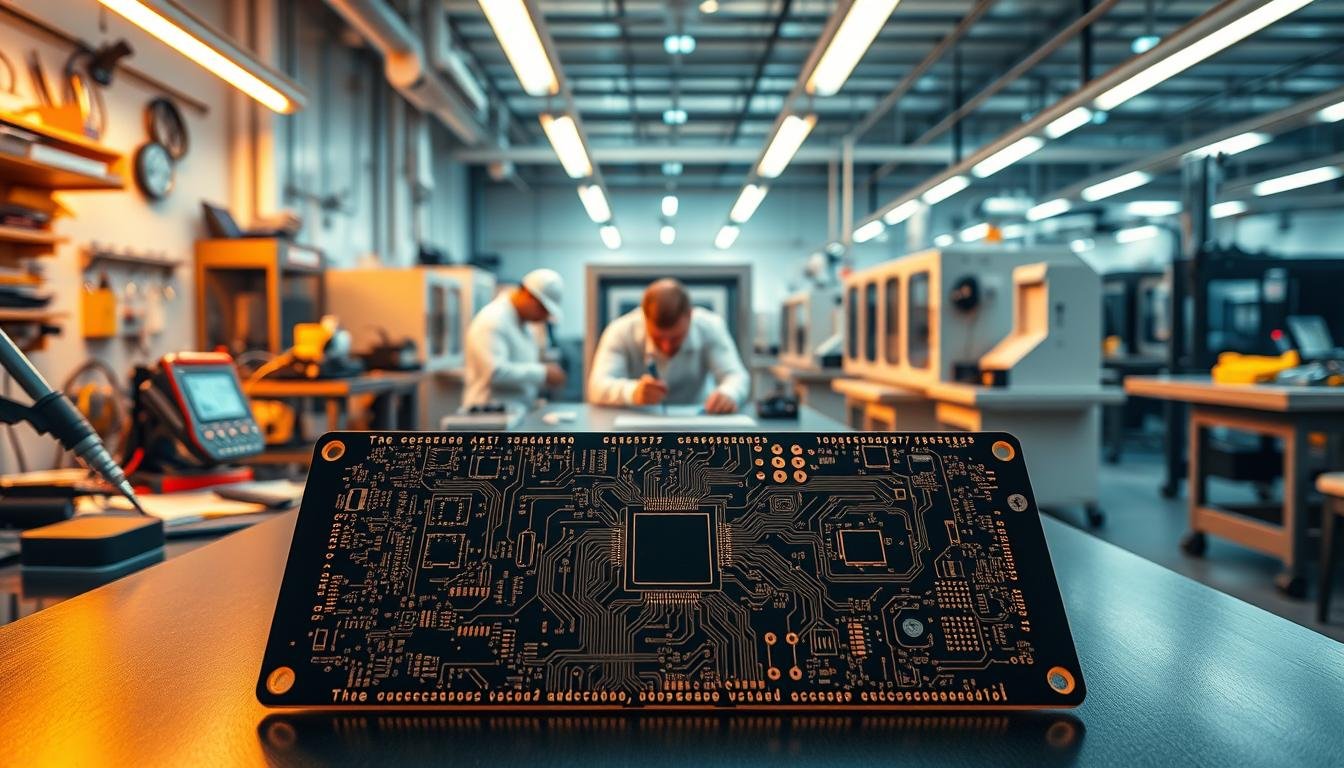
Are you ready to revolutionize your approach to electronics development? The emergence of on-demand manufacturing is transforming the landscape of PCBA prototyping, offering unprecedented agility and efficiency.
At espcba.com, we recognize the paradigm shift in the electronics manufacturing industry, driven by the need for faster time-to-market and more flexible production capabilities. Traditional PCBA production methods are being challenged by more agile, cost-effective approaches that leverage cutting-edge technologies and automation.
The future of PCBA prototyping lies in smart manufacturing systems that combine advanced printing technologies, automation, and artificial intelligence to create a more responsive production ecosystem. This transformative approach enables electronics developers to iterate designs rapidly, reduce costs, and maintain intellectual property security while accelerating the development cycle.
Key Takeaways
- On-demand manufacturing is revolutionizing PCBA prototyping with agile and cost-effective solutions.
- The global electronics industry is adopting on-demand manufacturing for faster time-to-market.
- Smart manufacturing systems are the future of PCBA prototyping, combining advanced technologies and AI.
- On-demand manufacturing enables rapid design iteration, cost reduction, and IP security.
- This approach is a critical competitive advantage for electronics companies.
The Evolution of PCBA Prototyping
The evolution of PCBA prototyping is marked by a shift from traditional methods to more innovative, on-demand manufacturing solutions. As we explore this transition, it’s essential to understand the historical context and limitations of conventional PCBA prototyping approaches.
Traditional PCBA Prototyping Methods
Traditionally, PCBA prototyping involved outsourcing to specialized PCB manufacturers. A CAD design was sent to a producer, where it was assembled using industrial equipment and then shipped to the customer. While this method ensured high-quality prototypes, it came with significant costs, especially for small orders, and lengthy turnaround times. For complex electronics prototyping, this was often the only viable option, despite its drawbacks.
Limitations of Conventional Approaches
Conventional PCBA prototyping approaches face several limitations, including extended lead times, high costs for small-batch manufacturing, and a lack of flexibility in accommodating rapid design changes. Additionally, the disconnect between design and manufacturing often leads to implementation issues, and intellectual property concerns arise when sending proprietary designs to third-party manufacturers. These limitations have driven the demand for more responsive, flexible, and accessible PCBA prototyping solutions.
- Limited flexibility and high costs hindered innovation in the electronics industry.
- Outsourcing prototypes resulted in extended lead times and substantial delays.
- High costs made iterative prototyping financially challenging for startups and research institutions.
Understanding On-Demand Manufacturing for PCBA
https://www.youtube.com/watch?v=ehtSgJQ3oKA
On-demand manufacturing is revolutionizing the PCBA prototyping landscape by providing a flexible and efficient production process. We are witnessing a significant shift in how PCBA prototyping is approached, with on-demand manufacturing at the forefront.
What is On-Demand Manufacturing?
On-demand manufacturing refers to the production of goods as they are needed, rather than producing them in advance. In the context of PCBA, this means that prototypes can be manufactured quickly without the need for large inventory storage. This approach reduces waste and allows for more agile product development.
Key Technologies Enabling On-Demand PCBA Production
Several key technologies are enabling on-demand PCBA production. These include advanced 3D printing techniques, rapid prototyping platforms, and smart manufacturing technologies. We are leveraging these technologies to improve efficiency and accuracy in PCBA production.
| Technology | Benefit |
|---|---|
| 3D Printing | Rapid production of complex geometries |
| Rapid Prototyping Platforms | Quick iteration and testing |
| Smart Manufacturing | Real-time monitoring and optimization |
The Role of Automation and AI in Modern Prototyping
Automation and AI are playing a crucial role in modern PCBA prototyping. AI-driven design optimization and automated assembly lines are improving efficiency, accuracy, and quality control. We are utilizing AI-powered software to streamline PCB layout design and optimize component placement.
As noted by industry experts, “AI is transforming PCBA prototyping by automating complex design optimization tasks.” This is a significant development, as it enables us to produce high-quality PCBA prototypes more quickly and efficiently.
“The integration of AI with robotic manufacturing systems creates autonomous production cells capable of adapting to different PCBA designs without manual reconfiguration.”
Benefits of On-Demand Manufacturing: The Future of PCBA Prototyping

On-demand manufacturing is revolutionizing the PCBA prototyping landscape by offering numerous benefits that enhance the overall production process. This approach is transforming the way companies develop and produce printed circuit boards (PCBs), enabling them to bring products to market faster and more efficiently.
Accelerated Time-to-Market
With on-demand manufacturing, companies can significantly reduce the time it takes to develop and test new PCB designs. By leveraging advanced technologies such as 3D printing and rapid prototyping, businesses can quickly iterate on their designs, make necessary adjustments, and move forward with production.
Cost Efficiency and Resource Optimization
On-demand manufacturing also enables companies to optimize their resources and reduce costs associated with traditional PCB manufacturing methods. By producing PCBs in small batches or on-demand, businesses can avoid unnecessary inventory and minimize waste, leading to improved efficiency and reduced production expenses.
Enhanced Design Flexibility and Iteration
The flexibility offered by on-demand manufacturing allows designers to make changes to their designs quickly and easily, without being constrained by long lead times or large production runs. This enables companies to refine their designs, test new ideas, and improve overall product quality.
Intellectual Property Protection
On-demand manufacturing provides enhanced intellectual property protection by keeping sensitive designs and prototypes entirely in-house throughout the development process. This reduces the risk of proprietary design information being compromised or leaked to competitors, ensuring that companies can maintain control over their innovations.
By adopting on-demand manufacturing, businesses can reap the benefits of accelerated time-to-market, cost efficiency, design flexibility, and intellectual property protection, ultimately staying competitive in the rapidly evolving electronics manufacturing landscape.
Breakthrough Technologies Transforming PCBA Prototyping
The landscape of PCBA prototyping is undergoing a significant transformation with the advent of breakthrough technologies. These advancements are not only improving the efficiency and quality of prototype production but also revolutionizing the way manufacturers approach the development process.
Advanced 3D Printing for PCB Production
Advanced 3D printing technology is transforming PCB production by enabling the rapid creation of complex prototypes. This technology allows for greater design flexibility and faster iteration, significantly reducing the time-to-market for new products. As highlighted in recent advancements in PCB manufacturing, 3D printing is set to play a crucial role in the future of PCB production.

Rapid Prototyping Platforms and Solutions
Rapid prototyping platforms are providing manufacturers with the tools needed to quickly turn designs into functional prototypes. These platforms, such as PCBA rapid prototyping systems, are essential for companies looking to accelerate their product development cycles. By leveraging these solutions, businesses can achieve a competitive edge in the market.

Smart Manufacturing and Industry 4.0 Integration
The integration of smart manufacturing principles and Industry 4.0 technologies is transforming PCBA prototyping into a highly efficient, data-driven process. Technologies such as IoT sensors, AI-powered analytics, and digital twins are enabling real-time monitoring and optimization of production processes. As discussed in the context of the future of printed circuit board manufacturing, these advancements are crucial for staying competitive.
Overcoming Challenges in On-Demand PCBA Manufacturing

As we delve into the world of on-demand PCBA manufacturing, we encounter several challenges that need to be addressed to ensure seamless production. At Macrofab, we understand that overcoming these challenges is crucial for delivering high-quality PCBAs.
Quality Assurance in Rapid Production
Ensuring quality in rapid PCBA production is paramount. We utilize AI-Powered Inspection Systems, such as automated optical inspection (AOI) and X-ray inspection, to detect defects accurately and efficiently. Additionally, Real-Time Quality Monitoring through IoT-enabled sensors helps track performance metrics throughout the manufacturing process.
Material and Component Considerations
The selection of appropriate materials and components is critical for the reliability and longevity of PCBs, especially in mission-critical applications. We consider factors such as material properties and component sourcing strategies to ensure that our PCBA manufacturing meets the required standards.
Scaling from Prototype to Mass Production
Bridging the gap between on-demand prototyping and volume pcb manufacturing presents significant challenges. We develop hybrid production approaches that combine the flexibility of on-demand methods with the efficiency of traditional manufacturing. By leveraging digital manufacturing platforms, we maintain design consistency across prototyping and production phases, reducing the engineering effort required for transition.
By addressing these challenges, we can ensure that our on-demand PCBA manufacturing capabilities meet the evolving needs of the electronics industry, providing reliable and high-quality products.
Conclusion: Embracing the On-Demand Future of Electronics Manufacturing
Emerging technologies are driving a paradigm shift in PCBA prototyping through on-demand manufacturing. As we look towards the future of PCB manufacturing, it’s evident that the demand for advanced PCBs will continue to grow, driven by technologies like 5G, IoT, and AI.
The convergence of advanced printing technologies, automation, and AI has created an ecosystem that’s transforming PCBA development. Forward-thinking electronics manufacturers are embracing these changes to gain competitive advantages in time-to-market and design innovation. The future of PCB manufacturing will likely involve distributed production networks, enabling localized production that reduces logistics costs and environmental impact.
To stay ahead, PCB manufacturers must innovate and adapt. Companies that fail to adopt on-demand manufacturing risk being left behind. For more insights on the future of PCB manufacturing, visit realtime.ie and bencor-llc.com for the latest trends and technologies.
FAQ
What is the typical turnaround time for on-demand PCBA production?
How does on-demand manufacturing ensure quality and reliability in PCBA production?
Can I make changes to my PCBA design during the production process?
What file formats are accepted for PCBA design and production?
How do you protect my intellectual property during the PCBA production process?
Can I scale up production from prototype to mass production with your services?
What are the benefits of using advanced 3D printing for PCB production?
About The Author
