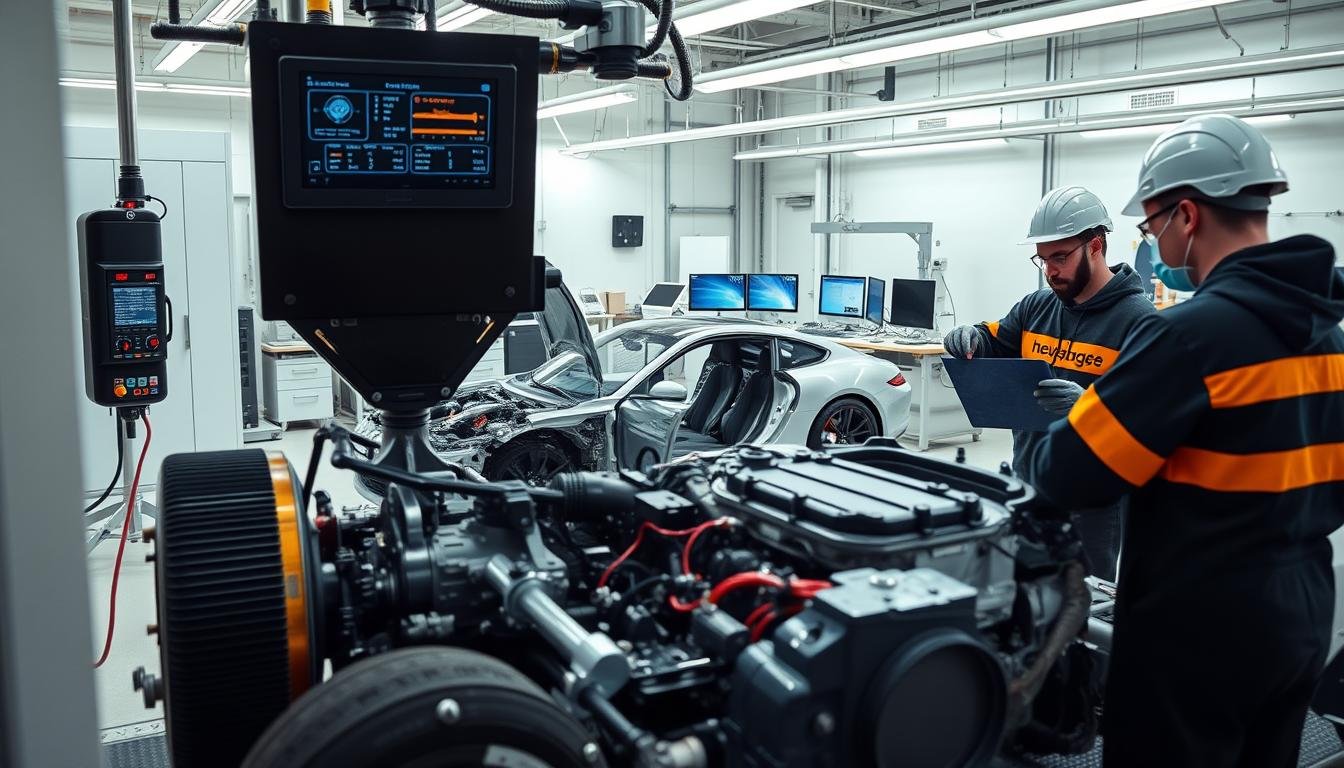
Modern vehicles now rely on up to 150 interconnected electronic control units (ECUs) to manage everything from acceleration to emissions. With over 30,000 parts sourced globally, how can manufacturers guarantee these complex systems won’t malfunction when lives are at stake?
We’ve entered an era where software defines vehicle performance. The automotive software market is projected to reach $80 billion by 2030, growing nearly 9% annually. This explosive innovation demands rigorous validation processes that outpace traditional quality checks.
Consider this: Each component undergoes hundreds of thousands of evaluations before assembly. Yet with multiple OEMs contributing subsystems, final integration testing becomes the ultimate safeguard. It’s not just about individual parts – it’s about how they communicate under real-world stress.
Today’s engineers face a critical balancing act. They must verify intricate interactions between propulsion systems, energy management, and safety protocols – all while meeting compressed development cycles. The stakes? Preventing failures that could compromise both driver trust and regulatory compliance.
Key Takeaways
- Modern vehicles contain up to 150 ECUs that have replaced mechanical control systems
- Automotive software market growth demands advanced validation methods
- Integration testing serves as the final quality checkpoint before production
- Interconnected systems require validation of complex component interactions
- Standardized platforms help meet tight timelines without sacrificing reliability
- Testing must account for diverse communication protocols and safety standards
Introduction to Automotive Powertrain Functional Testing
Today’s vehicles operate through a complex web of specialized computers that manage every operational parameter. These digital guardians replaced mechanical linkages and analog controls, creating systems where split-second decisions determine performance and reliability.
Understanding the Role of ECUs and Powertrain Control Modules
At the core of modern vehicles lie electronic control units (ECUs) – dedicated microprocessors governing specific functions. Critical modules like engine controllers make 5,000+ adjustments per second, while convenience systems manage climate settings through intricate sensor networks.
We categorize these control units by priority:
- Safety-critical: Engine management, braking, and stability systems
- Operational: Transmission control and energy distribution
- Convenience: Infotainment and comfort features
This hierarchy dictates testing requirements. A navigation system glitch inconveniences drivers – an engine ECU failure risks lives.
The Need for Robust Functional Testing in Today’s Vehicles
Modern architectures demand validation beyond individual component checks. As one industry expert notes:
“Today’s testing must replicate how 40+ ECUs interact during emergency maneuvers at -40°F and 120°F environments.”
Three factors drive rigorous protocols:
- Regulatory mandates for emission controls and crash avoidance
- Consumer expectations of 100,000+ mile reliability
- Interconnected systems sharing data across 5+ communication protocols
Manufacturers now verify over 800 signal pathways in powertrain networks – a 300% increase from 2010 standards. This ensures seamless coordination between combustion timing, battery management, and drivetrain components under all operating conditions.
The Evolution of Electronic Control Units in Modern Vehicles

Automotive systems have undergone a radical metamorphosis, replacing gears with gigabytes in vehicle management. This shift from analog mechanisms to software-driven architectures demands smarter validation approaches. We’ve seen ECU counts surge from single-digit installations to networks exceeding 100 units per vehicle – each requiring flawless coordination.
From Mechanical Systems to Digital Integration
The journey began with standalone controllers managing basic functions like fuel injection. Today’s multicore processors handle simultaneous tasks across powertrain, safety, and connectivity systems. Four communication protocols now form the backbone of vehicle networks:
- CAN bus for real-time critical operations
- LIN managing low-speed components
- FlexRay enabling high-bandwidth data transfer
- Automotive Ethernet supporting 10 Gbps+ connectivity
This integration allows features like predictive maintenance but introduces new failure points. Where mechanics once diagnosed issues with wrenches, engineers now trace software conflicts across 15+ layered protocols.
Impact of Increased ECU Complexity on Testing Demands
Modern luxury vehicles contain more code than early space shuttles – over 150 million lines. Testing must verify:
- Hardware-software compatibility under extreme temperatures
- Data consistency across mixed-protocol networks
- Cybersecurity vulnerabilities in connected systems
We’ve moved from checking individual sensors to validating entire digital twins. Advanced driver-assist features require 5,000+ simulated scenarios before road testing. The stakes? A single software glitch could disable multiple safety systems simultaneously.
Functional Testing for Automotive Powertrain Control Modules

Advanced validation platforms now form the backbone of vehicle development pipelines. Leading manufacturers achieve 40% faster defect detection through integrated measurement architectures that combine multiple verification stages into unified workflows.
Core Architecture of Modern Validation Platforms
Effective verification systems require three foundational elements:
- Modular instrumentation supporting 50+ signal types
- Software-defined workflows enabling test reuse across projects
- Synchronization engines maintaining nanosecond timing precision
The NI ECUTS demonstrates this principle, combining 18 measurement tools in one chassis. Its PXI backbone handles 12 GB/s data transfers while coordinating fuel injector pulses with 10μs accuracy.
Accelerating Development Through Configurable Solutions
Preconfigured platforms slash setup time by 65% compared to custom builds. Engineers can deploy:
- Current validation using source measure units
- Sensor simulation through programmable load modules
- Protocol analysis across CAN FD and Ethernet networks
One automaker reduced test cycles from 14 hours to 93 minutes using synchronized power supply sequencing. As production deadlines tighten, these smart verification ecosystems prove essential for maintaining quality benchmarks without compromising speed.
Optimizing Hardware and Software Integration in Test Systems
Effective validation of modern vehicle systems hinges on seamless collaboration between hardware interfaces and software platforms. Our approach combines configurable instrumentation with intelligent management tools to address evolving technical demands.
Leveraging Tools Like TestStand and InstrumentStudio™
TestStand revolutionizes validation workflows through parallel execution capabilities. We’ve seen teams reduce development time by 40% using its prebuilt templates for:
- Multi-station test coordination
- Automated report generation
- Legacy system compatibility
InstrumentStudio™ elevates efficiency further by abstracting complex coding tasks. Engineers configure CAN bus simulations through visual interfaces rather than manual scripting – a shift that cuts debugging phases by 65%.
Ensuring Seamless Data Flow and Synchronization
Switch Executive tackles signal routing challenges in multi-instrument setups. One automaker eliminated 92% of connection errors using its automated pathfinding algorithms. This smart routing ensures:
- Consistent signal integrity across 200+ channels
- Real-time impedance matching
- Dynamic load balancing
Open architectures prove critical for maintaining data continuity. Support for C# and LabWindows/CVI lets teams integrate existing codebases while adopting new protocols like Automotive Ethernet. As one validation lead noted:
“Our synchronization accuracy improved from milliseconds to microseconds when we unified timing engines across platforms.”
These solutions form interconnected ecosystems where hardware responses align perfectly with software commands – the foundation for reliable system validation.
Addressing Signal Generation, Conditioning, and Data Quality
Precision signal management forms the backbone of effective system validation. Modern validation platforms must replicate real-world electrical behavior while maintaining measurement integrity across fluctuating conditions.
Techniques for Sensor Simulation and Load Testing
Accurate sensor replication requires dynamic voltage ranges and frequency responses matching actual components. We implement waveform generators producing 0-5V signals with 0.1% tolerance – critical for testing throttle position sensors and knock detection circuits.
Load simulation presents unique challenges. Actuators like fuel injectors demand precise resistor networks that mirror mechanical loads. Our approach combines:
- Programmable DC loads for electric motor emulation
- High-speed switching matrices handling 20A surges
- Isolated channels preventing ground loop interference
Best Practices for Reliable Signal Routing
Modern SLSC hardware solutions reduce wiring errors by 78% through modular design. These systems enable:
- Automated path configuration between test units
- Real-time impedance matching across 500+ connections
- Active noise cancellation for microvolt-level measurements
One recent deployment achieved 99.998% signal fidelity using shielded twisted-pair routing. As validation lead Mark Tabor notes:
“Proper conditioning transforms raw data into actionable insights – it’s the difference between guessing and knowing.”
These methodologies ensure test outcomes reflect true system performance, not measurement artifacts. By combining advanced simulation with robust routing architectures, teams achieve faster validation cycles without compromising data quality.
Best Practices for Automotive Software Testing and Regulatory Compliance
Validating automotive systems demands more than technical precision—it requires strict adherence to global safety protocols. We implement layered verification strategies that combine simulation accuracy with real-world validation rigor.
Understanding SIL, HIL, and In-Circuit Testing Approaches
Software-in-the-Loop (SIL) testing accelerates development by isolating code validation from physical hardware. Our teams achieve 70% faster defect detection through automated scenario simulations, particularly crucial for safety-critical systems like torque management.
Hardware-in-the-Loop (HIL) testing bridges virtual and physical realms. Using real-time engine models, we replicate extreme operating conditions—from arctic cold starts to desert heat stress—while monitoring ECU responses. Though resource-intensive, HIL remains indispensable for final certification.
Aligning with ISO 26262, ISO 21434, and AUTOSAR Standards
Modern compliance extends beyond functional checks to cybersecurity resilience. Our frameworks integrate:
- ISO 26262 safety mechanisms for fault detection
- ISO 21434 threat analysis for connected systems
- AUTOSAR architecture for seamless ECU interoperability
These protocols form the backbone of trustworthy vehicle software. As the automotive software market grows, standardized approaches prevent costly redesigns while ensuring passenger protection. We balance innovation with accountability—because reliable mobility starts with validated code.
FAQ
Why is functional testing critical for powertrain control modules?
How does increased ECU complexity impact testing demands?
What key components define an effective automotive test system?
How do tools like TestStand optimize hardware-software integration?
What best practices ensure reliable signal routing in test environments?
Which regulatory standards govern automotive software testing today?
About The Author
