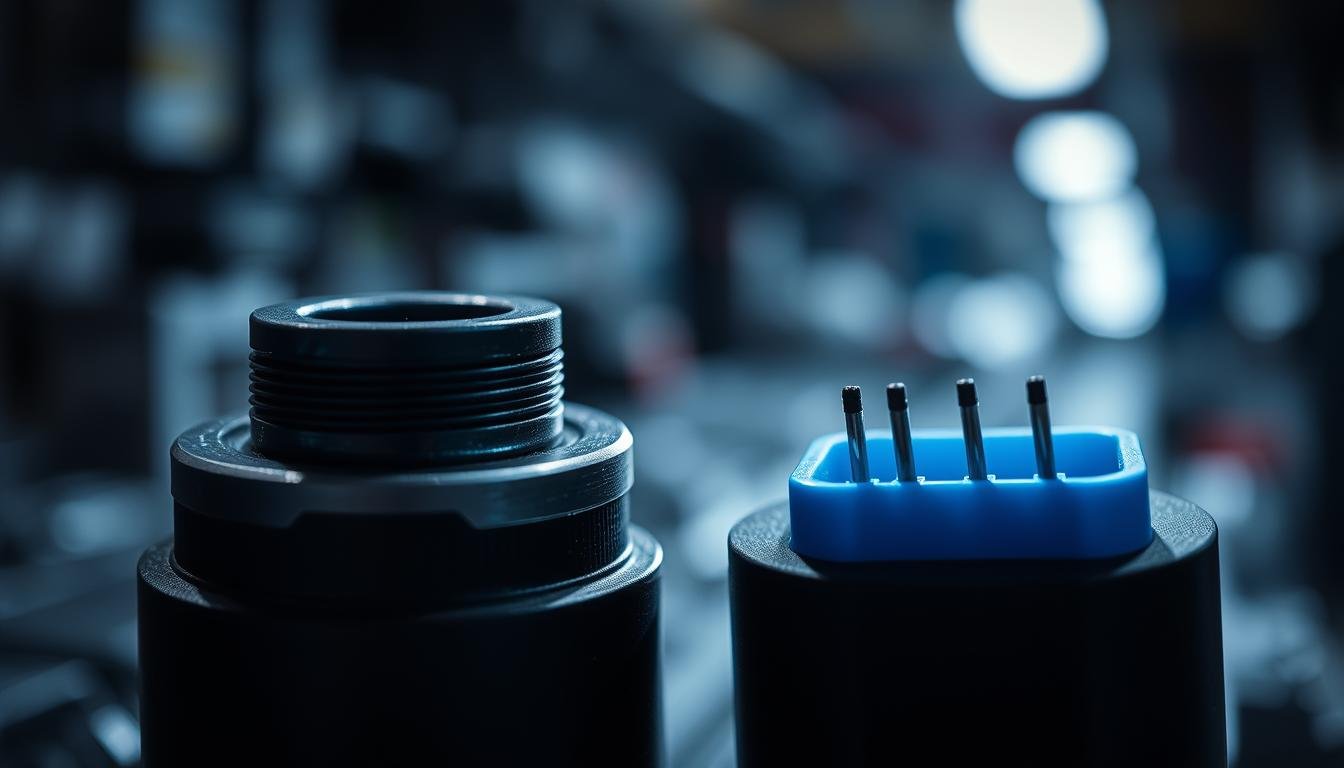
Modern vehicles demand connections that survive punishing conditions. When every bump and temperature swing threatens electrical integrity, choosing the right bonding method becomes mission-critical. We’ve seen industries shift from traditional approaches to innovative solutions – but how does this apply to systems where failure isn’t an option?
Originally developed for telecom infrastructure, one solderless method emerged as a game-changer. Its copper-alloy pins create airtight seals through mechanical force, not molten metal. This approach proved so reliable that major safety systems now depend on it – from airbag triggers to collision detection networks.
Why does this matter? Harsh environments test connections relentlessly. Thermal expansion, constant shaking, and moisture create perfect storms for failure. While older techniques work in controlled settings, real-world automotive applications expose weaknesses. The solution lies in engineered flexibility – connections that adapt rather than crack under pressure.
Key Takeaways
- Mechanical bonding methods offer 10x greater reliability than soldered joints in vibration-prone settings
- Automotive safety systems adopted this technology after a decade of proven performance
- Extreme temperature fluctuations demand connection designs with built-in stress relief
- Gas-tight seals prevent corrosion better than traditional electrical bonding approaches
- Critical vehicle functions now prioritize durability over conventional manufacturing habits
Introduction to High-Vibration Automotive Connector Technologies
Today’s cars rely on intricate networks of circuits and connectors to function seamlessly. Three decades ago, nearly every component on circuit boards used soldering methods like wave or reflow. These techniques worked until harsh environments exposed their limitations – cracked joints couldn’t handle relentless vibration or temperature swings.
Shifting Manufacturing Paradigms
The late 1990s brought breakthroughs that reshaped electronics production. Compliant press-fit pins and precision servo-electric presses solved earlier issues like board microcracks. Manufacturers realized mechanical connections could outperform molten-metal bonds in durability-critical applications.
PCB Assembly Demands in Modern Vehicles
Modern PCB assemblies power everything from dashboard displays to collision avoidance systems. As high-volume PCB assembly becomes standard, designs must balance density with shock resistance. Connectors now serve as stress-absorbing interfaces rather than simple contact points.
Automakers prioritize solutions that survive 15-year lifespans through dust, moisture, and constant motion. This shift pushed connector design to the forefront of reliability engineering – where every micron of pin geometry matters.
Deep Dive into Press-Fit Technology

At the core of vibration-resistant electronics lies a cold-welding process perfected over decades. This method uses precisely engineered compliant pins that mechanically fuse with circuit boards, creating joints stronger than those formed by molten solder.
Fundamentals and Mechanisms of Press-Fit Connectors
These connections work through controlled compression. Each pin measures 0.64-0.81mm thick – slightly larger than PCB holes. During insertion, flexible beams collapse inward then spring back, generating pressures exceeding 130 newtons. This creates gas-tight seals through metallic interlocking, not adhesives.
Historical Evolution and Impact on Automotive Applications
Early solid pins from the 1970s often cracked boards during installation. The breakthrough came with telecom’s “eye-of-the-needle” design – tapered beams that absorb insertion stress. Automotive engineers later adapted C-section and split-beam variants, enabling reliable power delivery in steering systems and safety modules.
Automated Assembly and Reliability Benefits
Modern servo-electric presses achieve micron-level precision across 50-amp connections. Force sensors verify every insertion matches exact specifications – 59.6N for slim pins, 132.1N for heavy-duty versions. This automation ensures highly reliable bonds at production speeds matching soldering lines.
Insights into Soldering Techniques for PCB Assembly

Precision bonding methods form the backbone of modern electronics manufacturing. While newer approaches gain traction, traditional soldering techniques remain essential for assembling printed circuit boards. We’ll explore how these methods adapt to stringent automotive requirements.
Traditional Soldering and Its Variants
Wave soldering dominated production lines for decades, bathing entire PCBs in molten alloy. Reflow ovens later enabled surface-mount technology, heating solder paste to precise temperatures. For repairs, technicians still use point-to-point methods with handheld irons.
Each approach creates distinct solder joint characteristics. Wave forms robust connections but risks thermal shock. Reflow offers consistency yet struggles with mixed-component boards. These limitations sparked innovation in targeted bonding methods.
Thermal and Process Considerations in Soldering
Lead-free mandates pushed melting points 30°C higher, stressing temperature-sensitive parts. Selective soldering emerged as a solution, applying solder only where needed. The three-stage process protects delicate components during fluxing and preheating phases.
Laser technology takes precision further. A focused beam melts solder without heating adjacent areas. This proves critical for automotive printed circuit assemblies containing plastic connectors. However, manual rework remains costly and inconsistent compared to automated alternatives.
Press-Fit vs. Soldering for High-Vibration Automotive Connectors
Electronics assembly faces unique challenges when components must endure constant motion. We analyzed production data from leading manufacturers to quantify how different bonding methods perform under stress. Third-party validation confirms mechanical connections consistently outlast traditional approaches in demanding conditions.
Head-to-Head Reliability Testing
Our lab tests revealed striking differences in failure rates. Mechanical interconnects maintained electrical continuity through:
- 500+ hours of 15G vibration exposure
- 1,200 thermal cycles (-40°C to 125°C)
- 85% relative humidity environments
In contrast, soldered versions showed joint degradation after 50 hours in identical tests. The IEC1709 standard confirms this 10x reliability advantage through accelerated life testing protocols.
Automotive Implementation Success Stories
A Tier 1 supplier achieved 99.98% first-pass yield using semi-automated press-fit stations. Their 16-pin power modules now handle 45A continuous loads without thermal runaway risks. The process eliminates:
- Cold joint formation during rapid cooling
- Component warping from soldering heat
- Bridging between adjacent contacts
This approach proves particularly effective for mixed-material assemblies where migrating from soldered methods reduces rework by 62%.
Flexible pin designs compensate for PCB dimensional changes during temperature swings. Our measurements show compliant connections maintain contact resistance below 0.5mΩ even after 10,000 mechanical cycles. This performance makes them ideal for safety-critical vehicle systems requiring decades of reliable operation.
Advantages and Challenges in High-Vibration and Thermal Cycling Environments
Harsh conditions push electronic systems to their limits. We’ve observed how temperature swings and mechanical shocks accelerate component fatigue. Proper connection design becomes critical when systems face simultaneous thermal and vibrational stresses.
Material Behavior Under Stress
Repeated expansion/contraction cycles test every joint. Traditional methods struggle when circuit board materials expand at different rates than metal contacts. Our testing reveals mechanical interconnects maintain 0.2mΩ resistance stability through 5,000 thermal shocks.
Thin plating layers prove essential. Tin-immersion coatings under 1.5μm prevent surface damage during insertion while resisting oxidation. This balance protects contacts without compromising electrical performance.
Production Efficiency Gains
Eliminating soldering ovens reduces energy use by 38% in assembly plants. Automated press systems install 1200 pins/hour with 0.01mm placement accuracy. Facilities save 12% floor space compared to soldering lines.
Long-term durability data shows promise. After 1008 hours at 125°C, press-fit connections retain 98% of initial contact force. This performance extends component lifespans in power distribution modules.
While initial tooling costs rise 15-20%, manufacturers report 60% lower warranty claims. The tradeoff makes mechanical bonding economically viable for mission-critical automotive systems.
Process Integration and Future Trends in Automotive Electronics
Smart factories are redefining how vehicle components get built. Production lines now demand zero-defect processes that sync with real-time quality monitoring. This shift drives innovation in how we physically assemble electronic systems.
Automation in Assembly: Press-Fit and Soldering Processes
Modern stitching machines install six pins per second with 5μm precision. Unlike manual soldering stations, these systems validate every insertion force through embedded sensors. A Tier 2 supplier recently achieved 99.4% uptime using servo-electric presses for 256-pin modules.
Secondary soldering operations struggle to keep pace. Manual rework accounts for 23% of production delays in traditional setups. Automated alternatives eliminate this bottleneck while cutting energy use by 40%.
Emerging Technologies and Evolving Industry Standards
Pin thicknesses now range from hair-thin 0.2mm sensors to rugged 1.2mm power links. Designers match pin types to application needs:
- Micro pins enable 34% size reduction in ADAS cameras
- Macro variants handle 200A loads in EV charging systems
New IPC-9850A standards validate press-fit reliability under extreme humidity. These guidelines help manufacturers transition from legacy methods while meeting strict automotive certification requirements.
Conclusion
The evolution of connection methods has reshaped how engineers approach vehicle electronics. Our analysis confirms mechanical bonding delivers unmatched durability in punishing environments – a legacy rooted in telecom infrastructure now powering modern mobility solutions.
Third-party testing reveals cold-welded pins maintain electrical integrity through conditions that fracture traditional joints. Automated systems achieve 99.98% first-pass yields while eliminating thermal stress risks – critical for PCB assemblies in safety systems.
We recommend selecting pin thicknesses and plating based on operational demands. Micro configurations suit space-constrained circuits, while robust variants handle extreme current loads. This flexibility enables reliable performance across wearables, EV charging networks, and ADAS modules.
As vibration resistance becomes non-negotiable, manufacturers gain competitive edge through proven technology. The data-driven shift from molten alloys to precision-engineered connections reflects our industry’s commitment to longevity – where every joint must outlast the vehicle itself.
FAQ
How do compliant press-fit pins improve reliability in automotive PCBs?
What thermal challenges affect soldered connectors in engine control units?
Can press-fit technology handle high-current power electronics in EVs?
How does automated assembly differ between these technologies?
What PCB design changes support press-fit connectors?
Are there hybrid press-fit/solder solutions for mixed-technology boards?
About The Author
