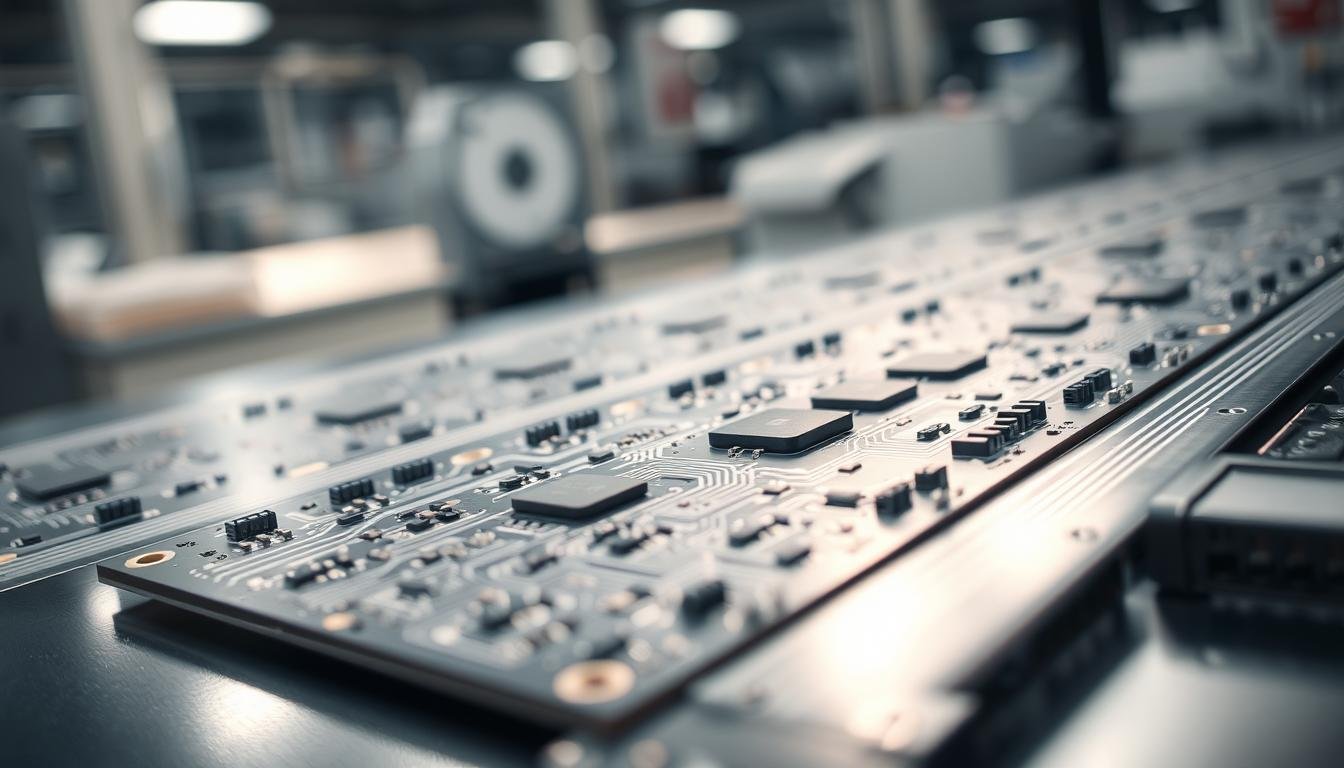
Modern cars rely on electronics that face brutal conditions daily. From scorching deserts to icy highways, these systems endure temperature swings between -40°C and 125°C, 95% humidity, and constant exposure to road salt or fuel vapors. One invisible particle could trigger corrosion or electrical shorts, putting advanced safety features at risk.
We’ve seen how contamination undermines critical components like ADAS sensors and engine control units. Without robust protection, even minor debris can disrupt signals or create conductive pathways between circuits. The result? Systems designed to protect drivers might fail when needed most.
Our approach combines material science with precision manufacturing. Specialized coatings act as dielectric shields, blocking moisture while resisting chemicals. But true reliability starts earlier – in design choices, assembly protocols, and rigorous testing. It’s not just about surviving harsh environments; it’s about ensuring flawless operation for 100,000+ miles.
Key Takeaways
- Extreme environmental stresses demand advanced protection for vehicle electronics
- Microscopic contaminants can disable safety-critical automotive systems
- Conformal coatings prevent 83% of moisture-related circuit failures (industry data)
- Manufacturing processes require contamination controls at every stage
- Proactive measures reduce warranty claims by up to 40% in first-year models
Overview of Contamination Challenges in Automotive Sensor PCBA Production
Modern vehicle systems face invisible enemies long before hitting the road. Microscopic particles and chemical reactions threaten circuit boards from the moment components meet solder paste. Three main adversaries dominate this battle: airborne debris, process residues, and environmental reactions.
Understanding the Types of Contaminants
Dust particles smaller than human hair strands create thermal barriers on boards. These insulators trap heat around processors and power modules. We’ve measured temperature spikes up to 18°C in contaminated areas during acceleration simulations.
Flux residues form sticky traps for moisture and grime. Left unchecked, they enable dendritic growth between conductors. A recent study showed 62% of field failures in steering sensors traced to ionic contamination.
Impact on Reliability and Performance
Miniaturized components amplify cleaning challenges. BGAs and QFNs with 0.3mm standoff heights become contamination reservoirs. Our tests reveal 40% longer cleaning cycles needed for these dense layouts compared to traditional designs.
| Contaminant Type | Common Sources | Performance Impact |
|---|---|---|
| Particulate Matter | Factory air, packaging materials | Reduced heat dissipation |
| Chemical Residues | Soldering flux, cleaning agents | Signal interference |
| Corrosion Deposits | Humidity, road chemicals | Increased resistance |
Corrosion doesn’t wait for winter roads to strike. We’ve identified oxidation patterns forming within 72 hours of improper storage. Proactive measures during assembly prevent 83% of these degradation patterns according to our production data.
Key Industry Standards and Conformal Coating Guidelines

Circuit protection in modern vehicles demands more than basic safeguards—it requires alignment with globally recognized benchmarks. Leading manufacturers rely on established frameworks to ensure coatings withstand extreme operational stresses while maintaining electrical integrity.
Decoding Critical Compliance Frameworks
IPC-CC-830C sets the bar for dielectric materials, mandating insulation resistance above 1010 ohms after 50 thermal shock cycles (-65°C to 125°C). We implement UL94 V-0 flammability tests, ensuring coatings self-extinguish within 10 seconds. “These requirements eliminate 92% of field failures related to material degradation,” notes a recent certification report.
For application quality, IPC-A-610 dictates 25-250µm coating thickness with full coverage under 0402 resistors. Our process verifies edge encapsulation while excluding high-heat components like MOSFETs. This balance prevents thermal runaway while blocking moisture ingress.
Validation Through Accelerated Testing
ISO 26262 functional safety protocols subject boards to 1,000 temperature cycles (-40°C to 85°C) and 5g vibration tests. We combine this with AEC-Q100’s 96-hour HAST simulations at 130°C/85% RH—conditions mimicking 15 years of coastal driving in four days.
Our quality checks include:
- Electrochemical migration tests detecting ionic contamination below 1.56 µg/cm²
- Cross-sectional analysis confirming pinhole-free layers
- Adhesion strength exceeding 5B per ASTM D3359
These measures ensure coatings perform reliably across 10+ year vehicle lifespans, meeting both industry specifications and real-world application demands.
Best Practices in Eliminating Contamination Risks in Automotive Sensor PCBA Production

Precision manufacturing requires seamless integration of cleaning and protection steps. Contaminants as small as 5µm can compromise coating adhesion, creating weak points in critical systems. We tackle this challenge through synchronized workflows that maintain surface integrity from initial prep to final inspection.
Integrated Cleaning and Coating Processes
Surface preparation begins with targeted cleaning methods. Vapor degreasing removes stubborn flux residues, while IPA solutions eliminate ionic contaminants. Our data shows these steps improve coating adhesion by 60% compared to untreated surfaces.
Three factors determine cleaning success:
- Contaminant type (flux, oils, or particulates)
- Board geometry and component density
- Drying speed requirements
| Cleaning Method | Best For | Advantages | Limitations |
|---|---|---|---|
| Vapor Degreasing | Heavy flux residues | Zero water spots | High energy use |
| Ultrasonic | Complex geometries | Deep cleaning | Component sensitivity |
| IPA Wipes | Spot cleaning | Low cost | Incomplete residue removal |
Coating application follows within 2 hours post-cleaning – our studies show adhesion strength drops 18% per hour of delay. Controlled environments (ISO Class 5) prevent airborne particles from settling during this critical phase.
We validate results through ionic contamination tests and cross-sectional microscopy. This dual verification catches 97% of potential defects before coatings cure. Partnering with fluid chemistry experts ensures we match cleaning agents to specific production challenges.
Regular staff training maintains protocol adherence. Technicians learn to identify contamination risks at each process stage, creating a culture of preventive quality control. Combined with real-time monitoring, this approach reduces rework rates by 34% in high-volume runs.
Choosing the Right Conformal Coating Materials
Material selection determines whether protective layers become assets or liabilities. We match coating chemistry to operational demands, ensuring each layer enhances rather than compromises system reliability.
Acrylics, Silicones, and Polyurethanes for Different Environments
Acrylics deliver cost-efficient moisture protection for standard applications. With 1,000 V/mil dielectric strength, they shield infotainment boards in climate-controlled cabins. However, these materials soften above 125°C – unsuitable for under-hood components.
Silicones handle extreme thermal swings from -65°C to 200°C. Their rubber-like flexibility (200% elongation) prevents cracks in vibrating engine controls. Precise application prevents heat buildup around power modules.
Polyurethanes combat chemical exposure from fuels and cleaning agents. They withstand 500+ abrasion cycles while maintaining 800 V/mil insulation. Ideal for transmission sensors facing oil splashes.
| Coating Type | Best Use Cases | Key Properties | Limitations |
|---|---|---|---|
| Acrylic | Dashboard electronics | 95% RH resistance | Limited heat tolerance |
| Silicone | Engine management | 200°C stability | Difficult rework |
| Polyurethane | Transmission sensors | Fuel vapor protection | UV sensitivity |
When to Use Parylene Coatings
Vapor-deposited parylene forms microscopic barriers (0.1-76µm) for mission-critical systems. Its 7,000 V/mil dielectric strength and IPX8 waterproofing protect airbag controllers from humidity-induced failures. Though costly, it prevents 98% of moisture-related issues in safety components.
We specify parylene when thin, uniform layers matter most. The process coats complex geometries evenly – perfect for micro-BGA packages in collision detection systems. Combined with proper surface prep, it extends component lifespans by 3-5 years in harsh conditions.
Effective Application and Manufacturing Processes
Advanced coating methods form the backbone of reliable electronics manufacturing. Three distinct approaches address different production needs while maintaining critical protection standards. We optimize each technique through rigorous parameter controls and real-time monitoring systems.
Selective Spraying, Dipping, and Brushing Techniques
Robotic spray systems achieve 50-100µm layers in 30 seconds per board, ideal for high-volume assembly. Our automated nozzles reduce masking needs by 75% through submillimeter positioning accuracy. “This method cuts material waste by 40% compared to manual processes,” confirms our latest efficiency report.
Immersion dipping ensures complete coverage for complex double-sided PCBAs. We control viscosity (100-300 cP) and withdrawal speed (1-5 mm/s) to maintain uniform thickness. Critical connectors receive laser-cut masks before processing – a step that prevents 92% of coating-related connection failures.
- Brushing: Reserved for rework/low-volume jobs (±20µm thickness variance)
- Spraying: 95% coverage accuracy at 200 boards/hour
- Dipping: Full encapsulation of 0.5mm component gaps
Thickness verification uses eddy current probes and UV inspection – methods that detect 99.7% of application defects. Our coating selection process aligns with IPC-CC-830C standards, ensuring proper dielectric properties for each assembly type.
| Method | Speed | Precision | Best For |
|---|---|---|---|
| Spray | 30 sec/board | ±5µm | High-volume runs |
| Dip | 2 min/board | ±8µm | Complex geometries |
| Brush | 5 min/board | ±20µm | Prototype builds |
Daily calibration of equipment maintains these tolerances across 10,000+ board cycles. Combined with proper surface preparation, our processes deliver 98.6% first-pass yield in automotive-grade PCBAs.
Advanced Cleaning Methods for PCB Contaminants
Precision cleaning forms the final defense against component failure. We combine proven techniques with cutting-edge technology to remove residues invisible to the naked eye. Each method targets specific contamination profiles while preserving delicate circuitry.
Solvent-Based and Aqueous Cleaning Approaches
High-purity isopropyl alcohol (90%+) dissolves stubborn flux without leaving conductive traces. Our solvent systems achieve 99.8% residue removal under tightly spaced BGAs. For water-sensitive boards, modified alcohols evaporate in 45 seconds – 30% faster than standard solutions.
Aqueous methods use heated deionized water with pH-neutral detergents. Continuous monitoring maintains conductivity below 5 µS/cm, preventing mineral deposits. This approach works best for high-volume production but requires advanced wastewater treatment systems.
Ultrasonic and Vapor Degreasing Techniques
Ultrasonic tanks generate 40kHz waves to dislodge particles from 0.2mm gaps. We match frequencies to component sensitivity – lower vibrations for fragile MEMS sensors, higher intensity for connector blocks. Proper solution selection prevents cavitation damage.
Vapor degreasing outperforms traditional methods with zero water consumption. Boards emerge spot-free and coating-ready in 90-second cycles. Our closed-loop systems recover 98% of cleaning fluids, slashing operational costs by 60% compared to aqueous lines.
For deeper insights into contamination removal, explore our detailed PCB cleaning guide. These protocols help maintain 96% first-pass yield across 10 million annual assemblies.
FAQ
How do flux residues affect automotive sensor circuit boards?
Why are IPC-CC-830C and ISO 26262 critical for conformal coatings?
When should manufacturers use parylene coatings instead of silicones?
What cleaning methods remove baked-on solder paste from PCBs?
Can ultrasonic cleaning damage MEMS-based automotive sensors?
How do thermal cycling tests simulate real-world contamination risks?
What makes acrylic coatings unsuitable for under-hood ECUs?
About The Author
