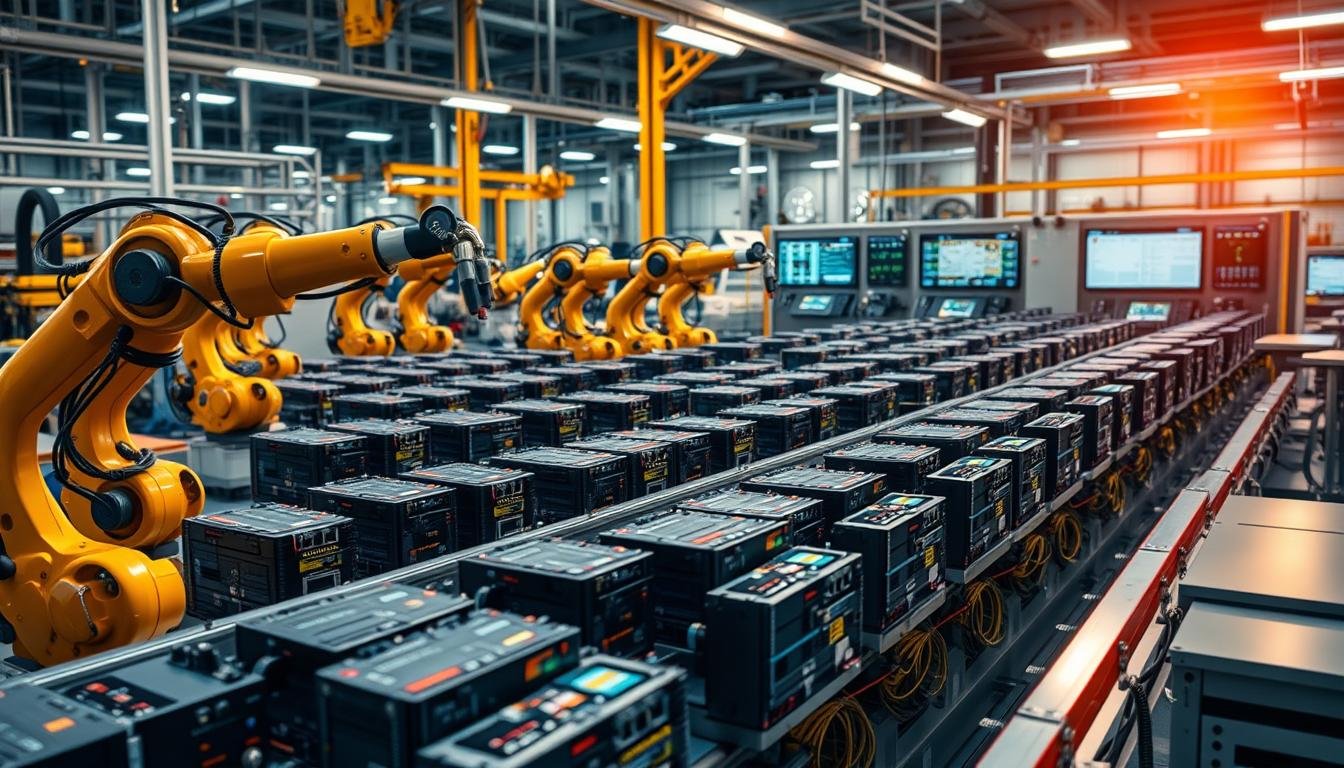
Modern automotive assembly faces a critical dilemma: balancing precision with adaptability. As manufacturers juggle gas-powered, hybrid, and electric vehicle components, traditional production methods strain under new demands. Mixed-model assembly—building different products on the same line—has become essential yet notoriously complex.
Industry leaders recognize the pressure to maintain quality while handling diverse electronic control unit configurations. Lean manufacturing expert Drew Locher highlights how high variability threatens productivity in these environments. The stakes intensify as electrification accelerates, requiring seamless transitions between combustion engine and electric vehicle technologies.
Success hinges on strategic resource allocation and intelligent scheduling systems. Advanced planning tools enable rapid changeovers while preserving rigorous quality benchmarks. Material flow complexities and workforce skill diversification further complicate this delicate equation.
Standardized processes form the backbone of adaptable operations. When implemented effectively, they allow manufacturers to pivot between product variants without sacrificing throughput. The real test comes in maintaining this flexibility while meeting automotive-grade reliability standards.
Key Takeaways
- Mixed-model assembly demands specialized strategies for handling component variations
- Lean principles reduce downtime during product changeovers
- Advanced scheduling systems optimize resource utilization across configurations
- Workforce cross-training enhances production line adaptability
- Standardized processes maintain quality during rapid transitions
- Material handling systems require smart customization for variant management
Introduction to Mixed-Model Assembly in the Automotive Industry
Modern vehicle production thrives on strategic adaptability. Mixed-model assembly lets factories build gas-powered cars, hybrids, and EVs on the same line during a single shift. This approach has become vital as consumer preferences shift and emission regulations tighten.
Understanding Mixed-Model Principles
At its core, mixed-model assembly balances two competing needs: standardization and customization. Factories must handle thousands of parts while maintaining precise quality standards. Key elements include:
- Synchronized workflow timing across vehicle types
- Dynamic material routing for different engine configurations
- Real-time production data analysis
The Evolution of Flexible Assembly Lines
The auto industry transitioned from rigid conveyor belts to modular systems using automated guided vehicles. These mobile platforms carry chassis through stations where robots and workers install components specific to each vehicle’s powertrain. A leading Detroit plant recently cut changeover time by 40% using this method.
Advanced tracking systems now manage component variations seamlessly. Sensors verify parts compatibility before installation, preventing errors in complex builds. This technological leap supports production of up to eight vehicle models simultaneously while maintaining 99.8% accuracy rates.
Automakers now confront an unprecedented convergence of engineering demands. Production facilities must accommodate combustion engines, hybrid configurations, and full electric drivetrains simultaneously. This triad of powertrain options creates unique spatial and logistical hurdles across assembly stages.
Integrating Different Powertrain Options
Combining traditional engine installations with electric vehicle components requires reimagined workstation designs. Gas-powered systems demand precise fuel line routing, while EV battery packs need specialized lifting equipment. Hybrid configurations compound these challenges by blending both technologies in confined spaces.
Material presentation becomes critical when handling components ranging from compact sensors to 900-pound battery arrays. Standardized mounting interfaces allow flexible tooling adjustments between vehicle types. Real-time tracking systems verify parts compatibility before installation, preventing costly mismatches.
Optimizing Floor Layout and Material Flow
Strategic zone planning separates heavy component staging areas from delicate electronics assembly stations. Automated guided vehicles follow dynamic routes adjusted for each vehicle’s engine or battery requirements. This approach reduces congestion while maintaining 98.6% on-time part delivery rates.
Cross-trained operators form the backbone of adaptable production systems. Workers certified in multiple powertrain installations can transition between stations with minimal retooling delays. This flexibility proves essential when balancing daily output targets across fuel types and vehicle configurations.
How We Manage Multiple ECU Variants on a Single Production Line
The heart of modern vehicle assembly beats in its electronic control systems. Production variants require specialized handling, with circuit modifications executed during manufacturing rather than development phases. Unlike option controls used for prototyping, these customized units demand industrial-grade validation processes.
Best Practices for ECU Variant Handling
Effective management begins with standardized test protocols that adapt to different configurations. Our teams developed modular validation sequences that reduce changeover time by 37% compared to traditional methods. This approach maintains strict quality benchmarks while accommodating diverse customer specifications.
Key elements of successful variant production include:
- Unified software architecture supporting multiple control unit configurations
- Automated circuit population verification systems
- Cross-functional quality gates at critical assembly stages
“Reliable test systems form the backbone of variant production. They must withstand 24/7 operation while delivering sub-millisecond measurement accuracy.”
We address five core challenges through strategic design choices:
- Hardware durability for 50,000+ test cycles
- Throughput optimization via parallel processing
- Software platforms supporting future protocol updates
Real-time traceability systems track each electronic control unit through production, enabling instant defect correlation. This integration between manufacturing execution systems and test equipment reduces troubleshooting time by 68% across variant batches.
Implementing Lean Manufacturing Principles for Mixed-Model Assembly

Lean manufacturing reshapes production floors into agile ecosystems capable of handling diverse product configurations. This transformation requires synchronized efforts across equipment, personnel, and material flow systems. Three pillars drive success: rapid changeovers, meticulous workplace organization, and supplier integration.
Minimizing Changeover Times
True mixed-model efficiency emerges when switching between configurations takes minutes rather than hours. Our approach combines modular tooling systems with cross-trained operators to achieve 90-second changeovers for most ECU variants. Key strategies include:
| Traditional Approach | Lean Strategy | Time Reduction |
|---|---|---|
| Dedicated tooling stations | Quick-change modular kits | 55% faster |
| Sequential operator training | Cross-skilled workforce | 40% improvement |
| Static material layouts | Dynamic kanban zones | 60% less delay |
Enhancing Workplace Organization
Visual management systems form the backbone of efficient assembly operations. Color-coded tool stations and digital Andon boards enable instant status checks across production lines. As lean pioneer James Womack observes:
“The ability to identify abnormalities within three seconds separates world-class facilities from average performers.”
We implement 5S methodology through:
- Standardized work instructions at every station
- Shadow boards for tool organization
- Real-time inventory alerts for JIT replenishment
These practices reduce search time by 73% while maintaining 99.4% parts availability across variant production runs. Continuous improvement cycles ensure workplace organization adapts to evolving technical requirements.
Strategies for Customizing ECUs and Managing Production Variants
Automotive electronics demand precision-engineered solutions that align with specific vehicle requirements. Our approach combines technical expertise with economic efficiency, delivering tailored control systems while maintaining scalable production workflows.
Production Variant vs. Option Control
Understanding volume thresholds proves critical when selecting customization methods. Production variants become viable at 50+ units, enabling direct factory integration during surface-mount technology (SMT) processes. This contrasts with option controls – limited-run development units requiring post-production modifications.
| Factor | Production Variant | Option Control |
|---|---|---|
| Volume Range | 50+ units | 1-50 units |
| Modification Stage | Factory-integrated | Post-assembly |
| Certification Path | PPAP compliant | Prototype-only |
| Cost Efficiency | 15-30% savings | Higher per-unit |
Achieving Cost Optimization in Production
Effective control unit strategies eliminate unnecessary expenses through three key methods:
- Component rationalization: Remove non-essential parts during design phase
- Process automation: Reduce manual rework after SMT completion
- Lifecycle planning: Account for long-term support needs upfront
As one automotive engineer noted:
“The real savings emerge when you design manufacturability into the control system from day one.”
Early collaboration with manufacturing teams ensures requirements get baked into initial designs. This prevents costly redesigns while maintaining performance benchmarks across all production variants.
Designing Robust Test Systems in Production Environments

Automotive validation processes demand solutions that withstand relentless operational demands while delivering precision. Production facilities require test architectures capable of handling 800+ units daily without compromising accuracy. This challenge intensifies as vehicle configurations multiply and floor space shrinks.
Ensuring Reliability and High Throughput
Our approach integrates three-layer redundancy for mission-critical operations. Shock-resistant hardware withstands factory vibrations, while modular software adapts to protocol updates. Parallel test channels enable simultaneous validation of four units per station – a 300% throughput increase over legacy methods.
Maintenance protocols prevent unexpected downtime through predictive analytics. Temperature-stable components and error-correcting communication buses maintain sub-0.1% false failure rates across 24/7 cycles. As one validation lead noted:
“The difference between profit and loss often hinges on test system uptime. Robust designs must outlast the vehicles they validate.”
Balancing Flexibility with Quality Requirements
Adaptable test platforms now support 87% of common ECU configurations through flexible test configurations. Swappable interface panels and script-based parameter adjustments enable rapid transitions between variants. However, core validation sequences remain locked to prevent quality drift.
Data integration proves critical in maintaining standards. Real-time dashboards track 142 quality metrics per unit, flagging deviations before they impact batches. This fusion of adaptability and control reduces rework costs by 41% compared to rigid single-purpose testers.
Integrating Automation and Advanced Technologies
Automotive manufacturing has reached an inflection point where static production methods can’t keep pace with evolving demands. Facilities now deploy intelligent systems that adapt to component variations in real time, achieving unprecedented precision at scale. This technological leap addresses critical needs for flexibility while maintaining rigorous quality standards.
Smart Material Handling Solutions
Traditional conveyor systems are being replaced by autonomous mobile robots that adjust routes based on real-time workflow data. Porsche’s Leipzig plant demonstrates this shift effectively:
| Feature | Traditional Line | Automated System |
|---|---|---|
| Changeover Flexibility | Fixed configurations | Dynamic pathing |
| Error Detection | Manual checks | Laser-guided alignment |
| Throughput Capacity | 18 units/hour | 27 units/hour |
Advanced screwdriving stations exemplify this transformation. One facility’s implementation handles 142 fastener types across multiple product lines without manual adjustments. Torque accuracy remains within ±0.2 N·m even at 1,200 installations per hour.
Robotic systems now perform intricate tasks through adaptive programming. Vision-guided arms position components with 0.05mm repeatability, while self-learning algorithms optimize motion paths between different assemblies. As one engineering manager noted:
“Our automated lines achieve 99.97% first-pass yield rates – impossible with manual processes.”
These technologies reduce training time by 65% through intuitive interfaces and error-proofing safeguards. Operators transition from manual labor to system supervision, focusing on exception management rather than repetitive tasks.
Managing Data, Scheduling, and Resource Allocation
Automotive factories now operate as interconnected data ecosystems. Real-time analytics drive decisions from component staging to final quality checks, with sophisticated planning systems acting as central nervous systems. These platforms process 2.7 million data points hourly across typical assembly operations.
Leveraging Production Planning Systems
Advanced algorithms balance three competing priorities: equipment utilization rates, workforce availability, and material constraints. A multi-schedule synthesis approach proves particularly effective for managing configurations. This method identifies common workflows across vehicle types, reducing redundant validation steps by 22%.
Key benefits emerge through intelligent resource mapping. Dynamic scheduling adjusts workstation assignments based on real-time bottlenecks. Cross-trained teams receive optimized task sequences through wearable devices, cutting idle time by 19%.
Material flow optimization relies on predictive analytics. Machine learning models forecast parts consumption with 97% accuracy, triggering automated replenishment requests. This integration prevents stockouts while maintaining 73% less buffer inventory than traditional methods.
Successful implementation requires harmonizing three elements: modular software architecture, IoT-enabled machinery, and adaptive workforce protocols. When synchronized, these components enable seamless transitions between 14+ vehicle configurations per shift without compromising cycle times.
FAQ
How do mixed-model assembly lines handle different fuel types?
What strategies prevent errors with multiple ECU versions?
How does lean manufacturing reduce changeover complexity?
Can automated systems manage combustion and EV components equally?
How are quality requirements maintained across variants?
What data systems manage production scheduling complexity?
How do you handle supplier variations for global vehicle markets?
About The Author
