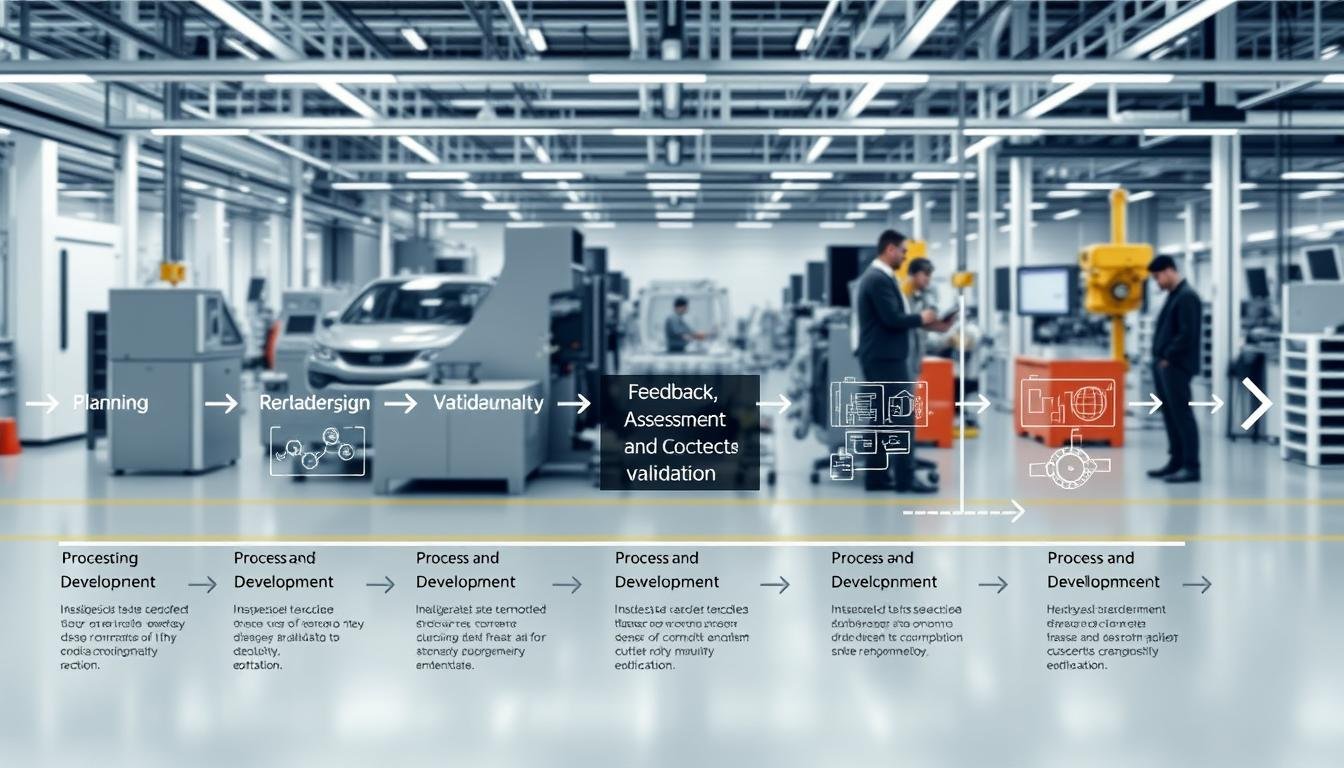
What if the traditional methods ensuring automotive quality are no longer sufficient for today’s complex supply chains? As vehicles evolve into sophisticated digital ecosystems, manufacturers face unprecedented challenges balancing speed, precision, and collaboration across global networks.
Advanced Product Quality Planning (APQP) remains the backbone of automotive excellence, but its execution requires fresh strategies. We combine decades of technical expertise with digital innovation to transform this structured process into a competitive advantage.
Modern automotive projects demand more than checklists. Thousands of components must align across suppliers, while evolving regulations add layers of complexity. A model-based approach creates digital threads that connect design specs to production realities, minimizing errors before prototypes exist.
Our methodology emphasizes early risk detection through AI-powered analytics and collaborative platforms. This proactive stance prevents costly delays, ensuring smoother launches and stronger supplier relationships. By integrating legacy systems with cutting-edge tools, we help teams meet both AIAG standards and emerging industry demands.
Key Takeaways
- APQP forms the foundation for managing complex automotive development cycles
- Digital transformation enhances traditional quality planning methods
- Cross-functional collaboration is critical for multi-supplier alignment
- Early risk identification prevents 80% of downstream quality issues
- Measurable outcomes include 30% faster time-to-market in recent implementations
Introduction to APQP and Its Role in Automotive Manufacturing
APQP’s legacy began when industry leaders sought to unify fragmented quality standards. In the late 1980s, General Motors, Ford, and Chrysler collaborated to create a shared framework for suppliers—laying the groundwork for today’s Advanced Product Quality Planning methodology.
Definition and Historical Background
Born from the need to streamline complex supply chains, APQP became one of five core tools in IATF 16949 compliance. This system works alongside PPAP, FMEA, MSA, and SPC to create end-to-end quality assurance processes. Early implementations focused on reducing part defects, but modern applications now address entire vehicle ecosystems.
The Importance of APQP in Modern Automotive Projects
Today’s vehicles contain over 30,000 components from global suppliers—a scale demanding rigorous quality planning. APQP bridges gaps between design teams, manufacturers, and regulatory bodies. Its phased approach prevents misalignment in electric vehicle battery systems, autonomous driving sensors, and connected car technologies.
The framework’s true power lies in proactive risk management. By identifying potential flaws during product development stages, teams avoid 80% of post-launch issues. This structured collaboration ensures compliance with evolving safety requirements while maintaining cost efficiency.
Our Approach to APQP for New Automotive Projects
Modern automotive development thrives when specialized expertise converges through structured collaboration. Cross-functional teams form the backbone of effective quality planning, combining engineering precision with manufacturing pragmatism. This integration ensures every component meets rigorous standards from prototype to production.
Core Elements of Execution
Specialized leaders guide integrated teams through complex development cycles. These professionals maintain accountability across departments while adapting methodologies to unique project needs. Whether refining electric drivetrains or autonomous systems, tailored approaches address specific technical challenges.
Digital tools transform traditional workflows by automating documentation and analysis. Model-based definitions replace error-prone manual processes, ensuring consistent interpretation of specifications. This shift accelerates validation phases while maintaining compliance with evolving industry benchmarks.
Clear communication protocols align suppliers with project milestones. Regular checkpoints verify component compatibility and regulatory adherence across global networks. Proactive risk management identifies potential bottlenecks before they impact timelines, preserving launch schedules.
Knowledge transfer remains central to sustainable success. Teams document lessons learned while building client capabilities for future initiatives. This dual focus delivers immediate results while strengthening long-term quality assurance practices.
The Five Phases of the APQP Process

Structured quality frameworks separate successful automotive launches from costly delays. The APQP methodology organizes development into five interdependent stages, each feeding critical data into the next. This pyramid-like structure ensures quality considerations mature alongside design decisions.
| Phase | Key Inputs | Critical Outputs |
|---|---|---|
| 1. Planning | Customer requirements | Design goals, BOM drafts |
| 2. Product Design | DFMEA results | Prototype control plans |
| 3. Process Design | Flow charts | Capability studies |
| 4. Validation | Production data | PPAP approvals |
| 5. Feedback | Field reports | Improvement roadmaps |
Planning and Program Definition
Phase 1 transforms voice-of-customer data into actionable specs. Teams establish measurable targets for performance, cost, and regulatory compliance. This stage locks in production feasibility before resource commitments.
Product and Process Validation
Phase 4 stress-tests manufacturing systems through pilot runs. We validate measurement consistency across global suppliers while documenting process capability metrics. This gate ensures readiness for full-scale operations.
Feedback and Continuous Improvement
The final phase turns real-world data into refinements. Analyzing warranty claims and assembly line adjustments drives iterative upgrades. This closed-loop system embeds learning into future development cycles.
Quality Planning and Risk Assessment Strategies

Effective automotive development hinges on anticipating problems before they disrupt production. Proactive strategies transform potential setbacks into opportunities for refinement. This phase ensures every component meets strict standards while maintaining cost efficiency.
Utilizing FMEA and Risk Analysis
Failure Mode and Effects Analysis (FMEA) serves as the cornerstone of predictive quality planning. Teams systematically evaluate potential failure modes in designs and manufacturing processes. Design FMEA identifies weaknesses in electric vehicle battery casings, while Process FMEA exposes assembly line vulnerabilities.
Risk prioritization matrices quantify threats based on severity and detection difficulty. This data-driven approach enables focused resource allocation. For example, autonomous sensor calibration processes undergo 35% more scrutiny than standard components.
Implementing Contingency and Improvement Plans
Contingency strategies address supply chain disruptions and technical bottlenecks. Alternative material sourcing plans reduce delays when geopolitical issues affect rare earth metal supplies. Real-time monitoring systems trigger alerts when production metrics deviate by ±2%.
Post-launch feedback loops fuel continuous improvement. Warranty claim patterns from connected vehicles inform next-gen failure prevention protocols. These adaptive methods ensure compliance with evolving Advanced Product Quality Planning (APQP) standards.
Digital Transformation in the APQP Workflow
The shift to digital workflows in APQP is transforming how automotive teams manage complex projects. Advanced tools now merge design intent with manufacturing realities, creating seamless data pipelines across global partners. This evolution addresses critical challenges in multi-supplier environments where manual processes once caused delays.
Embracing Model-Based Definition (MBD)
Modern teams utilize 3D CAD models combined with Product Manufacturing Information (PMI) as single sources of truth. This approach eliminates ambiguous drawings by embedding tolerances and specifications directly into digital assets. Suppliers access real-time updates through centralized repositories, reducing interpretation errors by 67% in recent implementations.
MBD-driven workflows streamline validation processes like PPAP and FAI. Automated checks verify component compliance against original design requirements, accelerating approval cycles. These digital threads connect engineering teams with quality control systems, ensuring consistent execution from prototype to production.
The Role of ISO QIF in Digital Data Management
The ISO QIF standard acts as the backbone for unified data exchange. It converts traditional measurement plans, SPC statistics, and MSA results into machine-readable formats. This enables automated analysis tools to identify trends faster than manual methods.
Key benefits include:
- 62% reduction in documentation errors through digital FMEA integration
- Real-time process control across distributed manufacturing sites
- Automated generation of PPAP packages meeting OEM specifications
These systems transform measurement data into actionable insights, moving beyond basic compliance checks. Teams now predict potential quality issues before tooling begins, reshaping traditional APQP timelines.
Supplier Integration and Cross-Functional Communication
Global automotive networks thrive when every supplier speaks the same quality language. Coordinating multiple tiers of partners demands structured communication frameworks and aligned technical standards. This synchronization prevents fragmented execution while maintaining cost efficiency.
Creating a Unified Supply Chain Approach
Modern supply chains require more than transactional relationships. We implement collaborative platforms that synchronize specifications across primary suppliers and sub-tier partners. Real-time data sharing eliminates version control issues in critical components like EV battery modules.
Key strategies include:
- Technical competency evaluations covering material science expertise
- Production capacity audits using digital twin simulations
- Quality system assessments aligned with IATF 16949 standards
These measures reduce interpretation errors by 67% compared to traditional methods. Training programs equip suppliers with tools to meet evolving customer expectations, creating self-sufficient partners rather than passive vendors.
Establishing Clear Part Approval Processes
Structured approval protocols prevent bottlenecks in multi-supplier environments. Digital checklists guide partners through design reviews, prototype testing, and production validation phases. This clarity reduces approval cycles by 42% in electric drivetrain projects.
Critical elements include:
- Real-time dashboards tracking part conformity metrics
- Automated alerts for specification deviations exceeding ±1.5%
- Centralized documentation repositories with version control
Open communication channels enable rapid resolution of tooling mismatches or material variances. This proactive alignment ensures customer satisfaction while preserving profit margins across the supply chain.
Evolving vehicle technologies demand quality systems that adapt faster than ever. The latest APQP revisions emphasize digital traceability and real-time supplier alignment – critical for electric and autonomous systems. Teams succeeding today treat quality planning as living processes, not static documents.
Three principles guide modern implementations: predictive analytics for early defect detection, standardized data exchange formats across supply tiers, and closed-loop feedback from production to design. These strategies reduce validation cycles while maintaining rigorous safety standards.
Emerging tools like AI-driven FMEA and blockchain-based part tracking reshape traditional workflows. However, human expertise remains vital for interpreting data patterns and fostering cross-functional trust. Balancing technological innovation with hands-on experience creates resilient quality ecosystems.
As automotive complexity grows, APQP frameworks must evolve beyond compliance checklists. Forward-thinking manufacturers integrate sustainability metrics and cybersecurity protocols into core quality plans. This proactive approach positions teams to lead in an era of software-defined vehicles and circular supply chains.
FAQ
How does APQP differ from standard quality planning in automotive projects?
What specific tools do you use for risk assessment during APQP phases?
How do you ensure supplier alignment during product quality planning?
What digital tools support your APQP workflow for automotive clients?
How does PPAP fit into your APQP implementation process?
What training do you provide for APQP implementation teams?
About The Author
