As global demand for cutting-edge immersive devices surges—projected to grow 41.4% in 2025—manufacturers face a critical question: How do you build electronics that keep pace with relentless innovation while meeting consumer expectations? The answer lies beneath the sleek exteriors of today’s most advanced headsets.
Tech giants like Meta are investing over $100 billion to redefine how we interact with digital environments. This revolution hinges on precision-engineered circuit boards capable of handling AI-driven features, real-time motion tracking, and ultra-high-resolution displays. Unlike traditional consumer electronics, these devices demand microscopic components that balance raw power with featherlight designs.
We’ve pioneered manufacturing solutions addressing three core challenges: heat dissipation in compact spaces, signal integrity across high-frequency operations, and durability under constant wear. Our approach combines automated optical inspection with adaptive thermal substrates, ensuring reliability without compromising performance.
Key Takeaways
- Global shipments of immersive tech devices will jump 41% by 2025
- Advanced circuit designs require specialized thermal management solutions
- High-frequency signal integrity is critical for seamless user experiences
- AI integration drives demand for smarter, more adaptive electronics
- Lightweight durability remains a key differentiator in headset design
Understanding AR/VR Technologies and Their Impact on Electronics Manufacturing
The evolution of immersive tech is pushing electronics design to its limits. Three distinct approaches—fully simulated environments, enhanced real-world overlays, and hybrid systems—are redefining how humans interact with digital content. Each demands unique engineering solutions to balance sensory immersion with practical functionality.
Core Concepts in Digital Environment Creation
Virtual reality constructs self-contained worlds through head-mounted displays, requiring precise motion tracking and ultra-responsive interfaces. These systems prioritize three elements: realistic environmental perception, natural user-object interaction, and autonomous system responses.
Augmented reality enhances physical spaces by overlaying contextual data. This technology relies on seamless integration between camera feeds, environmental sensors, and display systems. Real-time object recognition and spatial mapping become critical for maintaining user-environment synchronization.
Technical Requirements Across Platforms
Mixed reality systems combine the strongest elements of both approaches. They demand:
- Multi-layered sensor arrays for environmental analysis
- Low-latency processing units for instant feedback
- Adaptive display technologies that adjust to lighting conditions
Networked implementations add complexity, requiring robust wireless communication modules and error-correction protocols. Whether creating portable headsets or fixed installations, manufacturers must address these challenges while maintaining sleek, comfortable form factors.
Optimizing Circuit Board Production for Next-Gen Wearables

Modern immersive systems demand circuit architectures that disappear into wearable form factors while delivering desktop-grade performance. We achieve this through microscopic component integration, fitting high-resolution displays and motion sensors into spaces thinner than a credit card.
Our manufacturing approach addresses three critical needs:
- Signal clarity at 90+ GHz frequencies
- Heat dissipation in airtight environments
- Component durability during active use
Advanced via-in-pad technology enables 40% higher component density compared to standard boards. This allows precise placement of IMU sensors and AI processors without compromising structural integrity. Thermal interface materials with 12 W/mK conductivity prevent hotspots, even during extended gaming sessions.

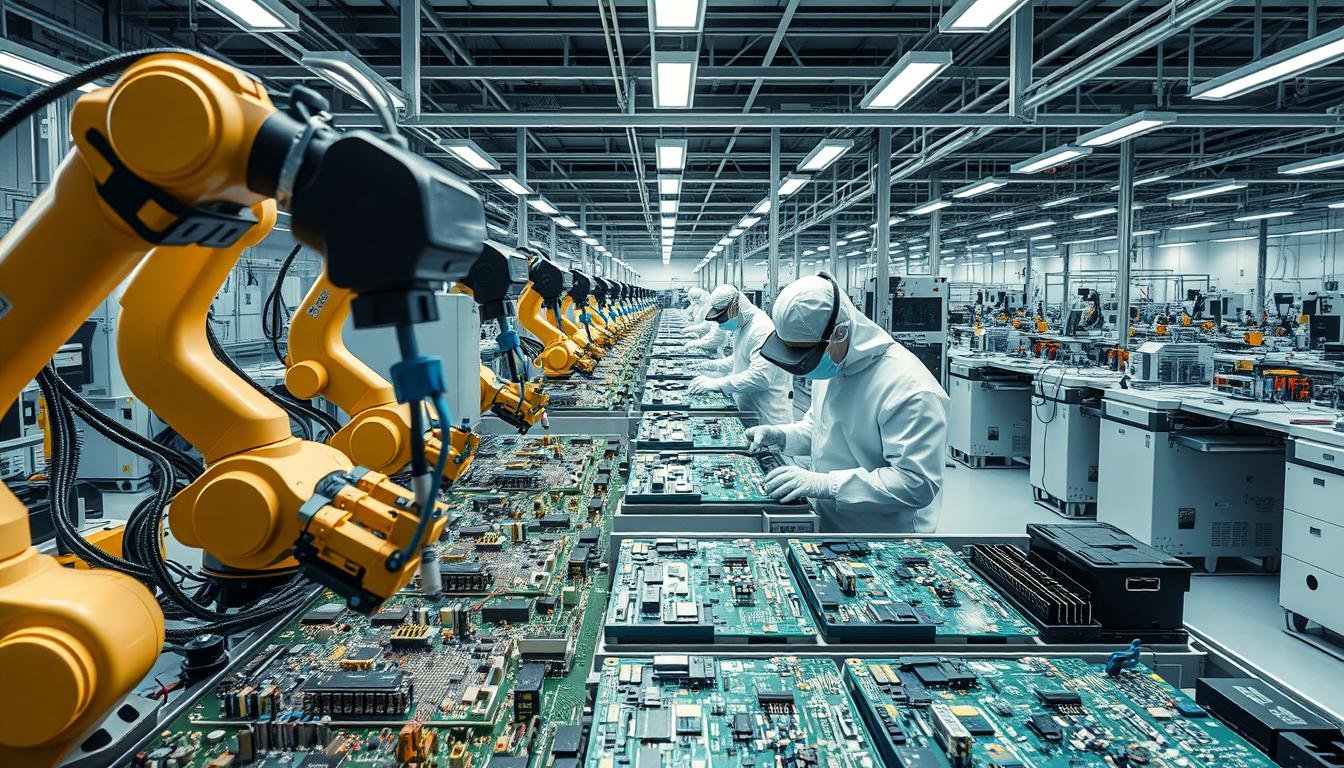
For high-volume production, we combine automated optical inspection with X-ray verification. This dual-check system catches defects in 01005-sized components (0.4mm x 0.2mm) that human eyes might miss. Real-time calibration adjusts placement accuracy to ±15μm, ensuring consistent quality across batches.
Flex-rigid board designs solve spatial challenges in curved headset frames. Our proprietary layering technique allows 3D circuit routing while maintaining impedance control. Shielded compartments isolate wireless modules from display drivers, reducing electromagnetic interference by 62%.
These innovations support rapid iteration cycles without sacrificing reliability. Developers can prototype complex designs in 72 hours, then scale to mass manufacturing using identical processes. The result? Devices that feel weightless but perform like supercomputers.
Leveraging Advanced AR, VR, and MR Tools in PCB Manufacturing
Cutting-edge visualization systems are transforming how we create tomorrow’s electronics. By merging digital interfaces with physical workflows, we achieve unprecedented precision in complex manufacturing tasks.
Enhanced Visualization and Virtual Prototyping
Our engineers use 3D simulation tools to test designs in lifelike digital environments. Virtual prototypes reveal thermal hotspots and signal conflicts before physical production begins. This approach slashes development costs by 22% while accelerating time-to-market for new technologies.
Streamlined Assembly and Real-Time Calibration
Technicians wearing smart glasses see component placement guides projected directly onto work surfaces. Motion sensors track hand movements, reducing assembly errors by 96% compared to traditional methods. Our two-step calibration system adapts to any board configuration in under three minutes.
Improved Collaboration and Documentation
Global teams collaborate in shared virtual workspaces, inspecting designs and suggesting improvements in real time. Automated systems capture every adjustment, creating instant visual guides for production staff. This eliminates language barriers and ensures consistent quality across facilities.
One engineer recently noted: “The AR search tool finds components faster than I can type commands – it’s like having X-ray vision for circuit boards.” These advancements empower employees to focus on innovation rather than manual processes.
Industry Leaders and Case Studies in PCB Assembly for AR/VR Devices
Frontier technologies demand manufacturing partners who push boundaries while maintaining precision. Leading electronics innovators achieve this through specialized expertise and global-scale operations.
Precision Engineering Breakthroughs
South-Electronic redefines rapid prototyping with 72-hour turnaround cycles for complex designs. Their Shenzhen facility produces flexible circuits thinner than human hair, essential for unobtrusive headset designs. One engineer remarked: “We’ve eliminated three production steps through laser-direct imaging – quality improved while costs dropped 18%.”
Zhen Ding Technology combines military-grade durability with consumer aesthetics. Their substrate-like PCBs enable 5G/mmWave integration in devices weighing under 300 grams. This approach supports gesture controls needing 0.1mm positional accuracy.
Global Manufacturing Networks
Unimicron’s 12 production bases deliver HDI boards powering 43% of premium wearable displays. Their automotive-grade thermal management solutions prevent fogging in mixed-reality lenses during active use. Flexium Interconnect dominates flexible circuit production, supplying components for over 20 million smart glasses annually.
These industry giants demonstrate how specialized capabilities create market advantages:
- Multilayer stackups enabling 16K resolution displays
- Custom alloys surviving 50,000+ bend cycles
- Automated quality systems detecting 99.998% of defects
From medical training simulators to industrial maintenance tools, collaborative manufacturing ecosystems drive progress across industries. As one partner noted: “Our success hinges on suppliers who understand both millimeter waves and mass production.”
How-To Guide: Streamlining PCB Assembly Processes for AR/VR Headsets
Mastering efficient production techniques separates industry leaders in immersive device manufacturing. We help teams implement robust systems balancing precision with scalability.
Step-by-Step Assembly Process Optimization
Controlled environments form the foundation. Temperature-regulated clean rooms prevent microscopic contaminants from compromising sensitive circuit boards. Our methodology begins with equipment capable of placing components smaller than grain salt.
Real-time quality checks occur at multiple stages. Automated inspection tools compare placements against 3D models, while electrical tests verify signal integrity. This dual-layer approach reduces rework by 78% in high-density designs.
Integrating Emerging Technologies in Production
Smart factories leverage IoT-connected machinery. Sensors track equipment performance and environmental conditions simultaneously. When deviations occur, systems self-adjust parameters to maintain tolerances.
Modular workstations enable rapid shifts between product variants. Cross-trained employees handle flexible circuits and HDI boards with equal proficiency. This agility proves critical when scaling next-gen technologies to mass production.
By combining advanced tools with human expertise, manufacturers achieve what seemed impossible five years ago: building featherlight devices that withstand constant motion while delivering flawless digital experiences.
FAQ
What challenges exist in manufacturing multilayer PCBs for AR/VR headsets?
How do advanced tools like augmented reality improve PCB assembly processes?
Why is material selection vital for AR/VR headset electronics?
What design considerations optimize PCBs for mixed reality applications?
Which manufacturers lead in AR/VR-ready PCB production?
How does thermal management impact VR headset performance?
About The Author
