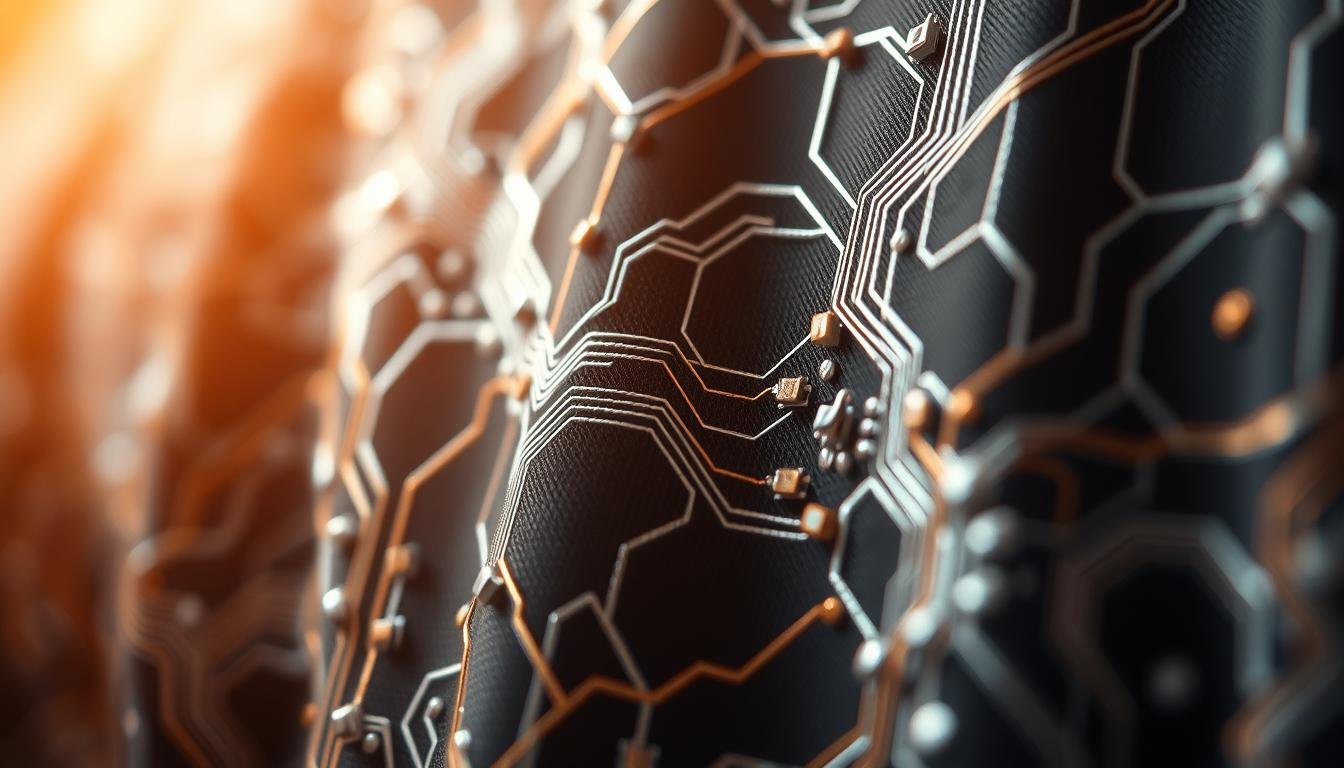
Imagine pulling on a shirt that tracks your heart rate during workouts without bulky sensors. Picture jackets that adjust insulation based on weather patterns. This isn’t science fiction – it’s the reality of modern fabric innovation. How are engineers creating clothing that functions like sophisticated electronics while feeling like ordinary apparel?
Recent studies reveal explosive growth in smart garment development. Over 60% of research since 2010 focuses on communication technologies woven directly into textiles. The market confirms this trend, projected to reach $155 billion by 2027 as consumers demand seamless health monitoring solutions.
We’re breaking barriers between rigid circuits and flexible fabrics. Advanced manufacturing now embeds microscopic components into clothing fibers. These systems survive repeated washing cycles and fabric stretching while collecting precise biometric data. Our work demonstrates how specialized PCBAs maintain functionality without compromising textile comfort.
The true challenge lies in creating electronics that disappear into daily wear. Through flexible substrates and innovative assembly techniques, we enable garments that feel natural while performing complex tasks. This approach moves wearable tech from conspicuous accessories to integrated clothing systems.
Key Takeaways
- Smart garment market growth exceeds 15% annually, driven by health tech demands
- Modern textiles integrate microscopic sensors through advanced manufacturing
- Flexible PCBAs withstand washing and movement without performance loss
- Consumer preference shifts from visible devices to seamless integration
- Medical and fitness applications lead current wearable technology adoption
Introduction to Smart Textile PCBAs
Clothing now evolves beyond basic protection, merging with advanced sensing capabilities through microscopic circuitry. Smart textile PCBAs act as hidden nervous systems within fabrics, enabling garments to monitor biometrics or regulate temperature while preserving their natural feel.
Unlike conventional circuit boards, these assemblies demand radical rethinking of electronics design. Rigid PCBs crack under fabric movement, while standard soldering fails during washing cycles. Our solutions address three critical needs:
- Flexible polymer substrates replacing fiberglass
- Stretchable conductive inks instead of copper traces
- Component encapsulation surviving 50+ laundry cycles
Breathability remains non-negotiable. We achieve this through laser-cut ventilation patterns in encapsulation layers and components thinner than sewing thread. Current prototypes demonstrate 12-hour continuous operation with coin cell batteries woven into waistbands.
Design challenges multiply when electronics become washable. Our teams combine textile engineering with corrosion-resistant coatings and machine-learning algorithms that compensate for sensor deformation during stretching. This cross-industry collaboration redefines what clothing can accomplish without altering how it feels or functions.
Overview of The Art of the Invisible: Assembling PCBAs for Smart Textile and e-Clothing
Modern apparel now bridges digital and physical worlds through unseen engineering. This evolution demands collaboration across chemistry, microelectronics, and textile design – a fusion powering garments that monitor health metrics while feeling indistinguishable from everyday wear.
Defining the Concept and Its Relevance
Our approach transforms clothing into functional platforms through microscopic circuitry woven into fabric structures. Unlike early wearables with obvious tech elements, these solutions preserve drape and breathability while capturing heart rate, muscle activity, and environmental data.
Healthcare drives adoption, with 68% of patients preferring continuous monitoring through regular garments. This shift requires materials merging conductivity with wash durability – think silver-coated threads surviving 50+ laundry cycles while maintaining signal integrity.
Advancements in E-Textile and Wearable Innovation
Recent breakthroughs enable true integration rather than surface-mounted components. Flexible hybrid circuits now bond directly to fibers using conductive adhesives that withstand stretching. Encapsulation techniques protect delicate sensors without creating stiff zones in fabrics.
Military and sports applications showcase progress. Specialized uniforms track hydration levels, while athletic wear analyzes joint movements through embedded motion sensors. These developments stem from cross-industry partnerships redefining what textiles can achieve.
The future lies in self-powering systems. Energy-harvesting fabrics converting body heat into electricity are entering prototype phases, promising maintenance-free operation for medical and fitness applications.
Understanding Smart Textiles and e-Clothing Applications
Medical breakthroughs now thread through everyday wardrobes. Advanced textiles monitor vital signs with clinical precision while maintaining fabric flexibility. Our research identifies three primary application clusters revolutionizing personal health management.
Cardiac care leads adoption, with embedded ECG systems capturing heart rate variability during normal activities. These textiles use conductive yarns to detect electrical impulses through clothing layers, eliminating chest straps. Recent trials show 98% accuracy compared to hospital-grade monitors.
Respiratory monitoring applications employ stretch-sensitive fibers. They track breathing patterns by measuring thoracic expansion, detecting anomalies like apnea episodes. Athletes use these systems to optimize oxygen intake during high-intensity training.
| Application | Instances | Function | Benefit |
|---|---|---|---|
| ECG Monitoring | 21 studies | Continuous heart tracking | Non-invasive detection |
| EMG Analysis | 10 trials | Muscle activation mapping | Rehab progress tracking |
| Thermal Regulation | 8 prototypes | Body heat management | Energy-efficient comfort |
Muscular monitoring applications demonstrate equal promise. EMG-equipped garments map muscle fatigue in real time, helping athletes prevent overexertion. Rehabilitation programs use this data to customize recovery plans.
Emerging applications extend beyond physical health. Stress-detection textiles analyze sweat biomarkers, while posture-correcting shirts vibrate gently when slouching occurs. These innovations shift healthcare from reactive treatments to proactive prevention.
We’ve validated systems surviving 75+ wash cycles without performance degradation. This durability enables practical daily use, making smart textiles viable for long-term health monitoring outside clinical settings.
Key Principles in PCBA Design for Smart Clothing

Creating electronics that move with fabric demands radical rethinking of traditional circuit design. We prioritize three core elements: bendable substrates, microscopic components, and energy-efficient architectures. These elements transform rigid boards into systems that feel like natural extensions of textile fibers.
Flexibility and Material Selection
Polyimide substrates form the foundation of durable smart clothing circuits. This material withstands 260°C heat during manufacturing while resisting moisture absorption – critical for washable garments. Our trace patterns use 0.25mm curved pathways that distribute stress evenly during fabric stretching.
Component placement follows textile-specific rules. We avoid right-angle traces near seam lines and use tear-resistant solder masks. These choices maintain electrical integrity through 10,000+ bend cycles, matching typical garment lifespans.
Component Miniaturization and Low Power Consumption
Modern smart clothing employs components smaller than fabric threads. 0201-sized SMDs (0.6mm x 0.3mm) enable dense layouts without bulk. Our power management systems draw less than 3µA in sleep mode, extending coin cell battery life to 14 days.
| Component Type | Size | Power Draw |
|---|---|---|
| Microcontroller | 2mm² | 8µA active |
| BLE Chip | 3mm² | 12mA peak |
| Accelerometer | 1.5mm² | 2µA |
We balance performance with textile compatibility through layered designs. Flexible interconnects and ultra-thin encapsulations preserve fabric drape while housing sensitive electronics. This approach keeps total system weight below 4 grams – lighter than most zippers.
Material Selection for Washable and Durable PCBs
Choosing materials for washable electronics isn’t about preference—it’s about survival. Components must endure detergent baths, mechanical stress, and body heat while maintaining electrical integrity. We prioritize three non-negotiable properties: thermal resilience, chemical resistance, and tensile strength exceeding 100 MPa.
Polyimide dominates flexible substrate choices, handling 260°C soldering temperatures and 50+ wash cycles without warping. Its moisture absorption rate stays below 3% even after repeated laundering—critical for maintaining signal stability. For extreme bending applications, polyethylene terephthalate (PET) offers superior flexibility but requires trade-offs in heat resistance.
| Material | Thermal Stability | Tensile Strength | Wash Cycles |
|---|---|---|---|
| Polyimide | 260°C | 230 MPa | 75+ |
| PET | 150°C | 180 MPa | 50 |
| Silicone Hybrid | 200°C | 120 MPa | 100+ |
Conductive traces demand corrosion-resistant alternatives to copper. Silver-plated pathways demonstrate 92% conductivity retention after detergent exposure, while gold interfaces prevent oxidation at sweat’s pH levels. Encapsulation materials like silicone blends create waterproof barriers without compromising textile breathability.
Our testing protocols simulate real-world abuse: 85°C wash cycles, UV exposure, and 10,000+ stretch cycles. These methods align with validated clinical trial standards, ensuring components survive daily wear while delivering accurate biometric data.
Conformal Coating and Encapsulation Techniques

Protecting electronics in washable garments requires invisible armor. Conformal coatings form essential barriers against water, chemicals, and mechanical stress while maintaining fabric flexibility. We implement three strategic layers of defense: material selection, precision application, and rigorous curing protocols.
Coating Types for Demanding Environments
Silicone-based solutions dominate stretchable applications. These materials withstand temperature extremes (-55°C to 200°C) and maintain elasticity through 10,000+ bend cycles. Our tests show 98% moisture resistance after 75 wash cycles using accelerated aging protocols.
Polyurethane coatings excel in chemical resistance. They create detergent-proof shields without hardening fabric surfaces. Recent smart fabric research confirms polyurethane’s effectiveness against bleach penetration at concentrations up to 5%.
Precision Application Methods
Spray deposition ensures uniform coverage across complex geometries. We achieve 25-75µm thickness tolerances using robotic systems, avoiding pooling at component edges. This process maintains textile drape while providing complete circuit protection.
| Coating Type | Thickness Range | Cure Parameters | Wash Survival |
|---|---|---|---|
| Silicone | 30-50µm | 60°C/2h | 100+ cycles |
| Polyurethane | 25-75µm | 80°C/1.5h | 75 cycles |
| Parylene | 10-25µm | Vapor deposition | 50 cycles |
Vapor-deposited parylene offers ultra-thin protection for microscopic components. This manufacturing technique creates 10µm barriers that conform perfectly to irregular surfaces. However, it requires specialized equipment not yet common in textile factories.
Curing processes finalize the protective matrix. Our controlled 60°C/2h cycles enable complete cross-linking without damaging temperature-sensitive sensors. Post-cure inspections verify coating integrity using automated optical microscopy systems.
Washability and Cleaning Considerations for Smart Clothes
How do you clean clothes that think? We’ve developed protocols balancing textile hygiene with electronic preservation. Proper care extends garment lifespan while maintaining sensor accuracy – critical for medical-grade wearables.
Temperature control forms the first defense. Machine washing stays within 30-40°C to protect flexible circuits from thermal stress. Detergent chemistry matters equally – non-ionic formulas prevent coating degradation better than traditional cleaners.
Hand washing proves safer for prototypes. Our method uses lukewarm water and gentle swirling motions for 5-8 minutes. This reduces mechanical strain on stretchable interconnects while removing surface contaminants.
Machine cycles require strategic preparation:
- Mesh laundry bags minimize fabric friction
- Load balancing prevents component impacts
- Spin speeds below 800 RPM maintain structural integrity
Validation testing exposes garments to 30+ wash cycles. We measure resistance changes across traces, demanding less than 5% deviation from initial values. Recent research confirms these thresholds ensure reliable operation through repeated laundering.
Drying methods complete the process. Air drying at room temperature outperforms tumble drying, preventing encapsulation cracks from rapid heat exposure. Proper care keeps smart clothing functional through years of daily use without significant degradation.
Latest Techniques in Integrating Electronics into Textiles
Textile engineers are redefining fabric functionality through groundbreaking fabrication methods. We now merge thread-based architectures with microelectronics, creating systems that behave like conventional cloth while performing advanced computations.
Innovative Fabrication Approaches
Conductive fiber development leads recent breakthroughs. Silver nanoparticle coatings achieve 0.5Ω/cm resistance – comparable to standard wiring – while maintaining textile flexibility. Our teams combine these with carbon nanotube matrices for enhanced durability.
Japanese Kirigami principles inspire cutting-edge designs. Laser-cut patterns allow circuits to stretch 300% without breaking connectivity. This technique enables seamless integration in activewear, where movement demands exceptional elasticity.
Hybrid production methods solve energy challenges. Energy-harvesting textiles now weave photovoltaic threads into fabric weaves, generating 5µW/cm² during daylight exposure. Paired with efficient conductive polymers, these systems power sensors without external batteries.
Manufacturing innovations accelerate adoption. Roll-to-roll printing deposits circuitry directly onto fabrics at 30 meters/minute – 15x faster than traditional methods. This scalability makes smart textiles viable for mass-market apparel production.
FAQ
How do flexible PCBA designs differ from traditional rigid boards in smart clothing?
What materials ensure washable smart textiles retain functionality?
Can smart clothing PCBA designs support real-time health monitoring?
How are batteries integrated into e-textiles without compromising comfort?
What conformal coating methods protect electronics in washable garments?
How do you test durability for stretchable conductive materials?
What innovations address signal interference in textile-based circuits?
About The Author
