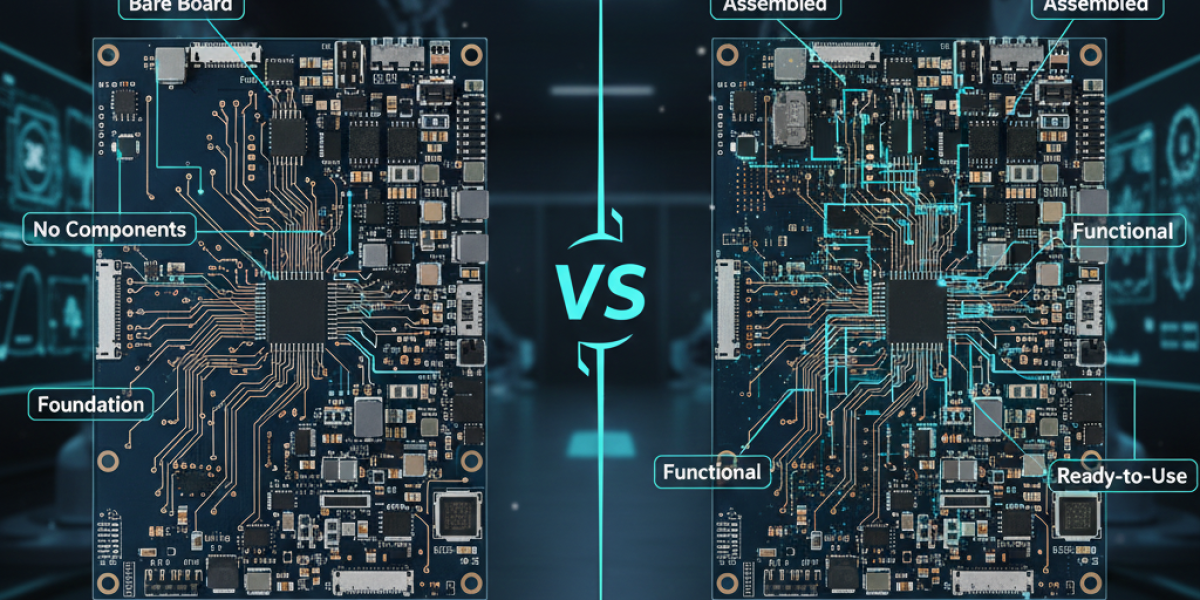
Understanding the distinction between PCB and PCBA proves essential for anyone involved in electronics manufacturing. While these terms often appear interchangeably in casual conversation, they represent fundamentally different products with distinct manufacturing processes, costs, and applications. PCB refers to bare printed circuit boards, while PCBA represents fully assembled and functional boards. Grasping these distinctions enables informed decision-making throughout electronics development and manufacturing. This comprehensive guide explores both technologies, their manufacturing differences, cost implications, and when to utilize each solution.
Table of Contents
What is a PCB (Printed Circuit Board)?
A printed circuit board (PCB) is a bare substrate providing physical structure and electrical interconnection for electronic components. PCBs consist of copper-clad laminate layers (typically fiberglass-reinforced epoxy or FR-4) etched with conductive traces creating pathways for electrical signals. Vias drilled through layers enable interconnection between conductive layers. Solder pads provide attachment points for components.
PCB manufacturing involves photolithography, chemical etching, drilling, plating, and finishing processes creating precise copper trace patterns. Multiple layers enable complex circuit implementations impossible with single-layer designs. Advanced PCBs incorporate controlled impedance traces for high-speed signal transmission, blind and buried vias for high-density designs, and specialized materials for extreme applications.
Bare PCBs ship without any electronic components mounted. They represent manufacturing’s first stage—the foundation upon which functional electronics are built. PCBs serve as intermediary products for manufacturers requiring assembly by separate facilities or as completed products for advanced manufacturers needing bare boards for specialized purposes.
What is PCBA (Printed Circuit Board Assembly)?
A printed circuit board assembly (PCBA) represents a fully assembled, functional electronics module. PCBA takes bare PCBs and populates them with electronic components creating working electronics ready for integration into larger systems. PCBA includes PCB substrate plus resistors, capacitors, inductors, integrated circuits, connectors, and all other required components soldered in precise positions.
PCBA manufacturing combines PCB fabrication with precision assembly, component sourcing, quality assurance, and functional testing. Advanced assembly techniques including surface mount technology (SMT), through-hole assembly, and ball grid array (BGA) placement create reliable interconnections. Comprehensive testing validates functionality ensuring products meet specifications before delivery.
PCBA represents the final integrated product ready for immediate deployment or integration into larger assemblies. Most electronics consumers encounter are PCBAs—smartphones, computers, industrial control modules, medical devices. The complete functionality derives from PCBA integration of multiple components working in coordinated roles.
Key Differences Between PCB and PCBA
Understanding fundamental distinctions clarifies manufacturing approaches and product selections.
| Aspect | PCB (Bare Board) | PCBA (Assembled Board) |
|---|---|---|
| Definition | Bare substrate with traces and vias only | PCB with components soldered and functional |
| Components | None—empty pads only | All required components populated |
| Functionality | No electrical function—substrate only | Fully functional electronics module |
| Manufacturing Stage | First stage—fabrication only | Final stage—complete assembly |
| Typical Cost | $10-$100 per unit (varies by complexity) | $50-$1000+ per unit (depends on components) |
| Testing | Electrical continuity, dimension checks | Functional testing, environmental validation |
| Lead Time | Typically 2-4 weeks | Typically 4-8 weeks (includes sourcing) |
| End Use | Intermediate—requires assembly | Complete—ready for deployment |
Manufacturing Process Comparison
Distinct manufacturing sequences differentiate PCB and PCBA production.
PCB Manufacturing Process
PCB fabrication involves substrate cutting, photolithography transferring design patterns, chemical etching removing unwanted copper, via drilling creating layer interconnections, electroplating establishing copper conductivity, solder mask application protecting traces, silkscreen printing adding labels, and surface finishing protecting copper from oxidation. Quality inspection verifies dimensional accuracy and electrical continuity. Manufacturing typically completes within 2-4 weeks depending on complexity.
PCBA Manufacturing Process
PCBA production begins with bare PCB receipt, followed by component procurement and verification, solder paste printing applying precise paste quantities, automated pick-and-place positioning components, reflow soldering establishing connections, automated optical inspection detecting defects, through-hole component insertion where required, wave soldering through-hole components, cleaning removing residual flux, comprehensive functional testing, and final packaging. PCBA manufacturing extends to 4-8 weeks accounting for component sourcing and testing requirements.
Cost Implications and Pricing Analysis
Significant cost distinctions influence purchasing decisions between PCB and PCBA alternatives.
PCB Cost Structure
PCB costs depend primarily on design complexity, material selection, and manufacturing volume. Single-sided boards cost less than multilayer designs. FR-4 material costs less than specialized high-frequency substrates. Volume purchasing dramatically reduces per-unit costs through economies of scale. Complex boards with controlled impedance and blind vias cost more than simple designs. Typical PCB costs range from $5-$50 per unit depending on specifications.
PCBA Cost Components
PCBA costs include PCB substrate plus component material, labor, equipment depreciation, testing, packaging, and profit margins. Component costs dominate total PCBA price, especially with expensive integrated circuits or specialized components. Assembly labor affects total cost significantly, though automation reduces per-unit labor. Testing and quality assurance add 10-15% to final costs. Typical PCBA costs range $50-$500+ per unit depending on component selection.
Volume Economics
At low volumes (1-100 units), per-unit PCBA costs remain high due to fixed overhead spread across few units. Medium volumes (100-10,000 units) achieve moderate cost reductions through component quantity discounts. High volumes (10,000+ units) achieve optimal pricing through material consolidation, process optimization, and equipment amortization. Volume planning directly impacts per-unit costs and profitability.
When to Choose PCB vs PCBA Solutions
Strategic selection depends on specific manufacturing and business requirements.
Choose PCB (Bare Boards) When:
Manufacturing custom assemblies with specialized components unavailable through standard PCBA services. Testing prototype designs before committing to full production. Maintaining inventory of boards for distribution to assembly partners. Developing highly specialized applications requiring custom assembly techniques. Cost optimization through DIY assembly or specialized contractor services. Educational purposes where component-level understanding proves important.
Choose PCBA (Assembled Boards) When:
Complete electronics functionality required immediately without internal assembly capability. Time-to-market demands rapid production without assembly infrastructure development. Outsourcing manufacturing simplifies product development and eliminates assembly complexity. Quality assurance and testing requirements demand specialized expertise. Volume production requires reliable, consistent assembly. Cost optimization through specialized manufacturer economies of scale. Risk mitigation through experienced assembly partners preventing costly manufacturing mistakes.
Quality Standards and Testing Differences
Testing protocols differ reflecting distinct manufacturing stages and product functionality.
PCB Testing and Verification
Bare PCBs undergo electrical continuity verification confirming all traces and vias conduct properly. Insulation resistance testing ensures adequate separation between conductive elements. Dimensional measurement verifies board size and hole locations. Visual inspection detects manufacturing defects. Automated optical inspection (AOI) scans for copper defects and solder mask coverage issues. Testing confirms manufacturing quality without validating functional performance.
PCBA Testing and Validation
PCBA testing encompasses component verification, solder joint quality assessment, in-circuit testing measuring component values, functional testing exercising circuit operation, environmental stress testing predicting reliability, and final performance validation. Comprehensive testing ensures complete functionality and reliability. Statistical sampling or 100% testing determines appropriate quality levels. Testing directly affects product reliability and customer satisfaction.
ESPCBA’s PCB and PCBA Capabilities
ESPCBA delivers complete solutions spanning both bare PCB fabrication and comprehensive PCBA services.
Advanced fabrication equipment produces high-quality bare boards meeting stringent specifications. Precision assembly systems handle diverse component types from micro-BGAs to large connectors. Comprehensive testing capabilities validate functionality and reliability. Expert engineering teams optimize designs for manufacturability and performance. PCB fabrication and PCBA services integrate seamlessly enabling complete manufacturing control.
Whether requiring bare boards for specialized assembly or complete turnkey PCBA solutions, ESPCBA delivers manufacturing excellence. Contact our team discussing specific requirements or request quotes for PCB and PCBA solutions.
Conclusion
PCB and PCBA represent distinct products serving different manufacturing and business roles. Bare PCBs provide fabrication foundation for specialized applications and distribution channels. PCBA delivers complete electronics functionality ready for immediate deployment. Understanding distinctions enables informed selection matching specific project requirements. ESPCBA’s comprehensive capabilities spanning both services enable flexible solutions supporting diverse manufacturing needs from prototypes through high-volume production.
Choose Your Perfect Manufacturing Solution
Whether bare PCBs or complete PCBA, ESPCBA delivers quality and reliability.
Expert guidance, proven processes, quality assurance—manufacturing excellence.
