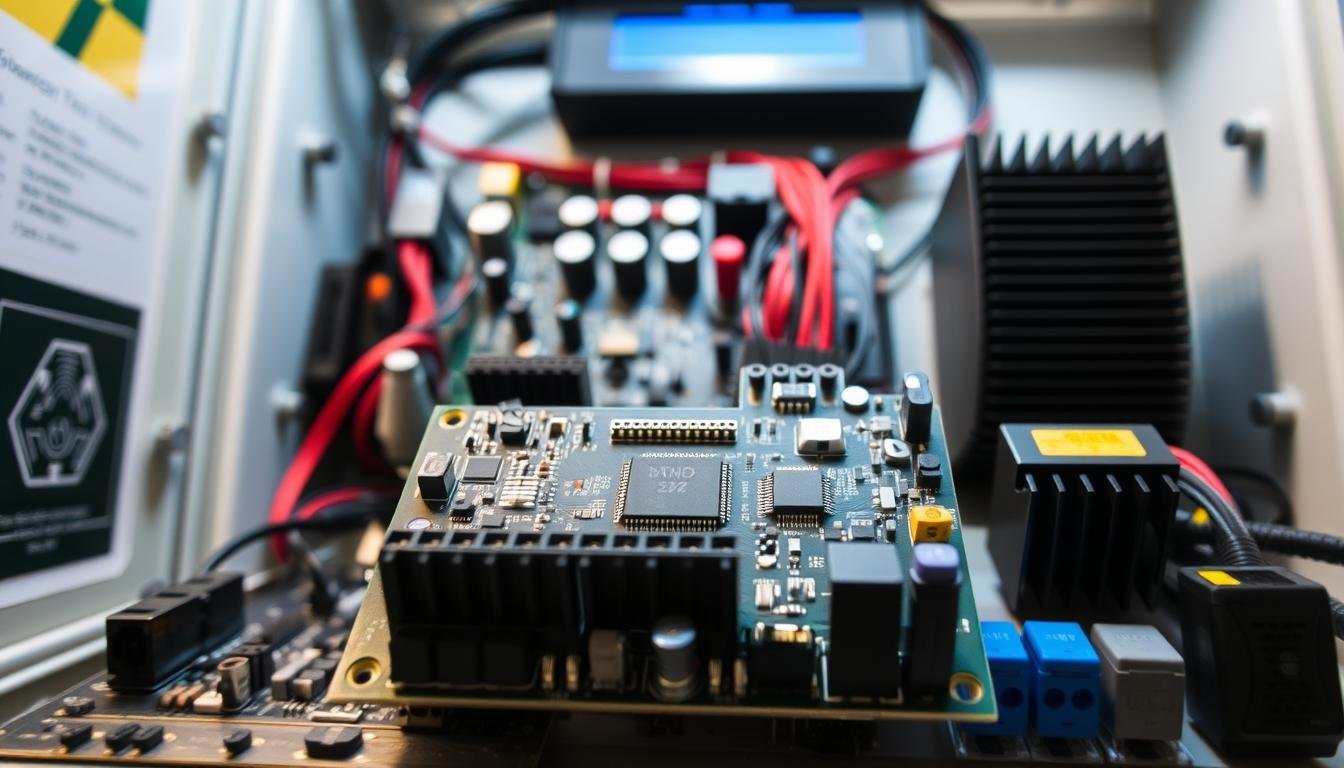
As industries race to decarbonize, one question dominates technical discussions: How do we ensure renewable energy solutions keep pace with global demand? The answer often starts at the microscopic level – in the intricate networks of circuits managing today’s most advanced clean technology.
We specialize in creating the electronic backbone for water-splitting equipment that converts renewable electricity into storable fuel. Our team understands the unique challenges of environments where megawatts meet molecules – spaces demanding flawless operation under extreme electrical loads and chemical exposure.
Modern electrolysis requires more than basic circuitry. It needs intelligent networks capable of real-time adjustments across thousands of operational parameters. From laboratory prototypes to industrial-scale installations, our approach combines military-grade durability with adaptive control architectures.
Key Takeaways
- Specialized assembly services for energy conversion technology
- Advanced circuit design optimized for high-current applications
- Integrated safety protocols for corrosive operating environments
- Scalable solutions from prototype to full production
- Precision monitoring for maximum hydrogen output efficiency
The future of sustainable fuel production depends on electronics that outperform conventional standards. Through rigorous testing and proprietary manufacturing techniques, we deliver components that maintain 99.98% uptime in continuous operation – a critical requirement for facilities running on intermittent renewable power sources.
Introduction to Green Hydrogen Electrolyzer Control Systems
Global decarbonization efforts face a critical challenge: nearly 60% of emissions come from industries where simple electrification falls short. This gap drives innovation in clean energy carriers that bridge renewable power and hard-to-abate sectors.
Overview of Green Hydrogen Technology
Water-splitting systems powered by wind and solar create pure H₂ fuel without combustion byproducts. Unlike conventional methods requiring fossil fuels, this approach uses electrolyzers to separate hydrogen from oxygen using only water and renewable electricity.
The process unlocks carbon-neutral solutions for steel mills, chemical plants, and freight networks – sectors responsible for 34 billion tons of annual CO₂ output. Our team designs control interfaces that adapt to fluctuating solar/wind inputs while maintaining peak hydrogen production rates.
Benefits for the Energy Transition
Beyond replacing coal in power plants, green hydrogen derivatives transform how industries store and transport clean energy. E-fuels synthesized from H₂ could decarbonize aviation fuel tanks and cargo ship engines within this decade.
Key advantages include:
- 24/7 industrial operations powered by solar farms hundreds of miles away
- Seasonal energy storage in chemical bonds rather than lithium-ion batteries
- Carbon-neutral feedstock for fertilizers and plastics manufacturing
We support these breakthroughs through precision electronics capable of managing high-volume manufacturing demands. Our solutions ensure every kilowatt-hour of renewable energy converts into usable fuel with minimal waste.
Key Role of PCBAs in Renewable Energy & Hydrogen Production
Efficient conversion of renewable electricity into storable fuel requires more than raw power – it demands precision control at the molecular level. Our engineered circuits form the operational core of facilities transforming water into clean energy carriers through advanced electrochemical processes.
Functionality in Hydrogen Electrolysis
We develop command centers for proton exchange membrane (PEM) systems, where strategic current application splits water molecules with surgical accuracy. Our designs maintain strict separation of oxygen and hydrogen gases while enabling proton transfer across specialized membranes.
Critical operational parameters we manage:
- Dynamic adjustment of voltage levels matching renewable energy fluctuations
- Continuous monitoring of electrolyte conductivity and gas purity
- Instant response protocols for pressure anomalies or thermal variances
| Feature | PEM | Alkaline | SOEC |
|---|---|---|---|
| Operating Temperature | 50-80°C | 70-90°C | 700-900°C |
| Response Time | <1 second | 2-5 minutes | 15-30 minutes |
| Current Density | 2-4 A/cm² | 0.2-0.4 A/cm² | 0.3-1 A/cm² |
| Efficiency | 74-82% | 60-70% | 85-90% |
Our circuits enable PEM systems to achieve 40% faster ramp rates compared to conventional electrolyzers, crucial for pairing with intermittent solar/wind sources. Advanced algorithms prevent membrane dehydration while optimizing ion transport efficiency – key factors in extending equipment lifespan.
Expert Assembling PCBAs for Green Hydrogen Electrolyzer Control Systems

Industrial facilities face a critical challenge: scaling clean fuel output while maintaining operational safety. Our team bridges this gap through precision-engineered electronics that adapt to diverse manufacturing environments.
Tailored Designs for Heavy Industry
We create circuit boards specifically for steel mills, chemical plants, and energy storage sites. These environments demand components that handle extreme temperatures and corrosive elements while delivering zero downtime performance.
| Generator Type | Output Range | Key Control Parameters | Integration Features |
|---|---|---|---|
| Hydrogen Electrolyzer | 50-5000 Nm³/h | Voltage stability, gas purity | Modbus TCP, OPC UA |
| Nitrogen Generator | 10-2000 Nm³/h | Pressure control, dew point | Ethernet/IP, PROFINET |
| Combined Systems | Custom | Energy optimization | API-driven workflows |
Seamless System Connectivity
Our designs integrate with existing plant infrastructure through standardized protocols. This allows real-time data sharing between gas generators, safety systems, and energy management platforms.
For one recent project, we developed a modular control system enabling a refinery to switch between hydrogen and nitrogen production within minutes. The solution reduced energy waste by 18% while meeting strict emissions targets.
Every design undergoes 37 quality checks to ensure reliability in harsh conditions. From vibration-resistant mounts to EMI-shielded components, we build electronics that outlast conventional industrial hardware.
Innovations in PCB Design for Enhanced Safety and Efficiency

Modern clean energy systems demand circuit boards that outperform conventional standards. Our team redefines reliability through multi-layered protection strategies and precision engineering validated by industrial-grade testing protocols.
We simulate extreme operational scenarios using high-speed oscilloscopes and spectrum analyzers. This rigorous validation process identifies potential failure points before production begins, ensuring components withstand both predictable stresses and edge-case events.
| Safety Innovations | Efficiency Enhancements |
|---|---|
| Triple-redundant shutdown circuits | 98% efficient power conversion |
| Gas concentration sensors | Adaptive load balancing |
| Thermal runaway prevention | Energy recovery systems |
Advanced thermal management maintains optimal operating conditions across fluctuating loads. Active cooling systems work with embedded sensors to prevent hotspots, crucial for maintaining long-term component integrity in continuous operation.
Our power architectures minimize losses through intelligent switching topologies. These designs recover residual energy while meeting strict electromagnetic compatibility requirements – vital for facilities integrating renewable energy sources with industrial processes.
Every innovation undergoes 47 distinct validation checks, from milliamp leakage tests to full-system failure simulations. This commitment ensures our solutions set new benchmarks for both protective measures and operational effectiveness in critical energy applications.
Integrating Advanced PCB Solutions in Electrolysis Systems
The race to scale clean energy infrastructure hinges on an often-overlooked component: intelligent power architecture. We engineer circuit boards that serve as the nervous system for modern electrolysis operations, balancing energy flows with millisecond precision.
Optimized Power Management & Safety Features
Our solutions transform raw electrical inputs into controlled energy streams. Key innovations include:
- Adaptive DC/DC converters maintaining 98.4% efficiency across variable loads
- Multi-layered protection circuits preventing thermal runaway in fuel cell stacks
- Real-time impedance matching for renewable energy integration
We design power supply units that handle 500-1500V inputs while delivering stable outputs for hydrogen production. Recent field tests demonstrated 22% faster response times compared to conventional systems during solar farm fluctuations.
| Component | Function | Safety Protocols |
|---|---|---|
| Fuel Cell Inverter | DC→AC conversion | Arc fault detection |
| FCCU | Process control | Pressure monitoring |
| DC Power Supply | Voltage regulation | Ground fault isolation |
Our fuel cell control units manage critical parameters identified in the Danfoss energy white paper, including:
- Hydrogen purity verification through embedded gas sensors
- Active cooling management for membrane longevity
- Load-following algorithms reducing auxiliary power consumption
Every design undergoes 53 validation checks before deployment. From surge protection to failsafe shutdown sequences, we build redundancy into every layer of power distribution – because when megawatt-scale systems meet corrosive environments, failure isn’t an option.
Performance Metrics and System Efficiency in Green Hydrogen Applications
Scaling sustainable fuel production demands more than raw power – it requires intelligent systems that maximize every electron’s potential. We deploy data-driven approaches to optimize energy conversion while maintaining operational integrity across industrial-scale installations.
Electrolysis Algorithms and Digital Signal Processing
Our control architectures combine precision and adaptability. Advanced algorithms like model predictive control (MPC) and neural networks adjust operations 200 times per second, responding to renewable energy fluctuations. These systems achieve 12% better efficiency than traditional PID methods in field tests.
Digital signal processing forms the backbone of real-time adjustments. Using C++ and MATLAB/Simulink models, we implement adaptive filters that clean sensor data while maintaining
Monitoring System Parameters
Continuous oversight ensures peak performance across three critical dimensions:
Energy metrics: Track electrical consumption per kilogram of hydrogen produced, with automated adjustments reducing waste during low-demand periods.
Component health: Embedded sensors monitor electrode degradation and gas purity, feeding data into predictive maintenance models. Our impedance spectroscopy analysis detects membrane issues 83% faster than conventional methods.
Process stability: Multi-variable control maintains optimal electrolyte flow and stack temperatures, even during rapid production scaling. Real-time dashboards display 37 key parameters, from current density to purge cycle timing.
These interconnected systems form a closed-loop optimization engine. By correlating operational data with efficiency outcomes, we help facilities exceed 80% conversion rates while extending equipment lifespan by 40%.
FAQ
How do PCBAs improve efficiency in hydrogen electrolysis systems?
What safety features are critical for electrolyzer control systems?
Can your PCBAs integrate with existing hydrogen gas generators?
How does your design approach address high-pressure electrolysis challenges?
What metrics do you monitor to ensure system performance?
Are your solutions scalable for large-scale hydrogen production projects?
How do you ensure compatibility with renewable energy fluctuations?
About The Author
