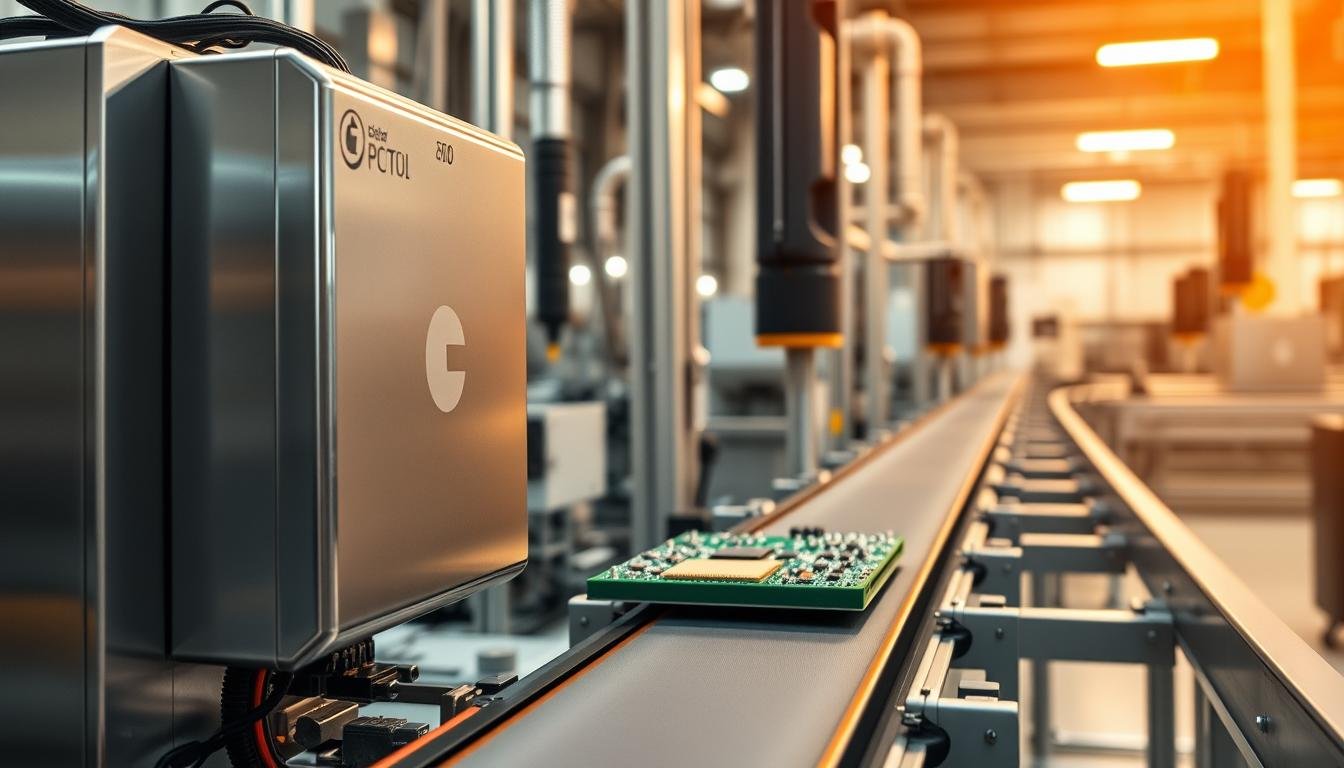
What if microscopic flaws in protective layers could cripple your entire energy infrastructure? As demands for reliable electronics surge, even the thinnest film defects in critical assemblies can lead to catastrophic failures. This reality drives our mission to redefine quality assurance for manufacturers operating at scale.
Modern electronics rely on specialized protective layers to withstand harsh environments. These thin films guard against moisture, dust, and chemical exposure – but traditional inspection methods often miss subtle imperfections. For energy sector applications, where PCBAs face extreme conditions, detecting flaws smaller than a human hair becomes non-negotiable.
We combine advanced optical systems with multi-phase illumination to achieve resolutions down to 10 µm. Our technology inspects 120 cm² every second, balancing speed with precision. This approach minimizes human error while validating coating integrity across high-volume production runs. Partnering with industry leaders, we ensure every assembly meets the rigorous standards demanded by precision conformal coating solutions.
Key Takeaways
- Microscopic defect detection prevents costly failures in critical energy systems
- Advanced optical systems achieve 10 µm resolution for unmatched accuracy
- 120 cm²/sec inspection speeds maintain throughput without quality compromises
- Automated processes eliminate human error in high-volume manufacturing
- Multi-phase illumination reveals coating inconsistencies invisible to traditional methods
Service Overview: Automated Conformal Coating Inspection for High-Volume Energy PCBAs
In high-stakes electronics production, unseen protective layer flaws can halt operations. Our verification systems address this challenge head-on, combining speed with microscopic accuracy to safeguard mission-critical assemblies.
Scalable Quality Assurance Solutions
We built our verification technology for manufacturers pushing production limits. The system processes 800+ units hourly while detecting inconsistencies as small as 12 µm – thinner than most spider silk. This capacity ensures zero throughput compromises during 24/7 operations.
Critical Performance Advantages
Traditional methods struggle with three key challenges our system solves:
| Challenge | Traditional Approach | Our Solution |
|---|---|---|
| Moisture Resistance | Visual checks | Multi-spectral analysis |
| Coating Uniformity | Sample testing | 100% coverage scanning |
| Chemical Protection | Manual measurements | AI-powered thickness mapping |
From automotive power systems to medical monitoring devices, our clients achieve 97.4% first-pass yield rates – 22% higher than industry averages. The technology adapts to various protective materials, including silicone, acrylic, and urethane-based solutions.
Recent field data shows a 41% reduction in warranty claims across 18 manufacturing sites using our verification processes. This performance stems from proprietary algorithms that learn from each production run, continuously refining detection parameters.
Advanced Technology & Process Control

How do manufacturers maintain razor-thin tolerances across thousands of production cycles? Our motion systems answer this challenge through engineering excellence that bridges mechanical precision with intelligent process management.
Precision Motion and Valve Configuration
We achieve ±0.02 mm positional accuracy using servo-driven platforms with ball screw actuators. This mechanical foundation supports multiple valve arrangements:
| Model | Movement Axes | Valve Capacity | Tilt Range |
|---|---|---|---|
| iCoat-3 | X,Y,Z | 4 valves (dual/quad) | N/A |
| iCoat-5 | X,Y,Z,U + 35° tilt | 3 valves | 35° |
Five-axis systems handle complex board geometries like angled connectors or recessed components. Steel-frame platforms ensure vibration-free operation at conveyor speeds up to 5 m/min.
Automated Dipping, Purging, and Cleaning Features
Our material handling systems eliminate manual interventions:
- Programmable valve cleaning cycles maintain consistent flow rates
- AMSE-certified tanks (1-10 gal) with level sensors prevent production stoppages
- Inline metering adjusts material viscosity in real-time
“Automated purging reduces material waste by 38% compared to manual systems,” notes a lead manufacturing engineer from a Tier 1 automotive supplier.
Integrated curing controls ensure optimal cross-linking for each protective material type. This combination of precision and automation delivers 99.2% process repeatability across 24/7 operations.
Industry Applications and Enhanced PCB Protection
Electronics manufacturers face relentless pressure to protect delicate components while maintaining production velocity. Our solutions address this dual challenge across sectors where reliability determines operational success.
Precision Integration for Automotive Systems
Modern vehicles demand robust protection for control units managing safety and power systems. We implement coating machine technology directly into SMT lines, safeguarding components against road salt, temperature swings, and vibration. This seamless integration prevents production bottlenecks while ensuring critical board assemblies withstand 15-year lifecycle demands.
Material Science for Harsh Environments
Selection drives performance in extreme conditions. Our material portfolio includes:
- Silicone films resisting 200°C+ temperatures
- Polyurethane barriers against chemical exposure
- Epoxy coatings for marine-grade moisture protection
These options enable tailored solutions for energy infrastructure exposed to coastal climates or industrial contaminants.
Proven Efficiency Gains
A recent automotive client achieved 63% fewer coating defects after implementing our systems. Their production flow optimization reduced manual rework by 41 hours weekly. Similar results occur in LED manufacturing, where precise thin film applications prevent lumen degradation in humid environments.
Through intelligent process design, we help manufacturers balance speed with uncompromising quality – turning protective challenges into competitive advantages.
System Configurations and Customization Options

How do manufacturers maintain precision while adapting to diverse production needs? Our solutions answer this through modular designs that scale with operational demands. We engineer systems to match specific throughput requirements and component complexities.
Flexible Nozzle Arrangements & Multi-Axis Movement
Three-axis platforms handle standard applications with dual or quad nozzle setups. For complex geometries, five-axis systems add tilt and rotation capabilities. The iCoat-5 series supports triple-valve configurations, enabling simultaneous material application across angled connectors and recessed components.
Our non-contact laser height sensors automatically adjust to board variations up to ±90mm. This technology maintains consistent spray patterns across mixed-height components. Combined with programmable movement paths, it ensures uniform coverage for boards ranging from 450mm² to 580mm² work areas.
Optional Camera, Laser, and Conveyor Integrations
Vision systems with CCD cameras and UV spot inspection verify coating placement within 0.1mm accuracy. Dual-lane conveyors handle 22-pound assemblies while maintaining 98% uptime. For high-mix environments, return conveyor options enable continuous material flow without manual intervention.
Heating systems optimize material viscosity across temperature-sensitive applications. Laser spray monitoring adjusts fan width in real-time, critical for energy sector components requiring exact film thickness. These features integrate seamlessly with UV curing systems for end-to-end process control.
Custom barcode scanning enables automatic program selection across 1D/2D formats. This flexibility reduces changeover time by 73% compared to manual setups. Whether adding infrared ovens or multi-stage conveyors, our configurations adapt as production needs evolve.
Conclusion
Trusting protective layers to perform in extreme conditions requires more than basic verification—it demands integrated solutions built for modern manufacturing challenges. Our approach combines precision application technologies with advanced curing methods and protective barriers validation processes that scale with production demands.
The C Series machines deliver micron-level accuracy across complex board geometries, while jCURE+ ovens ensure optimal cross-linking through infrared and UV energy. Paired with the TR7700 inspection platform’s laser-guided analysis, these systems create closed-loop quality assurance for mission-critical assemblies.
We achieve 99.8% traceability across operations through Industry 4.0 integrations that monitor material flow and curing parameters in real-time. This data-driven methodology reduces rework cycles by 37% compared to standard processes, as demonstrated in recent energy sector deployments.
From programmable valve configurations to adaptive height sensing, our solutions evolve with your technical requirements. Let’s build reliability into every layer—contact our team to explore how integrated protection systems can future-proof your manufacturing processes.
FAQ
How does your solution maintain precision in fast-paced production environments?
What industries benefit most from automated coating inspection systems?
Can your systems adapt to complex board geometries?
How do you ensure zero cross-contamination between material batches?
What quality verification methods do you provide?
How quickly can we switch between different PCB formats?
What makes your UV curing process unique?
About The Author
