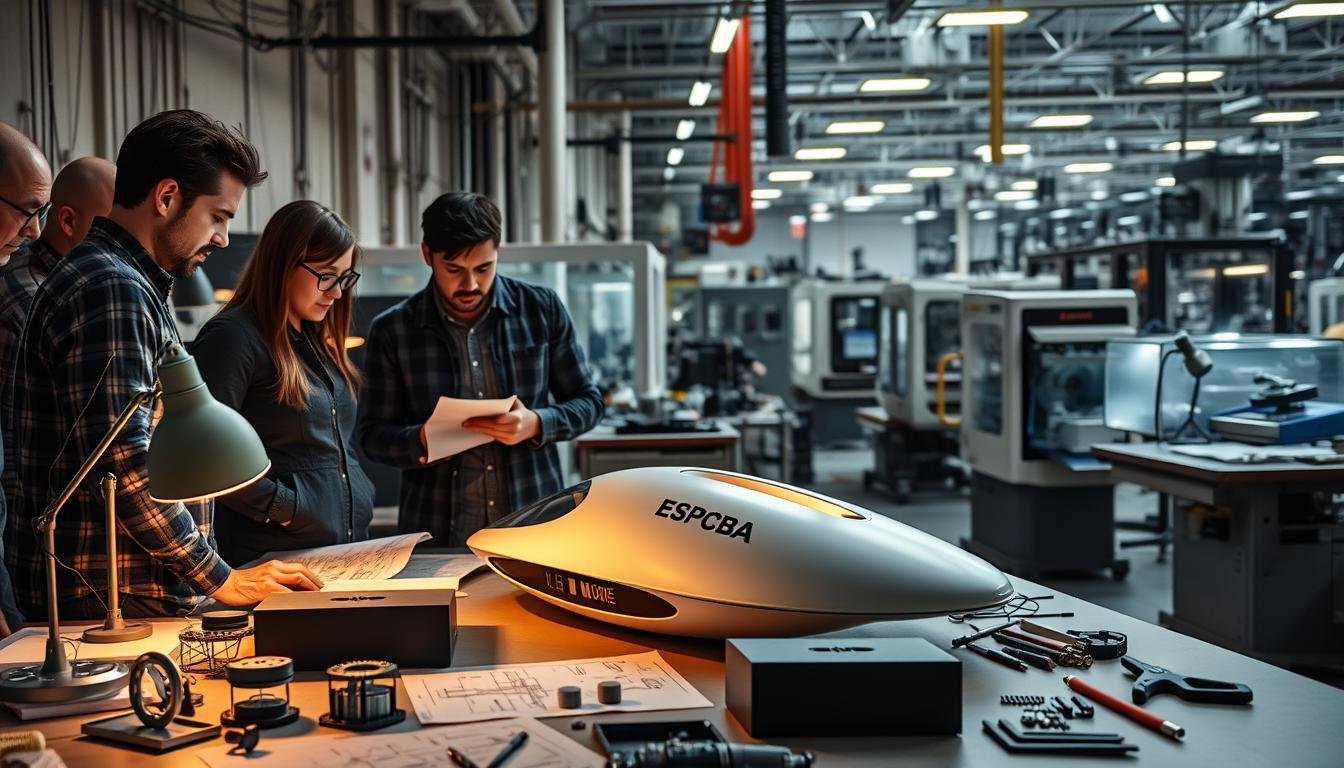
Can effective collaboration between designers and manufacturers be the key to unlocking product success? We believe it can. When designers work closely with manufacturing experts from the outset, the benefits are clear: reduced costs, increased profits, and a higher likelihood of market success.
Product design decisions have a profound impact on final product quality and manufacturing costs, influencing up to 80% and 75% respectively. By fostering a collaborative environment, we can ensure that products are designed with manufacturability in mind, streamlining the production process and improving overall quality.
As we explore in this article, the synergy between designers and manufacturers is crucial for driving innovation, quality, and market success. By understanding the intricacies of this relationship, companies can optimize their product development processes and create superior products.
Key Takeaways
- Collaboration between designers and manufacturers is critical for product success.
- Product design decisions significantly impact final product quality and manufacturing costs.
- Effective collaboration can reduce costs, increase profits, and improve product quality.
- Designing with manufacturability in mind streamlines the production process.
- Fostering a collaborative environment is essential for driving innovation and market success.
The Critical Relationship Between Design and Manufacturing
Effective product development relies heavily on the collaboration between designers and manufacturers. The decisions made during the design phase have a significant impact on the manufacturing process, influencing everything from production costs to product quality.
Impact on Manufacturing
Design decisions made early in the product development cycle have far-reaching consequences throughout the manufacturing process. These decisions affect material selection, assembly methods, and quality control procedures. For instance, a seemingly minor design choice, such as the position of a single screw, can increase production costs and compromise product quality.
- Design decisions influence material selection and assembly methods.
- Minor design choices can create significant production challenges.
- More than 40% of quality problems are directly related to inadequate product design.
Consequences of Disconnection
The cost of disconnection between design and manufacturing is substantial, resulting in production delays, increased material waste, higher labor costs, and potentially compromised product quality. Companies that maintain separate design and manufacturing operations without adequate communication channels often experience higher product development costs and longer time-to-market.
| Consequences | Description | Impact |
|---|---|---|
| Production Delays | Delays in production due to design-manufacturing disconnect | Higher costs and longer time-to-market |
| Increased Material Waste | Waste generated due to inefficient design | Increased production costs |
| Higher Labor Costs | Increased labor costs due to complex design | Higher production costs |
| Compromised Product Quality | Quality issues arising from poor design | Potential product failure and reputational damage |
Effective collaboration between designers and manufacturers is crucial to bridge the gap between theoretical design and practical manufacturing constraints. By working together, teams can identify potential issues before they become expensive problems, ensuring higher product quality and reduced production costs.
Understanding the Design-Manufacturing Chain (D-MC)
Understanding the Design-Manufacturing Chain (D-MC) is crucial for ensuring product quality and effective collaboration between designers and manufacturers. The D-MC represents the complete sequence of activities from initial concept development through final production, encompassing both design and manufacturing processes.
In today’s globalized economy, the D-MC often spans multiple organizations, with design and manufacturing functions frequently performed by different companies with specialized expertise. This complexity necessitates a clear understanding of the key components involved in the D-MC.
Key Components of the D-MC
The D-MC comprises several critical elements, including concept design, detailed engineering, process planning, prototype development, tooling creation, and production implementation. Each of these components represents a vital transition point where information must be effectively transferred to ensure seamless collaboration between designers and manufacturers.
- Concept design and detailed engineering lay the foundation for product development.
- Process planning and prototype development are crucial for testing and refining the product.
- Tooling creation and production implementation are essential for translating designs into final products.
How the D-MC Affects Product Quality
The D-MC significantly impacts product quality through multiple mechanisms. Design decisions influence manufacturability, while material selections affect durability. Moreover, production processes determine the consistency and reliability of the final product. By understanding the D-MC, organizations can identify vulnerabilities in the product development system and implement targeted improvements to enhance overall quality.
Effective management of the D-MC is essential for achieving high-quality products that meet customer requirements. By integrating design and manufacturing functions, companies can ensure that products are both well-designed and manufacturable, ultimately leading to improved customer satisfaction and reduced production costs.
The Product Development Process: Where Collaboration Begins
The product development process is the foundation where collaboration between designers and manufacturers begins. This process involves several stages, from concept to production design, each offering unique opportunities for integrating manufacturing expertise into design decisions.
Effective collaboration during product development is crucial for achieving high-quality products and reducing time-to-market. We have identified that organizations with formal collaborative processes typically achieve 15-20% faster time-to-market and significantly fewer design revisions.
Concept and Specification Stages
During the concept and specification stages, early manufacturer involvement is critical. Manufacturers can provide valuable insights into material availability, processing capabilities, and production technologies that might influence design direction. This stage shapes the product’s fundamental architecture and feasibility, setting the stage for successful production. For more information on how design influences manufacturing, visit our resource on learning the PCB manufacturing process from design to.
- Early manufacturer involvement helps identify technological constraints and opportunities.
- Manufacturers contribute insights on material and production technologies.
Detailed Design and Production Design Phases
The detailed design phase is a critical juncture where design intent must be translated into manufacturable specifications. Close collaboration between design and manufacturing teams is required to ensure that the product is both functional and manufacturable. Production design focuses on optimizing the product for efficient manufacturing, addressing tooling requirements, assembly sequences, and quality control methodologies.
- Detailed design requires close collaboration between design and manufacturing teams.
- Production design optimizes the product for efficient manufacturing.
Early Manufacturer Involvement: A Competitive Advantage
In today’s competitive market, Early Manufacturer Involvement (EMI) has emerged as a crucial strategy for companies seeking to optimize their product development process. By integrating manufacturing expertise early in the design phase, companies can reap significant benefits that impact their bottom line and market competitiveness.
Benefits of Early Supplier Involvement
Early Supplier Involvement (ESI) brings numerous advantages to the product development process. Research demonstrates that companies implementing EMI achieve significant competitive advantages, including 15-30% reductions in development time and 10-30% lower product costs. By engaging manufacturers during concept development, organizations gain access to specialized production knowledge that can identify potential manufacturing challenges before designs are finalized.
- Enhanced information and expertise regarding new ideas and technology
- Early identification of potential problems, improving the quality of the final product
- Elimination of rework and reduction of costs
- Substantial improvements in first-pass quality rates
Implementing ESI in Your Organization
To successfully implement ESI, organizations must commit to collaborative processes. This includes establishing shared design platforms, regular cross-functional meetings, and aligned incentive structures that reward joint optimization. Successful ESI implementation typically involves defining collaboration touchpoints throughout the development process and creating shared metrics that balance design innovation with manufacturing efficiency.
| Benefits of ESI | Implementation Strategies |
|---|---|
| 15-30% reduction in development time | Shared design platforms |
| 10-30% lower product costs | Regular cross-functional meetings |
| Improved first-pass quality rates | Aligned incentive structures |
Building a Successful Product: The Synergy Between Designer and Manufacturer
The collaboration between designers and manufacturers is crucial for developing successful products that are both innovative and profitable. At PI, we’ve seen firsthand how this synergy can lead to outstanding results. Our team of designers works closely with manufacturing experts to ensure that products are not only well-designed but also efficient to produce.
Creating Mutual Understanding
To achieve successful product development, it’s essential to establish a foundation of mutual understanding between designers and manufacturers. This begins with cross-training initiatives that give designers basic manufacturing knowledge and manufacturers insight into design principles and customer requirements. By doing so, both parties can appreciate each other’s expertise and constraints, leading to more effective collaboration.
- Cross-training programs help designers understand manufacturing processes and constraints.
- Manufacturers gain insight into design principles, customer needs, and market trends.
- Co-location of design and manufacturing teams during critical development phases enhances collaboration and problem-solving.
Establishing shared goals and metrics is vital to ensure alignment between design innovation and manufacturing efficiency. This involves creating balanced scorecards that measure both creative excellence and production practicality. By doing so, organizations can foster a culture that celebrates collaborative problem-solving and recognizes contributions from both designers and manufacturers equally.
- Balanced scorecards measure design innovation and manufacturing efficiency.
- Common terminology and documentation standards bridge the communication gap between design and manufacturing disciplines.
- Regular touchpoints throughout the development process integrate design and manufacturing perspectives, preventing late-stage conflicts.
By focusing on mutual understanding and shared goals, companies can create a collaborative environment that drives product success. This synergy between designers and manufacturers is key to developing products that are both innovative and profitable.
Communication Strategies for Effective Collaboration

In today’s fast-paced product development landscape, effective communication between designers and manufacturers is more critical than ever. We have observed that successful collaborations rely on a combination of technological tools and human-centered strategies to bridge disciplinary boundaries.
Effective communication forms the cornerstone of successful designer-manufacturer collaboration. To achieve this, companies are leveraging digital collaboration platforms that integrate CAD/CAM systems with production planning tools, creating a shared technical environment where design intent and manufacturing constraints can be visualized and resolved collaboratively.
Tools and Platforms for Designer-Manufacturer Communication
Cloud-based product lifecycle management (PLM) systems enable real-time collaboration between geographically distributed design and manufacturing teams, facilitating concurrent engineering practices that compress development timelines. We’ve seen that the most effective communication strategies combine formal documentation systems with regular face-to-face interactions, particularly during critical design reviews and manufacturing process planning.
| Tool/Platform | Description | Benefits |
|---|---|---|
| Digital Collaboration Platforms | Integrate CAD/CAM systems with production planning tools | Improved design-manufacturing collaboration, reduced errors |
| Cloud-based PLM Systems | Enable real-time collaboration between design and manufacturing teams | Compressed development timelines, improved concurrent engineering |
| Visual Communication Tools | Utilize digital prototyping, simulation, and augmented reality technologies | Reduced misinterpretation, accelerated decision-making |
Overcoming Communication Barriers
Overcoming communication barriers requires addressing both technical vocabulary differences and cultural perspectives that can create misunderstandings between design and manufacturing disciplines. To achieve this, we recommend establishing communication protocols that define when and how design changes are communicated to manufacturing teams, preventing costly disconnects and ensuring production planning can adapt to evolving design requirements.
To facilitate effective collaboration, we suggest using visual communication tools such as digital prototyping, simulation, and augmented reality technologies to translate abstract design concepts into manufacturing realities. For more information on collaborating with manufacturers, visit https://ajgfashionconsulting.com/blog/collaborate-with-manufacturer.
Quality Management Across the Design-Manufacturing Chain
A well-integrated quality management system is key to success in the design-manufacturing chain. We recognize that quality management across this chain requires a comprehensive approach that acknowledges the distinct yet interdependent nature of design quality and manufacturing quality.
Design Quality vs. Manufacturing Quality
Design quality focuses on how well specifications meet customer requirements, while manufacturing quality addresses how accurately production processes realize those specifications in the final product. As noted in a study on quality management, “conformance to requirements” is a critical aspect of quality (source). This dichotomy highlights the need for a balanced approach to quality management that considers both design and manufacturing aspects.
Integrated Quality Control Approaches
Effective quality management systems span the entire design-manufacturing chain, with shared responsibility and collaborative problem-solving. We have identified several key strategies for integrated quality control, including:
- Implementing verification and validation activities at key transition points in the design-manufacturing process.
- Utilizing methodologies like Design for Six Sigma (DFSS) and Advanced Product Quality Planning (APQP) to integrate quality considerations throughout the product development process.
- Leveraging digital twin technologies to enable virtual testing and validation of both design concepts and manufacturing processes.
Organizations that implement integrated quality management across the design-manufacturing chain typically achieve significant reductions in defect rates and warranty costs. By adopting these strategies, companies can ensure high-quality products that meet customer requirements and reduce the risk of quality issues downstream.
Challenges in Designer-Manufacturer Relationships and Solutions

Effective collaboration between designers and manufacturers is crucial for product success, yet their relationship is often fraught with challenges. With over 40 years of experience in the industry, we’ve seen firsthand the tension that can arise between these two disciplines. Designers focus on form, function, and usability, while manufacturers prioritize production efficiency and cost control.
Common Points of Friction
Several factors contribute to the friction between designers and manufacturers. These include:
- Different priorities and technical languages
- Timing misalignments, such as design changes after manufacturing planning has begun
- Geographical and cultural separation, particularly in global supply chains
These differences can lead to misunderstandings and disruptions in the product development process. For instance, designers may prioritize aesthetic and functional innovation, while manufacturers focus on production efficiency and cost control, creating natural tension in decision-making.
Strategies for Alignment and Conflict Resolution
To overcome these challenges, successful organizations implement strategies for alignment and conflict resolution. These include:
- Joint training programs and cross-functional career paths
- Leadership that equally values design excellence and manufacturing efficiency
- Data-driven decision matrices to weigh design intent against manufacturing constraints
- Formal escalation pathways for resolving conflicts promptly and systematically
By adopting these strategies, companies can foster a more collaborative environment and improve the overall quality of their products. For more insights on design and manufacturing collaboration, visit our academy resources.
| Challenge | Solution |
|---|---|
| Different priorities | Joint training programs |
| Timing misalignments | Data-driven decision matrices |
| Geographical separation | Formal escalation pathways |
Conclusion
In the competitive world of product development, the partnership between designers and manufacturers plays a vital role in determining market success. Throughout this article, we’ve explored how early collaboration between design and manufacturing teams creates substantial benefits across multiple dimensions of product performance and business results. By working together from the outset, designers and manufacturers can create products that are not only of high quality but also profitable to produce.
Effective designer-manufacturer relationships require deliberate management, appropriate communication tools, and shared quality systems. As manufacturing capabilities continue to evolve with advanced technologies, the designer-manufacturer relationship will become even more critical in leveraging these capabilities for competitive advantage. Companies seeking to improve their product development performance should assess their current collaboration state, identify barriers, and implement targeted improvements.
We encourage organizations to view the designer-manufacturer relationship as a strategic partnership that creates significant value through better products, faster development cycles, and more efficient use of resources. By breaking down traditional boundaries between design and manufacturing, companies can create integrated teams with shared objectives and complementary skills, ultimately driving market success.
FAQ
What is the importance of collaboration between designers and manufacturers in product development?
How do design decisions impact manufacturing processes?
What are the benefits of Early Supplier Involvement (ESI) in product development?
What are the key components of the Design-Manufacturing Chain (D-MC)?
How can designers and manufacturers overcome communication barriers?
What are the common points of friction between designers and manufacturers?
How can integrated quality control approaches improve product quality?
What role does quality management play in the design-manufacturing chain?
About The Author
