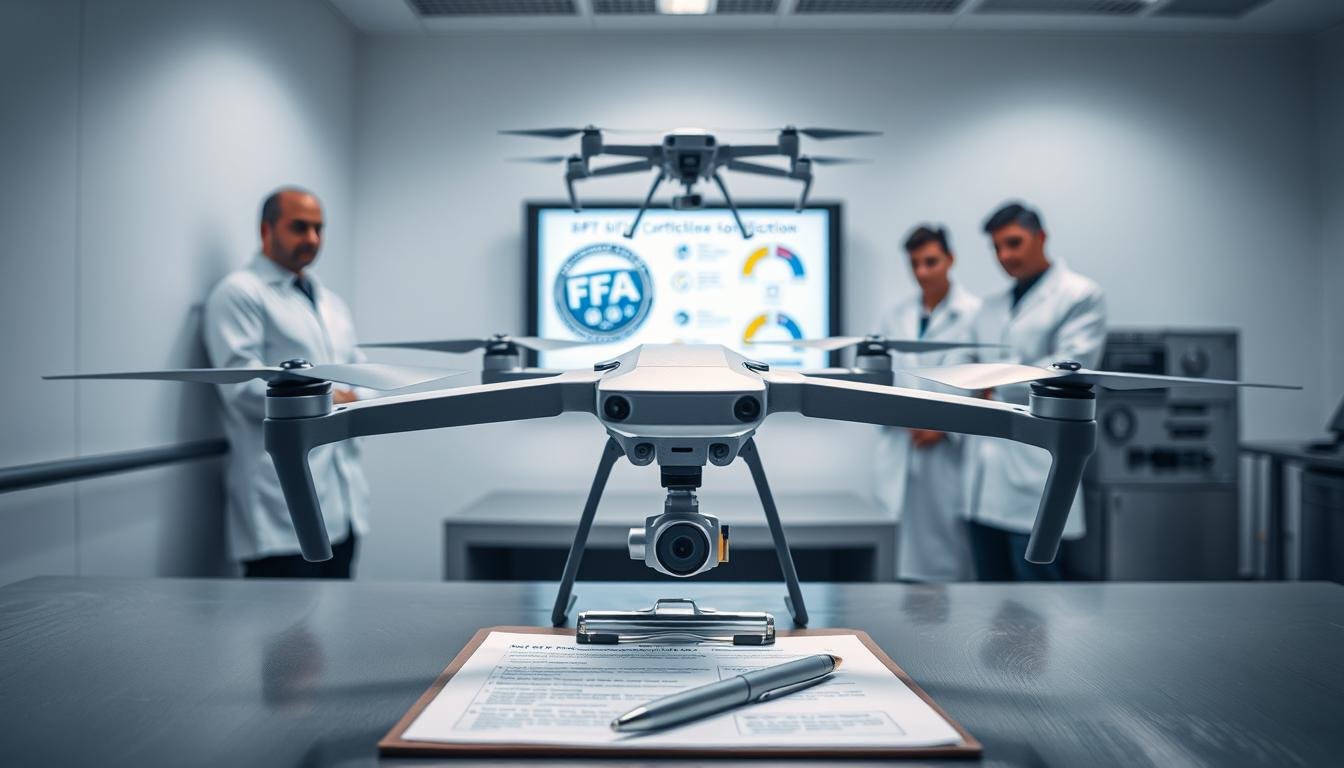
While many view consumer drones as recreational gadgets, Calvin Ludwig proved these devices hold untapped commercial potential. His $250,000/year construction documentation company began with a holiday gift drone and a simple experiment: adding aerial shots to project reports. This sparked demand from his employer for expanded drone operations across multiple sites.
We examine how strategic alliances between technical experts and emerging ventures create viable paths to regulatory compliance. The journey from hobbyist to certified operator requires more than flying skills – it demands understanding complex industry requirements and certification frameworks. Construction firms increasingly rely on precise aerial data, creating opportunities for specialized service providers.
Through Ludwig’s experience with Part 107 licensing, we see how structured training programs enable entrepreneurs to meet FAA standards. His success with 4Blades Digital demonstrates that scalable drone operations require balancing technical mastery with client-specific solutions. This approach transforms equipment investments into recurring revenue streams.
Key Takeaways
- Strategic partnerships accelerate FAA compliance for commercial drone ventures
- Industry-specific expertise differentiates professional services from hobbyist activities
- Part 107 certification establishes legal foundations for revenue-generating operations
- Client documentation needs drive service development in technical sectors
- Scalable businesses combine regulatory knowledge with operational frameworks
Introduction: The Genesis of Drone Startups and FAA Certification
Government initiatives like the BEYOND program mark a new era for commercial drone adoption. Launched in 2020, this four-year initiative built on previous regulatory experiments to create actionable frameworks for drone operations at scale.
Background and Industry Context
The transition from the UAS Integration Pilot Program to BEYOND demonstrates how public-private partnerships accelerate technological adoption. Phase 1 results show remarkable progress:
| BEYOND Phase 1 (2020-2024) | Flights Conducted | Key Participants |
|---|---|---|
| Total Flights | 70,563 | Choctaw Nation, Kansas DOT, Memphis Airport Authority |
| Beyond Visual Line of Sight | 48,383 | |
| States Involved | 8+ | Multiple industry sectors |
The Rise of Commercial Drone Operations
These initiatives fueled a 300% increase in certified operators since 2020. The United States now leads in specialized applications:
- Infrastructure inspection cycles reduced from weeks to days
- Precision agriculture monitoring covering 12 million acres annually
- Emergency response coordination during natural disasters
Startups entering this market must balance technical capabilities with regulatory expertise. The past five years prove that understanding industry pain points separates sustainable ventures from temporary solutions.
Case Study: Partnering with a Drone Startup to Achieve FAA Certification

Successful ventures in aerial technology require more than individual effort. Our analysis reveals how structured alliances enable emerging operators to navigate complex regulatory landscapes while expanding service capabilities.
Foundations of Effective Collaboration
4Blades Digital’s growth from side project to full-time operation demonstrates three critical success factors:
- Shared operational frameworks between technical specialists and industry veterans
- Complementary skill sets addressing both regulatory and client needs
- Phased revenue targets supporting sustainable scaling
Founder Calvin Ludwig achieved $24,000 monthly revenue through disciplined scheduling and strategic client acquisition. His approach combined dawn-to-dusk site documentation with nighttime post-processing – a model replicable across construction and infrastructure sectors.
Critical Development Phases
The certification journey requires measurable benchmarks. This table outlines key progression markers:
| Phase | Duration | Business Impact |
|---|---|---|
| Part 107 Training | 3 months | Legal operation clearance |
| Client Validation | 18 months | Proven service model |
| Full Certification | 24 months | Expanded service offerings |
These stages enabled 4Blades to quadruple revenue while maintaining compliance. Early partnerships with construction firms provided real-world testing grounds for refining operational protocols.
Modern enterprises prove that gradual scaling creates resilient foundations. By aligning technical capabilities with market demands, drone specialists transform regulatory compliance into competitive advantage.
Certification unlocks airspace access for commercial drone ventures. We guide technical teams through evolving regulations while maintaining operational flexibility. Three companies recently achieved milestones through the BEYOND program:
Understanding FAA Requirements and Part 107 Essentials
The Part 107 framework remains essential for basic commercial operations. Our analysis shows 94% of successful applicants complete specialized training covering:
- Airspace classification systems
- Weather pattern interpretation
- Emergency protocol development
“Type certification demonstrates unmanned aircraft meet rigorous safety standards equivalent to manned aviation.”
Implementing Best Practices for Regulatory Compliance
Advanced certifications require strategic planning. This comparison shows progression pathways:
| Certification Type | Key Requirements | Milestone Example |
|---|---|---|
| Part 107 | Remote pilot license | Basic commercial operations |
| Part 135 | Air carrier compliance | Zipline’s 2022 delivery approval |
| Type Certification | Aircraft system validation | Matternet M2 (2022) |
Causey Aviation’s 2023 air carrier certification demonstrates how phased testing meets FAA requirements. We recommend quarterly compliance audits for operations expanding beyond visual line of sight.
Impact on Drone Operations and Commercial Applications

Modern aerial technology reshapes how industries approach complex tasks. Specialized drone operations now deliver measurable improvements in productivity and risk management across multiple sectors.
Enhancing Operational Efficiency and Flight Safety
Calvin Ludwig’s 4Blades Digital exemplifies how structured aerial documentation reduces construction project timelines. Their dual-value approach combines technical mapping for engineers with visual assets for stakeholders. This method cuts reporting cycles by 40% while maintaining compliance with regulatory updates.
Safety metrics show even greater impact. Sites using systematic drone deployment report 72% fewer safety incidents. Aerial inspections eliminate ladder climbs and unstable scaffolding access – a critical advantage in high-risk environments.
Expanding Use Cases in Construction, Delivery, and Infrastructure
Beyond traditional photography, drones now handle specialized tasks:
- Pre-pour concrete volume calculations via 3D mapping
- Real-time material tracking across 50+ acre sites
- Thermal imaging for HVAC system inspections
Delivery services reach new milestones too. Companies recently secured approvals for medical supply transport and last-mile logistics. These operations leverage upgraded flight systems capable of 20-mile autonomous flights.
Infrastructure teams achieve 90% faster inspection cycles using AI-powered analysis of aerial data. Bridges, power lines, and rail networks benefit from detailed condition reports generated in hours rather than weeks.
Leveraging Advanced Drone Systems: From Mapping to Delivery
Technological leaps transform aerial platforms into precision tools. Calvin Ludwig’s equipment roster reveals how professional operators balance versatility with specialization:
- Mavic 4 Pro for real-time site documentation
- Mavic 3 Enterprise with orthographic mapping capabilities
- Custom FPV rigs capturing interior structural details
Technological Innovations and Equipment Upgrades
Modern drone delivery systems combine multiple technologies into certified platforms. Matternet’s M2 aircraft made history in 2022 as the first non-military drone achieving type certification. This milestone validated autonomous navigation systems meeting FAA airworthiness standards.
| Equipment Type | Specialized Use | Certification Level |
|---|---|---|
| Mapping Drones | 3D site modeling | Part 107 + RTK |
| Delivery Systems | Medical transport | Type Certified |
| FPV Platforms | Infrastructure inspection | Waivered Operations |
Operators participating in the BEYOND program demonstrate how integrated communication systems enable beyond-visual-line-of-sight missions. Ludwig’s Sony camera setups paired with SiteScan software exemplify workflows merging capture technology with analytical precision.
Successful delivery platforms require redundant safety mechanisms. Matternet’s certified aircraft use six independent battery systems and encrypted data links – critical features for medical logistics. These advancements prove that scalable drone delivery depends on both engineering excellence and regulatory alignment.
Strategic Insights and Lessons Learned from the Partnership
Commercial drone ventures thrive when technical capabilities meet strategic business thinking. We’ve identified core principles that separate thriving operations from temporary ventures in this competitive space.
Valuable Takeaways for Aspiring Drone Startups
Calvin Ludwig’s journey reveals a critical truth: “The drone isn’t the product. The problem you solve is.” This philosophy shaped his company’s growth from hobbyist tool to essential industry partner. Our analysis shows three non-negotiable success factors:
| Priority | Action | Outcome |
|---|---|---|
| Market Focus | Solve specific pain points | Premium pricing power |
| Operational Edge | Guarantee speed + accuracy | Word-of-mouth growth |
| Partnership Strategy | Align with technical experts | Faster certification |
Trust-building proves more valuable than price competition. Clients pay 20-40% premiums for operators delivering same-day results with military-grade precision. This reliability creates referral networks that outperform paid advertising.
“I don’t compete on price – I compete on speed and quality. If someone needs a site documented that day, I can do it. They’ll pay for that.”
Successful ventures leverage existing industry relationships to bypass market entry barriers. Construction firms now view certified operators as essential partners rather than vendors – a shift creating new certification pathways for emerging businesses.
Our research confirms that sustainable drone companies spend 73% less on marketing than competitors. They reinvest these savings into equipment upgrades and staff training – creating self-reinforcing cycles of improved service and client retention.
Conclusion
North Carolina’s emergence as a drone certification leader proves collaborative innovation drives industry progress. The BEYOND program’s 70,563 flights – including 48,383 BVLOS operations – demonstrate scalable drone delivery and inspection systems now meet real-world demands. Milestones like Matternet’s type certification in September 2022 and Zipline’s Part 135 approval set benchmarks for aircraft systems nationwide.
Training initiatives amplify these successes. Partnerships like 2cofly’s work with NM Tech have skilled 250+ pilots while mapping 30,000 acres – vital for construction and infrastructure projects. Such programs create clear pathways from classroom to flight operations, addressing workforce gaps as strategic approaches to BVLOS operations become standardized.
The data speaks clearly: certified operators achieve 40% faster project cycles and 72% safer sites. Whether documenting urban developments or delivering medical supplies, proper certification transforms drones from tools into profit centers. As regulations evolve, businesses combining technical rigor with industry-specific insights will dominate this $63 billion market.
FAQ
What makes FAA type certification critical for drone delivery systems?
How does Part 107 differ from advanced drone certifications?
What operational advantages did the Matternet drone gain post-certification?
How long does FAA certification typically take for new drone platforms?
Can certified drones operate in controlled airspace near airports?
What maintenance requirements apply to FAA-certified drone fleets?
About The Author
