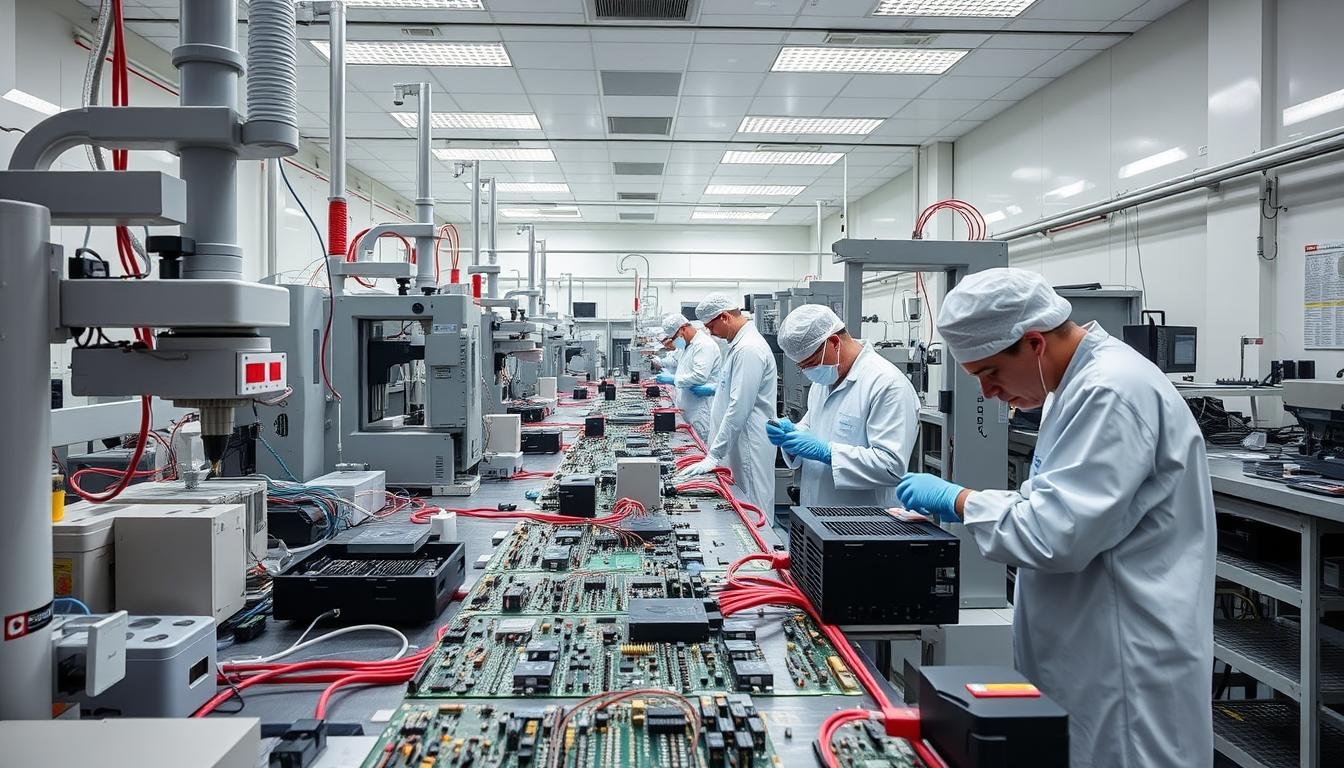
In today’s high-stakes electronics manufacturing environment, the demand for high-reliability assemblies is ever-increasing. The IPC-A-610 standard sets the benchmark for evaluating the quality of assembled PCBs, categorizing them into three classes based on their quality and reliability requirements.
At our company, we’ve developed comprehensive systems and processes that consistently deliver electronic assemblies meeting the most stringent IPC Class3 requirements. Our approach combines specialized manufacturing techniques, rigorous quality control, and expert team training to ensure every assembly meets the exacting standards required for high-reliability applications.
Key Takeaways
- Understanding the importance of Class3 quality in electronics manufacturing.
- Our methodologies for achieving high-reliability assemblies.
- The role of IPC Class3 requirements in ensuring assembly quality.
- How our quality control processes contribute to reliable electronics.
- The significance of adhering to stringent industry standards.
Understanding IPC Class 3 Standards and Requirements
Achieving IPC Class 3 standards is a hallmark of excellence in electronics manufacturing, reflecting a commitment to the highest levels of quality and reliability. As we navigate the intricacies of high-reliability electronics, understanding these standards is crucial.
What Defines Class 3 Electronic Assemblies
Class 3 electronic assemblies are characterized by their exceptional performance and durability, making them suitable for critical applications where failure could have severe consequences. “The highest level of quality is not just a goal, but a necessity,” especially in industries like aerospace and medical devices. To meet IPC Class 3 standards, our manufacturing processes must adhere to stringent requirements, including precise component placement and solder joint formation.
Key Differences Between Class 2 and Class 3 Standards
The transition from Class 2 to Class 3 standards represents a significant leap in quality requirements and manufacturing precision for printed circuit boards (PCBs). While Class 2 allows for certain imperfections, Class 3 demands near-perfection, particularly in areas like solder joint formation, where 100% wetting coverage is required. Our processes are designed to meet these heightened requirements, ensuring our Class 3 assemblies consistently meet the stringent standards that differentiate them from standard Class 2 production.
Some key differences include tighter component placement tolerances, often as precise as 0.1mm, and 100% inspection of all critical features. By adopting these rigorous standards, we ensure that our electronics meet the highest levels of performance and reliability, making them suitable for the most demanding applications.
Critical Applications That Require Class 3 Quality
Class3 quality is crucial for various high-reliability applications across different industries. We manufacture Class3 PCBs that are implemented in everything from computers in commercial aircraft and military applications to precision medical equipment and automobile braking systems.
Aerospace and Military Applications
In the aerospace and military sectors, reliability is critical for mission success and safety. Our Class3 PCBs are designed to withstand the harshest environments and are used in various applications, including avionics, radar systems, and military communications equipment.
Medical Devices and Life-Support Systems
Medical devices and life-support systems require the highest level of class quality to ensure patient safety and prevent medical errors. We manufacture Class3 PCBs for medical devices such as defibrillators, pacemakers, and diagnostic equipment, where reliability is paramount.
Other High-Reliability Applications
Beyond aerospace and medical applications, Class3 quality is essential for numerous other systems where reliability directly impacts safety and critical operations. Some examples include:
- Industrial control systems that manage critical infrastructure, such as power generation facilities and water treatment plants.
- Transportation systems, particularly safety-critical components like automobile braking systems and railway signaling equipment.
- Financial and data security systems that protect sensitive information and transactions.
Our expertise in Class3 manufacturing has positioned us as a trusted partner across multiple industry sectors where system failure would have severe consequences.
Our Specialized Manufacturing Processes for Class 3 Assemblies
We utilize cutting-edge manufacturing processes to ensure our assemblies meet the rigorous standards of Class3 quality. Our approach involves a combination of advanced techniques and strict protocols to guarantee the highest reliability and performance in our printed circuit boards (PCBs).
Component Selection and Verification
We maintain a rigorous component selection and verification process. This involves sourcing components from reputable suppliers and verifying their authenticity and quality before assembly. Our quality control measures ensure that only reliable components are used in our Class3 assemblies.
Advanced Soldering Techniques
Our manufacturing processes incorporate advanced soldering techniques to ensure strong and reliable connections. We use specialized soldering agents and methods that are designed to minimize the risk of defects and ensure the long-term reliability of our PCBs. This is crucial in high-reliability applications where failure is not an option.
Cleanliness and Contamination Control
Cleanliness is paramount in the production of Class3 assemblies. Residues from flux or other contaminants can cause corrosion or short circuits over time. We employ multi-stage cleaning processes and use state-of-the-art equipment to verify that our assemblies meet or exceed the stringent cleanliness requirements for Class3 certification.
| Process | Description | Benefit |
|---|---|---|
| Controlled Manufacturing Environment | Strict protocols for cleanliness exceeding industry standards | Reduced risk of contamination |
| Multi-Stage Cleaning | Removal of flux residues and potential contaminants | Enhanced long-term reliability |
| Specialized Cleaning Agents | Specifically developed for high-reliability applications | Complete removal of ionic and non-ionic contaminants |
Quality Control Measures That Ensure Class 3 Compliance

Ensuring compliance with IPC Class3 standards requires rigorous quality control measures throughout the manufacturing process. Our approach to quality control is comprehensive, covering inspection protocols, testing methodologies, and meticulous documentation and traceability systems.
Inspection Protocols and Equipment
We utilize advanced inspection equipment to scrutinize every aspect of our assemblies. Our inspection protocols are designed to detect even the smallest defects, ensuring that every component meets the stringent Class3 standards. This includes Automated Optical Inspection (AOI) and X-ray inspection to identify potential issues that are not visible to the naked eye.
Testing Methodologies for High-Reliability Assemblies
Our testing methodologies are tailored to validate the reliability and performance of our assemblies under various conditions. We conduct environmental stress testing, functional testing, and other specialized tests to ensure that our products can withstand the demands of their intended applications. These tests help us identify and rectify any weaknesses, thereby enhancing the overall quality of our assemblies.
Documentation and Traceability Systems
We maintain detailed documentation and traceability systems that provide a comprehensive record of every Class3 assembly, from raw materials to finished products. Our systems ensure that every component is tracked back to its original manufacturer, including lot codes and date codes. This level of traceability not only meets Class3 requirements but also provides our customers with complete verification of compliance with their specific quality standards.
Team Training and Certification Requirements
In the realm of high-reliability electronics manufacturing, team training and certification are not just important, they are essential. Ensuring that our team is equipped with the latest knowledge and skills is crucial for maintaining the high standards required for IPC Class 3 assemblies.
Team Training and Certification Requirements
Our team undergoes rigorous training programs that are designed to meet the stringent requirements of IPC Class 3 standards. This includes comprehensive certification programs that ensure our team is well-versed in the latest manufacturing techniques and quality control measures.
Process Validation and Continuous Improvement
We implement a robust process validation protocol to ensure that all manufacturing processes meet the required standards for IPC Class 3. This involves continuous monitoring and improvement of our processes to maintain the highest level of quality and reliability.
Supplier Management and Material Control
Ensuring continuity of Class throughout the supply chain is vital. As emphasized by industry experts, “if you are assembling your components to IPC Class 3, but your printed circuit board is only manufactured to IPC Class 1, then your overall product can only be classified as IPC Class 1.” To avoid this, we implement a comprehensive supplier management program that includes:
- On-site audits to verify supplier capabilities.
- Quality system verification to ensure suppliers meet our high standards.
- Ongoing performance monitoring to maintain consistent quality.
- Strict material control procedures, including segregated storage for Class 3 materials.
This rigorous approach creates an unbroken chain of quality from raw materials to finished assemblies, ensuring the highest level of reliability for our PCBA solutions.
“The key to achieving high-reliability electronics manufacturing lies in the details of team training, process validation, and supplier management.”
Overcoming Common Challenges in Class 3 Manufacturing

To ensure high-reliability assemblies, we have implemented robust systems to overcome common Class3 manufacturing challenges. Class3 standards are the most stringent, requiring meticulous attention to detail during manufacturing and testing.
Addressing Design Complexities
Design complexities can hinder the production of high-reliability assemblies. We work closely with designers to optimize their designs for manufacturability, ensuring that the final product meets Class3 standards. For more information on design considerations, visit our page on cleanliness requirements for assembled PCBs.
Managing Increased Production Time and Costs
Class3 manufacturing often requires more time and resources. We’ve optimized our processes to minimize delays while maintaining the highest quality. Our efficient systems help manage costs without compromising on reliability.
Maintaining Consistency Across Production Runs
Consistency is key in Class3 manufacturing. We’ve developed robust systems to ensure consistency across all production runs. Our documented work instructions and process controls eliminate variability, ensuring every assembly meets the same exacting standards. We maintain detailed process records and conduct regular process capability studies to verify that our manufacturing processes consistently meet Class3 requirements.
By focusing on these areas, we ensure that our customers receive high-quality, reliable products that meet their specific needs.
The Business Benefits of Class 3 Quality Capabilities
Our commitment to Class3 quality has far-reaching implications for our business. By achieving this level of quality, we not only enhance our manufacturing processes but also open up new opportunities in the market.
Access to High-Value Markets and Industries
Being certified to Class3 standards demonstrates our commitment to quality, setting us apart in a competitive market. This certification streamlines our supply chain, as many clients prefer working with certified manufacturers to ensure consistency, reducing the need for additional incoming inspections on their end.
Reduced Field Failures and Warranty Claims
Our adherence to Class3 quality capabilities results in more reliable products, leading to reduced field failures and warranty claims. This reliability is crucial for our customers, who depend on our assemblies for critical applications.
Building a Reputation for Excellence
Our commitment to Class3 quality has established our reputation as a premier manufacturer of high-reliability electronic assemblies. This reputation for excellence attracts customers who value quality and reliability. We are recognized as a trusted partner within the industry, and our expertise positions us as thought leaders in high-reliability electronics manufacturing.
- Our commitment to Class3 quality has established our reputation as a premier manufacturer.
- This reputation attracts customers who value quality and reliability.
- We are a trusted partner for companies whose reputation depends on the reliability of their products.
By maintaining Class3 quality capabilities, we continue to strengthen our position in the market, attracting new customers and reinforcing our relationships with existing ones.
Conclusion: Excellence in High-Reliability Electronics Manufacturing
Our journey through the world of Class3 electronics manufacturing highlights the importance of precision and quality control. At the heart of this process is the IPC-A-610 standard, a powerful tool for ensuring quality in electronic assembly.
We’ve demonstrated our commitment to Class3 quality, representing the pinnacle of excellence in high-reliability electronics manufacturing. Our comprehensive approach encompasses every aspect of the manufacturing process, from component selection to final assembly and testing. The investment we’ve made in specialized equipment, IPC certification, and team training enables us to consistently deliver products that exceed customer expectations for quality and reliability.
While Class3 manufacturing requires more time and attention to detail than standard consumer electronics production, the resulting assemblies provide unmatched performance and longevity in critical applications. We continue to refine our processes and capabilities, staying at the forefront of high-reliability electronics manufacturing to serve industries ranging from aerospace and defense to medical devices and industrial controls.
Our track record of minimal field failures and satisfied customers demonstrates the real-world value of our Class3 manufacturing expertise. Whether you’re designing a new product that requires Class3 quality or seeking to improve the reliability of an existing design, we have the knowledge and capabilities to help you succeed. We invite you to experience the difference that true Class3 manufacturing excellence can make for your most critical electronic assemblies.
FAQ
What are the key differences between IPC Class 2 and Class 3 standards for electronic assemblies?
What types of applications require IPC Class 3 quality electronic assemblies?
How do manufacturers ensure cleanliness and contamination control in Class 3 assembly production?
What inspection protocols and equipment are used to ensure IPC Class 3 compliance?
How do manufacturers validate their processes for producing IPC Class 3 assemblies?
What are the benefits of having IPC Class 3 quality capabilities for a manufacturing business?
What role does supplier management play in maintaining IPC Class 3 quality?
Can you provide examples of high-reliability applications that require IPC Class 3 quality?
About The Author
