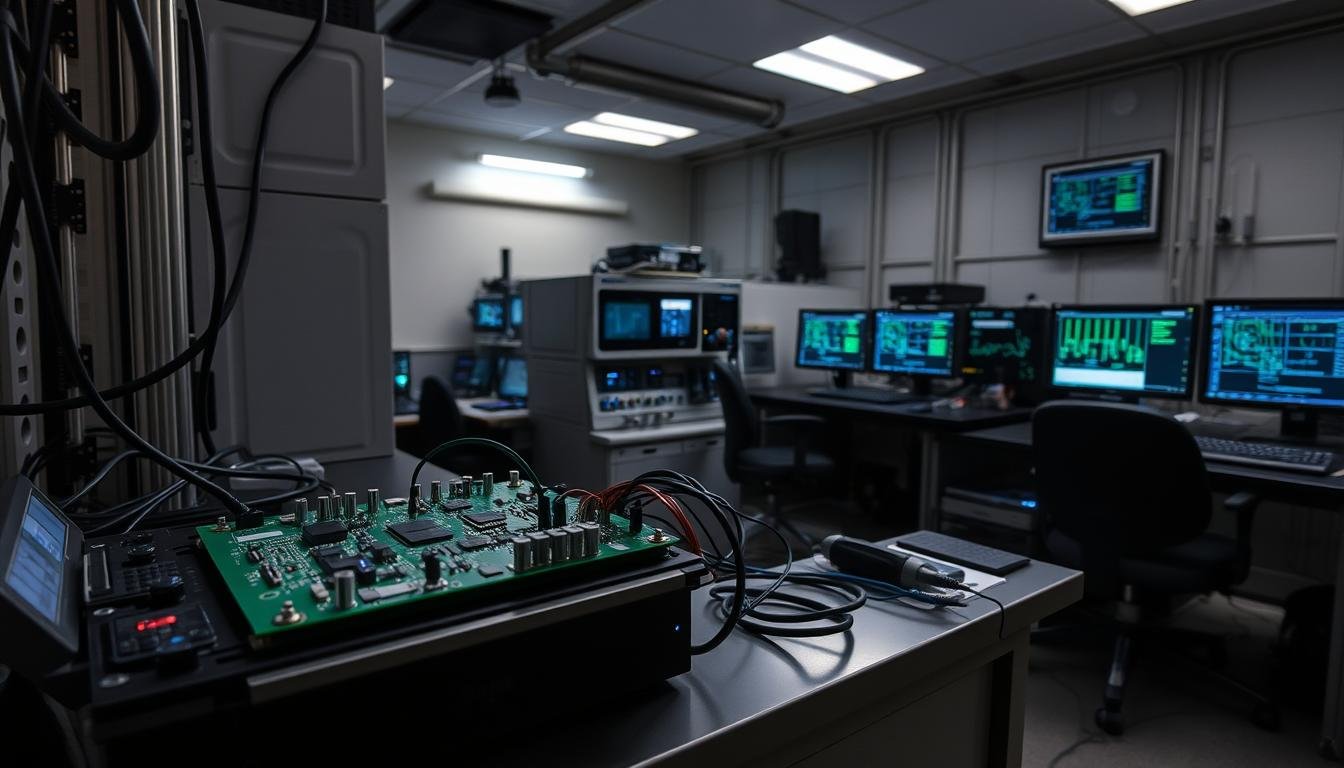
Could your product’s success hinge on weaknesses hidden in plain sight? Modern electronics face unprecedented demands, especially in fields like avionics and defense, where a single PCB flaw can compromise entire systems. Traditional quality checks often miss issues that emerge only under extreme, sustained stress — gaps that become apparent too late.
Thorough testing protocols simulate real-world conditions to expose vulnerabilities before deployment. By pushing assemblies to their operational limits, engineers uncover thermal stress points, material fatigue, and electrical instabilities invisible during standard inspections. This proactive approach transforms reliability from a buzzword into measurable performance.
Advanced analysis techniques now map failure modes with surgical precision. Environmental simulations replicate years of power cycling in weeks, while data-driven insights predict longevity under specific loads. For mission-critical applications, this depth of validation isn’t optional — it’s what separates functional prototypes from field-ready solutions.
Key Takeaways
- Mission-critical applications demand failure-proof electronics
- Real-world simulations expose hidden design weaknesses
- Thermal and electrical stress tests predict long-term performance
- Industry-standard protocols merge with cutting-edge diagnostics
- Collaborative partnerships optimize product lifespans
Introduction to PCB Power Cycling & Reliability Testing
Electronic systems face relentless demands in mission-critical environments. Power cycling acts as an accelerated aging process, revealing weaknesses that static inspections miss. This evaluation method subjects components to repeated activation sequences mirroring actual operational patterns.
Defining PCB Power Cycling
Power cycling systematically activates and deactivates circuits to simulate years of service in condensed timelines. Each transition generates thermal gradients that stress solder connections and conductive pathways. These controlled stress events expose:
- Material expansion mismatches between components
- Micro-fractures in copper traces and via walls
- Intermittent connection failures during temperature swings
Importance of Reliability in Critical Applications
Avionics systems and medical equipment demand zero-tolerance performance standards. A single compromised connection in flight controls or patient monitors can have irreversible consequences. Rigorous qualification processes verify assemblies withstand:
- Extreme temperature fluctuations (-55°C to 125°C)
- High-G vibration profiles matching field conditions
- Continuous electrical loads exceeding nominal ratings
Proactive identification of failure modes during development prevents costly recalls and maintains operational integrity. Our validation processes align with MIL-STD-810 and IPC-9701 standards, ensuring components meet stringent industry requirements.
Understanding Full Load Testing Fundamentals
Modern electronics endure harsh realities beyond controlled lab environments. Full load evaluation combines multiple stressors to mirror actual operational demands, creating a proving ground for hidden vulnerabilities.
Key Environmental and Electrical Stress Factors
Effective validation requires synchronized simulations of four primary challenges:
- Thermal extremes from -65°F to 257°F induce material expansion mismatches
- 90% relative humidity levels accelerate corrosion in exposed conductors
- 15G vibration profiles replicate transportation and operational shocks
Electrical stressors include sustained 125% rated current loads and rapid voltage fluctuations. These combined assaults expose weaknesses invisible during single-factor checks.
Advanced testing methods follow MIL-STD-202G and IPC-TM-650 protocols. Multi-axis shakers simulate real-world vibration while thermal chambers cycle between extremes in 30-second intervals. This approach reveals:
- Solder joint fatigue after 5,000+ power cycles
- Current leakage in high-density circuits
- Signal integrity loss under electromagnetic interference
By replicating field conditions through layered stress applications, engineers achieve predictive accuracy unmatched by isolated test environments.
How We Test PCBAs Under Full Load for Power Cycling Reliability
Validation frameworks for mission-critical electronics demand more than checklist compliance. Our multi-layered approach combines accelerated aging simulations with real-time performance monitoring, creating a stress test ecosystem that mirrors decades of service in weeks.
Overview of Testing Protocols and Methods
Core evaluation strategies blend three critical elements:
- Sequential power cycling at 150% rated capacity
- Thermal shock transitions exceeding 20°C/second
- Concurrent vibration profiles matching MIL-STD-810H
These methods reveal material fatigue patterns and connection weaknesses invisible during static analysis. Data capture systems track 200+ parameters simultaneously, from microamp current leaks to nanometer-scale board flexing.
Standards and Industry Guidelines
Compliance forms just the foundation of our verification process. While IPC-TM-650 provides the baseline, we integrate supplemental requirements from:
- SAE J3168 for automotive vibration resistance
- NASA-STD-8739 for space-grade solder integrity
- DO-160G for avionics electromagnetic compliance
“True reliability emerges when standards become living documents, evolving with technological advancements.”
Our engineers cross-reference 14 major industry specifications to create custom validation matrices. This hybrid approach ensures components survive both certified benchmarks and unpredictable field conditions.
Establishing Testing Conditions and Environmental Stress

Creating precise environmental simulations separates theoretical durability from proven performance. Custom stress profiles mirror operational extremes while maintaining repeatable measurement standards.
Simulating Extreme Temperatures & Thermal Cycling
Air-to-air evaluations cycle components between -40°C and 125°C using daisy chain test coupons. Our protocol maintains:
| Parameter | Standard Test | HATS |
|---|---|---|
| Transition Time | 5 minutes | 45 seconds |
| Dwell Period | 25-30 minutes | 3-5 minutes |
| Cycle Count | 1000 | 6000+ |
| Time Savings | Baseline | 84% reduction |
Highly Accelerated Thermal Shock (HATS) achieves equivalent stress exposure in 1/6th the time through single-chamber rapid transitions. Both methods identify solder joint fractures and substrate delamination.
Mechanical Loading and Vibration Considerations
Three-axis shakers replicate transportation impacts and operational vibrations up to 2000Hz. Combined stress testing exposes:
- Component detachment during thermal expansion
- Micro-crack propagation under simultaneous load
- Intermittent connections during harmonic resonance
Static loading conditions verify solder joint integrity at 150% design limits. This multi-stage process ensures components withstand cumulative stresses rather than isolated events.
Advanced PCBA Failure Analysis Techniques
Modern electronics reveal their secrets layer by layer when subjected to rigorous failure analysis. Our multi-stage approach uncovers defects from surface irregularities to molecular-level anomalies, providing actionable insights for design improvements.
Inspection Methods for Identifying Defects
High-magnification optical systems detect surface-level issues like cracked solder joints and corroded traces. These tools spot contamination buildup and lifted pads that escape standard visual checks.
Cross-sectional analysis takes investigation deeper through precision board sectioning. Scanning electron microscopy reveals plating voids and interlayer separation in via structures – critical factors in PCB reliability under thermal stress.
For chemical mysteries, energy-dispersive X-ray spectroscopy identifies harmful residues from manufacturing processes. This technique pinpoints ionic contamination that could trigger gradual failure modes during power cycling.
Non-destructive X-ray imaging exposes hidden flaws in complex assemblies. Ball grid array connections and internal trace fractures become visible, enabling corrective actions before field deployment. Combined with PCB/PCBA reliability standards, these methods form a diagnostic toolkit that addresses 98% of common failure scenarios.
Each technique feeds data into predictive models that forecast component lifespan. By correlating physical defects with electrical performance metrics, we establish clear thresholds for acceptable manufacturing variations.
Integrating Burn-In Testing for Enhanced Reliability

Early product failures erode customer trust and inflate warranty costs. Burn-in evaluation accelerates component aging through controlled stress exposure, filtering out weak units before deployment. This proactive strategy identifies latent defects that standard quality checks often miss.
Static vs. Dynamic Burn-In Testing Approaches
Two primary methodologies dominate accelerated reliability assessments:
| Parameter | Static Burn-In | Dynamic Burn-In |
|---|---|---|
| Voltage Input | Constant | Variable |
| Signal Simulation | None | Real-time patterns |
| Duration | 48-72 hours | 96-168 hours |
| Best For | Passive components | Smart assemblies |
Static methods apply unrelenting thermal and electrical stress to basic circuits. Dynamic protocols add operational simulations – particularly crucial for boards with embedded firmware that require software interaction during stress exposure.
Monitoring and Data Analysis for Early Failure Detection
Advanced sensor arrays track 40+ parameters during evaluations, including:
- Millisecond-level current fluctuations
- Thermal gradients across component clusters
- Signal distortion thresholds
“Burn-in data becomes actionable intelligence when paired with predictive analytics.”
Machine learning algorithms process terabytes of performance data to detect micro-trends indicating impending failures. This approach reduces false positives by 63% compared to threshold-based alert systems.
Combining these methods slashes field failure rates while providing design teams with concrete data for iterative improvements. The result? Products that survive not just lab conditions, but real-world abuse.
Optimizing PCB Assembly and Copper Plating Quality
Durable electronics begin with precision manufacturing at the molecular level. Three core fabrication stages – lamination, drilling, and plating – form the foundation of board longevity. Each phase demands exacting control to prevent latent defects that surface during thermal stress.
Ensuring High-Quality Solder Joints and Via Walls
Lamination parameters dictate material stability under load. We specify cure temperatures within ±2°C windows and monitor resin flow rates to prevent void formation. Properly cured substrates withstand 15% greater thermal expansion forces compared to standard batches.
Drilling operations require diamond-coated bits changed after 1,200 hits maximum. This protocol maintains hole-wall roughness below 35 µin – critical for uniform copper deposition. Real-time spindle monitoring ensures:
- Consistent chipload pressure during penetration
- Optimal retract speeds preventing material tear-out
- Accurate depth control across multilayer stacks
Electroplating baths receive hourly additive concentration checks. Our partners achieve copper thickness variations under 10% across panel surfaces, with elongation properties exceeding 15% for flexible applications.
Implementing Quality Control Measures in Assembly
Automated optical inspection (AOI) systems scan solder joints at 25μm resolution post-reflow. Machine vision algorithms compare fillet geometries against 87 dimensional parameters, flagging deviations in real-time.
Thermal profiling ensures peak temperatures stay within 5°C of ideal curves. This prevents component damage while achieving complete solder coalescence. Post-assembly cross-sectioning validates:
- Intermetallic layer formation between pins and pads
- Absence of microvoids in BGA connections
- Via barrel integrity after 6x thermal shock cycles
“True manufacturing excellence emerges when suppliers align their success with your product’s field performance.”
By auditing partner facilities quarterly and sharing failure analysis data, we create feedback loops that elevate production quality across entire supply chains. This collaborative approach reduces field returns by 42% compared to conventional vendor relationships.
Conclusion
Electronics that withstand extreme environments require more than theoretical validation. Through layered stress simulations and failure analysis, manufacturers gain actionable insights into product durability. The industry’s shift toward predictive reliability testing transforms how we approach long-term performance in critical systems.
Advanced protocols combine thermal cycling with mechanical stressors to expose material weaknesses early. These methods reduce field failures by identifying latent defects in bare board substrates and component interfaces. As PCB/PCBA reliability standards evolve, they incorporate lessons from real-world failure modes.
Successful products emerge when fabrication quality meets rigorous validation. High-voltage applications demand particular attention to copper plating integrity and solder joint stability. By aligning manufacturing processes with accelerated aging tests, teams achieve unprecedented confidence in their designs.
The future of electronics lies in balancing innovation with proven reliability strategies. Through continuous improvement in testing methodologies and collaborative partnerships, the industry elevates performance benchmarks for next-generation technologies.
FAQ
What distinguishes power cycling from standard operational testing?
Why do automotive and aerospace applications require stricter reliability protocols?
How does full load testing impact component selection for PCB assemblies?
What role does IPC-9701 play in thermal cycle testing procedures?
When should manufacturers opt for dynamic versus static burn-in testing?
How do conformal coating choices affect environmental stress test results?
What advanced techniques detect PCB substrate delamination risks?
About The Author
