
In today’s competitive electronics manufacturing landscape, delivering high-quality PCB assemblies is paramount. Our rigorous SMT process validation is the cornerstone of our commitment to exceptional quality.
We’ve developed comprehensive engineering standards that govern every aspect of our SMT manufacturing operations. From initial design verification to final quality inspection, our validation methodology ensures consistent, repeatable results that meet or exceed industry specifications.
By implementing systematic validation protocols, we’ve created a manufacturing environment where quality is built into the PCB assembly process rather than inspected after the fact.
Key Takeaways
- Rigorous SMT process validation ensures exceptional quality in PCB manufacturing.
- Comprehensive engineering standards govern all aspects of SMT manufacturing operations.
- Validation methodology ensures consistent, repeatable results that meet industry specifications.
- Systematic validation protocols build quality into the PCB assembly process.
- Our approach delivers superior SMT assemblies with exceptional reliability and performance.
The Fundamentals of SMT Process Validation
To produce high-performance electronic devices, it’s essential to grasp the fundamentals of SMT process validation. Surface Mount Technology (SMT) is a method of assembling electronic circuits where components are mounted directly onto the surface of a printed circuit board (PCB).
What is Surface Mount Technology (SMT)?
SMT represents the industry standard for modern PCB assembly, enabling us to place components directly onto the board surface rather than through drilled holes. This technology is critical for producing compact, reliable, and high-performance devices used in various industries.
Why Process Validation is Critical for Quality PCB Assembly
Our SMT process validation begins with understanding that each step in the manufacturing sequence must be carefully controlled and verified. We recognize that process validation is not a one-time event but a continuous system of monitoring and improving our SMT manufacturing operations.
Our Approach to Engineering Standards
Our engineering standards are built upon industry best practices, enhanced with proprietary methodologies. We’ve established clear acceptance criteria for each process step, creating a validation framework that ensures components are properly placed, soldered, and inspected throughout the assembly process.
Material and Program Preparation Validation
To ensure the integrity of our SMT process, we implement comprehensive material and program preparation validation. This critical step guarantees that all components and manufacturing data are thoroughly verified before production begins, laying the foundation for a successful SMT manufacturing process.
Component Verification Protocols
We implement rigorous component verification protocols that include incoming inspection, documentation review, and physical verification. This ensures that all materials meet both manufacturer specifications and our internal quality standards.
Gerber File and BOM Validation Techniques
Our Gerber file and BOM validation techniques involve multiple layers of verification, including automated checks for design rule compliance and manual reviews by our experienced engineering team. This helps identify potential manufacturing issues early on.
Program Testing and Verification Standards
We’ve developed comprehensive program testing and verification standards that validate pick-and-place machine programming, solder paste application parameters, and reflow profiles before any PCB or board enters production.
| Validation Step | Description | Benefits |
|---|---|---|
| Component Verification | Incoming inspection and physical verification | Ensures component quality and compatibility |
| Gerber File and BOM Validation | Automated and manual checks | Identifies potential manufacturing issues |
| Program Testing and Verification | Validation of machine programming and parameters | Ensures accurate process execution |
By meticulously validating our materials and programs, we optimize our manufacturing process, ensuring that every PCB meets our high-quality standards.
Solder Paste Application and Inspection Standards
To achieve high-quality PCB assemblies, we adhere to stringent solder paste application and inspection standards. This critical step in our SMT process validation methodology ensures that paste deposition directly impacts final solder joint reliability.
Stencil Design and Validation Process
We employ a comprehensive stencil design and validation process that includes aperture optimization for different component types, thickness calibration, and tension verification to ensure precise paste deposition.
Solder Paste Printing Quality Control Measures
Our solder paste printing quality control measures include regular monitoring of paste viscosity, temperature control, print pressure calibration, and squeegee angle optimization to maintain consistent paste application.
SPI (Solder Paste Inspection) Methodology
We’ve implemented advanced SPI methodology that uses automated optical systems to verify paste deposits against predetermined specifications before components are placed.
Volume and Height Measurement Standards
Our volume and height measurement standards establish acceptable parameters for paste deposits based on component requirements, with automated systems verifying that each deposit falls within these tolerances.
Alignment Verification Techniques
We utilize sophisticated alignment verification techniques that confirm proper registration between the PCB pads and solder paste deposits, preventing component placement issues and potential solder defects.
How We Validate Our SMT Processes: Component Placement

The accuracy of component placement is paramount in our SMT process validation, ensuring the quality of the final assembly. This stage is critical because it directly affects the functionality and reliability of the printed circuit board (PCB).
Pick-and-Place Machine Calibration Standards
We maintain rigorous pick-and-place machine calibration standards to ensure accurate component placement. This includes daily verification of placement heads, regular nozzle inspection, and vision system alignment to guarantee consistent component positioning.
Component Placement Accuracy Validation
Our component placement accuracy validation involves measuring X-Y coordinates and rotational positioning against design specifications. We achieve tolerances as tight as ±0.001 inches for fine-pitch components, ensuring high precision in our assembly process.
First Article Inspection Protocols
We’ve developed comprehensive first article inspection protocols that thoroughly examine the initial boards from each production run. This step verifies proper component placement before proceeding with full production, ensuring that our quality standards are met.
As emphasized by industry experts,
“The precision of component placement is crucial for the overall quality and reliability of electronic assemblies.”
Our validation process includes verification of component polarity, orientation, and centering on pads to prevent potential electrical failures or reliability issues in the finished assembly.
By employing advanced optical verification systems, we compare actual component placement against design data, providing real-time feedback to our pick-and-place machines. This approach enables us to maintain exceptional quality throughout the assembly process, aligning with our mission to deliver high-quality PCBA solutions.
Reflow Soldering Process Validation
Validating our reflow soldering process is essential for producing high-quality SMT assemblies that meet industry standards. During this stage, we monitor the production temperature curve, melt the surface mount solder paste through the reflow soldering technique, and complete the curing process necessary in every SMT line.
Temperature Profile Development
We implement rigorous temperature profile development and verification protocols that consider component specifications, board thermal mass, and solder paste characteristics to create optimized reflow profiles for each assembly. Our process validation includes regular profiling of the reflow oven using advanced thermal profiling equipment that monitors multiple zones and provides detailed temperature data throughout the soldering process.
Thermal Stress Management
Our thermal stress management standards protect sensitive components by controlling heating and cooling rates, with typical preheat slopes of 1-3°C per second and cooling rates of 2-4°C per second to minimize thermal shock. For more information on thermal stress management, you can refer to this resource.
Solder Joint Quality Inspection
We’ve established comprehensive solder joint quality inspection criteria based on IPC standards, evaluating factors such as wetting, fillet formation, and surface appearance to ensure reliable electrical and mechanical connections. Our reflow soldering process validation ensures that components are permanently bonded to the PCB with reliable, high-quality solder joints that meet or exceed industry standards.
| Inspection Criteria | Description | IPC Standard |
|---|---|---|
| Wetting | The ability of the solder to flow and cover the surface | IPC-A-610 |
| Fillet Formation | The formation of a solder fillet around the component lead | IPC-A-610 |
| Surface Appearance | The visual appearance of the solder joint | IPC-A-610 |
Our quality policy is designed to ensure that our SMT products meet the highest standards of quality and reliability. For more details, please visit our quality policy page.
Advanced Inspection and Testing Methodologies
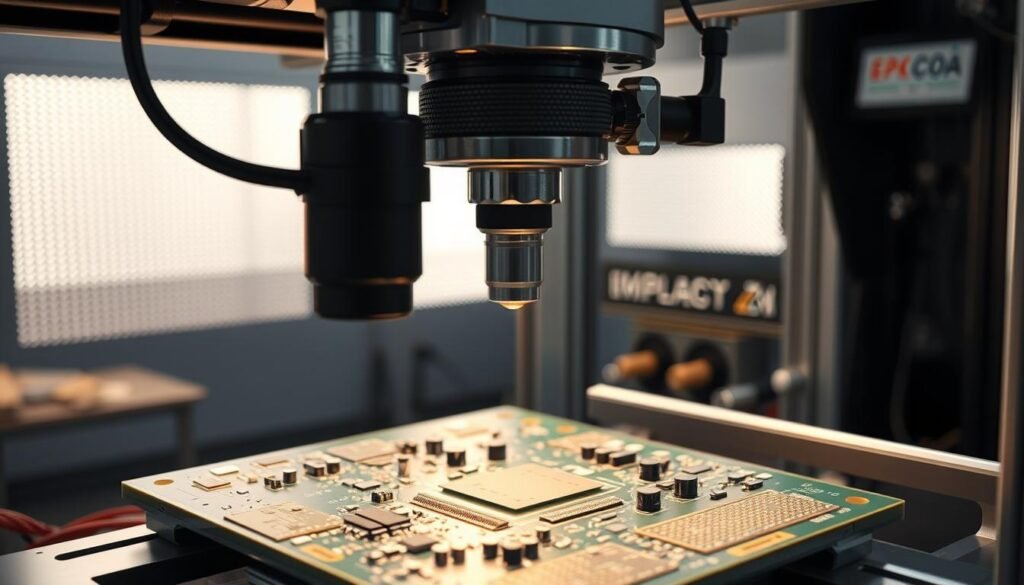
To guarantee the highest quality in our SMT processes, we employ advanced inspection and testing methodologies. These methodologies form a critical component of our SMT process validation, providing multiple layers of quality verification to identify and address potential defects.
Automated Optical Inspection Standards
We employ state-of-the-art automated optical inspection (AOI) standards that utilize high-resolution cameras and sophisticated algorithms to detect component presence, polarity, alignment, and solder joint quality with accuracy rates exceeding 99%. Our AOI inspection machine is an automatic optical inspection equipment that scans the mounted PCBA, collects real-time images, and compares them with a pre-existing database to judge whether the solder joints meet the requirements.
X-Ray Inspection for Complex Components
Our X-ray inspection capabilities for BGA and complex components allow us to validate hidden solder joints, detecting issues such as voids, bridging, insufficient solder, and misalignment that cannot be identified through visual inspection. As explained on our page about Surface Mount Devices, the nature and characteristics of BGA PCB require the use of X-RAY penetration to detect the electronic components’ solder paste state.
Functional Testing Validation Protocols
We’ve developed comprehensive functional testing validation protocols that verify electrical performance against design specifications, ensuring that each assembly functions as intended before shipment. Our inspection methodologies include detailed defect classification and tracking systems that feed into our continuous improvement process.
| Inspection Methodology | Purpose | Benefits |
|---|---|---|
| Automated Optical Inspection (AOI) | Detect component presence, polarity, alignment, and solder joint quality | Accuracy rates exceeding 99% |
| X-Ray Inspection | Validate hidden solder joints in BGA and complex components | Detect issues like voids, bridging, and misalignment |
| Functional Testing | Verify electrical performance against design specifications | Ensure assemblies function as intended before shipment |
By maintaining a multi-stage inspection approach that combines automated systems with human expertise, we create redundant verification points throughout the SMT process to ensure exceptional quality in the finished product.
Continuous Improvement and Process Control
Through continuous improvement and process control, we maintain our position as a leader in SMT manufacturing, delivering high-quality PCBA solutions. Our commitment to these principles ensures that our SMT manufacturing capabilities consistently evolve to meet increasingly demanding quality and performance requirements.
Statistical Process Control Implementation
We implement comprehensive statistical process control methodologies that monitor key process parameters, establishing control limits and tracking trends to identify potential issues before they impact product quality. This proactive approach enables us to maintain high-quality standards in our SMT production processes.
Defect Analysis and Root Cause Investigation
Our defect analysis and root cause investigation protocols employ structured problem-solving techniques such as 8D, 5-Why, and Fishbone diagrams to identify underlying causes of quality issues rather than simply addressing symptoms. This thorough analysis allows us to implement effective corrective actions, enhancing our overall manufacturing process.
Engineering Standard Updates and Refinement
We’ve established a systematic approach to engineering standard updates and refinement that incorporates lessons learned, technological advancements, and customer feedback to continuously enhance our SMT process validation. This ensures that our quality control measures remain up-to-date and effective.
| Process Control Measure | Description | Benefit |
|---|---|---|
| Regular Audits | Conducted to ensure compliance with established standards | Maintains high-quality production |
| Spot Checks | Random checks on products on the production line | Early detection of potential issues |
| Verification Points | Multiple checks throughout the manufacturing process | Ensures consistent quality across all products |
By integrating these process control measures, we ensure that our SMT manufacturing processes are not only efficient but also capable of producing high-quality PCBA boards consistently.
Conclusion
Our commitment to exceptional quality in PCB assembly is rooted in a comprehensive SMT process validation methodology. By implementing rigorous engineering standards at each stage of the manufacturing process, we ensure consistent, reliable results that meet or exceed our customers’ expectations.
Our validation approach combines advanced technology with experienced engineering expertise, creating a manufacturing environment where quality is built into the process rather than inspected after the fact. We recognize that effective SMT process validation is not static but requires continuous improvement and adaptation to evolving technologies.
Through our systematic validation protocols, we’ve created a manufacturing operation that delivers superior surface mount assemblies with exceptional reliability, performance, and value. We remain committed to advancing our validation methodologies, ensuring that our SMT processes continue to represent the highest standards in the electronics manufacturing industry.
FAQ
What is the significance of SMT process validation in electronics manufacturing?
What are the key factors in component verification protocols?
What is the role of automated optical inspection (AOI) in SMT process validation?
How do you ensure the quality of solder paste printing?
What is the importance of temperature profile development and verification in reflow soldering?
How do you validate the accuracy of component placement?
What is the role of statistical process control in SMT process validation?
About The Author
