Are you prepared for the inevitable obsolescence of your critical hardware and software components?
In today’s rapidly evolving technology landscape, component obsolescence presents significant challenges for businesses relying on established systems. When manufacturers announce End-of-Life (EOL) for components, it creates immediate concerns about continued operation, maintenance, and security.
We understand the importance of managing EOL effectively to maintain operational continuity while balancing budget constraints and technological advancement needs. In this guide, we’ll explore what EOL means, why components reach this stage, and the practical steps you can take.
Key Takeaways
- Understand the implications of EOL on your hardware and software components.
- Explore strategic options for managing EOL, including third-party support and upgrading.
- Learn how to balance operational continuity with budget constraints.
- Discover the importance of EOL management in maintaining system security.
- Identify the best practices for transitioning to newer technologies.
Understanding End-of-Life (EOL) in Technology
Understanding the concept of end-of-life (EOL) is vital for organizations relying on technology. As technology advances, products eventually reach a point where they are no longer supported or manufactured.
What Does EOL Actually Mean?
When a product reaches its EOL, it means it has reached the end of its manufacturing lifespan and will no longer be produced, sold, or advertised by the manufacturer. EOL does not necessarily mean the product stops working, but rather that it will not receive further updates or support. This stage is sometimes also referred to as End of Sale (EOS).
The Difference Between EOL and EOSL
While EOL marks the end of a product’s manufacturing cycle, End of Service Life (EOSL) signifies when a manufacturer ceases all technical support, maintenance, and software updates for a product. Understanding the distinction between EOL and EOSL is crucial for effective lifecycle planning, as products may still receive support after EOL but not after EOSL. Organizations must plan accordingly to mitigate potential risks associated with using products beyond their EOL or EOSL dates.
Why Do Components Reach End-of-Life?
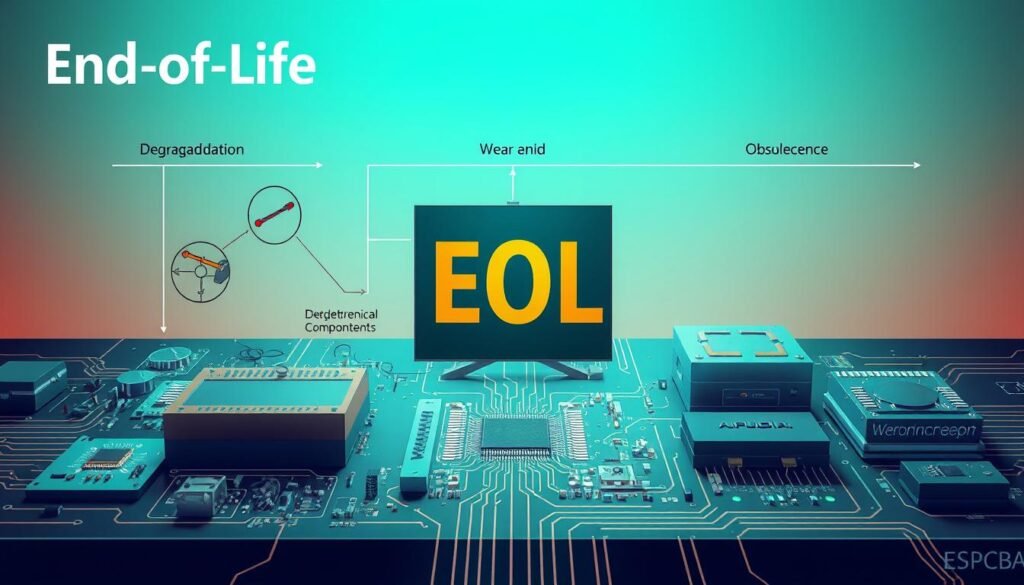
Understanding why components reach End-of-Life (EOL) is crucial for effective lifecycle management. Several factors contribute to a component’s EOL status, impacting its availability in the market. We will explore these factors in detail.
Manufacturer Business Decisions
Manufacturer business decisions often drive EOL announcements. When companies merge or acquire other businesses, they typically rationalize their product lines. This rationalization can lead to the discontinuation of certain products or parts. Additionally, declining sales volumes can make the continued production of a product uneconomic for the manufacturer.
Technology Advancements
The rapid pace of technology advancements continually pushes older components toward obsolescence. As newer, more efficient, and feature-rich alternatives emerge in the market, the demand for older components decreases. Manufacturing processes evolve over time, making it increasingly difficult and costly to maintain production of legacy components using outdated fabrication techniques or technologies.
Regulatory Changes
Regulatory changes, such as RoHS (Restriction of Hazardous Substances) directives, can force manufacturers to discontinue products that cannot be economically modified to meet new standards. Component interdependencies create cascading obsolescence effects, where the EOL status of a critical sub-component necessitates the discontinuation of the larger assembly or product.
| Factor | Description | Impact |
|---|---|---|
| Manufacturer Business Decisions | Rationalization of product lines due to mergers and acquisitions or declining sales | Discontinuation of products or parts |
| Technology Advancements | Emergence of newer, more efficient technologies | Decreased demand for older components |
| Regulatory Changes | Compliance requirements such as RoHS directives | Discontinuation of non-compliant products |
Identifying Components Nearing EOL
Recognizing when hardware or software products are approaching EOL is essential for effective lifecycle management. As products age, their availability on the market decreases, making it harder to find replacement parts or have repairs done.
Finding EOL Dates for Your Components
Locating EOL dates can be challenging due to varying manufacturer approaches. Some OEMs, like Dell and HP, are known for making it difficult to find accurate EOL and EOSL dates. To manage this, we should monitor manufacturer notifications closely, as they are the most direct source of EOL information. We can also check industry news and technology forums for advance notice of potential EOL announcements.
Signs Your Hardware or Software is Approaching EOL
Several indicators suggest that hardware or software is nearing EOL. For hardware, these include declining availability of replacement parts, extended lead times for repairs, and increasing service costs. For software, warning signs include decreased frequency of updates, lack of compatibility with newer operating systems, and reduced technical support quality. By recognizing these signs, organizations can proactively manage EOL components and minimize operational disruptions.
Challenges of Using EOL Components
As components near their end-of-life (EOL), organizations face significant challenges that can impact their operations and bottom line. The difficulties arise from various factors, including diminishing support and increasing maintenance needs.
Limited Technical Support
One of the immediate challenges is the limited technical support available for EOL components. As the original equipment manufacturer (OEM) gradually phases out support, organizations are left without expert guidance for troubleshooting and repairs, making it harder to resolve issues promptly.
Replacement Part Scarcity
As EOL components progress, replacement parts become scarce, driving up costs and extending repair times. This scarcity can significantly impact operational continuity and service levels, especially when equipment and devices are critical to daily operations.
Security Vulnerabilities
EOL components, particularly software and firmware, pose serious security risks due to the lack of critical security patches and updates. This vulnerability exposes organizations to emerging threats, potentially compromising their security and data integrity.
My Components are Nearing End-of-Life (EOL): What Should I Do?
As your components near their end-of-life (EOL), it’s crucial to take proactive steps to mitigate potential risks. Checking security on your products is essential to protect against malware and other risks. EOL software that is not supported becomes a high-security risk.
Immediate Assessment Steps
Conducting an immediate comprehensive assessment is crucial to understand the full scope of potential impact on your operations, security posture, and business continuity. Begin by creating a detailed inventory of all affected components, documenting their current operational status, and the estimated timeframe until support completely ends. For more information on managing EOL components, refer to our guide on what to do when your hardware nears.
- Create a detailed inventory of affected components.
- Evaluate the security implications of continuing to use each EOL component.
- Research available support options beyond the original manufacturer, including third-party maintenance (TPM) providers.
Creating an EOL Management Strategy
Develop a prioritized action plan based on risk assessment, addressing the most critical and vulnerable components first. Create a formal EOL management strategy that balances immediate operational needs with long-term technology roadmaps. Consider TPM providers for continued support and maintenance of EOL equipment.
Strategic Options for EOL Components
When components near End-of-Life (EOL), businesses must consider strategic options to maintain operational efficiency. Organizations facing EOL components have several paths to choose from, each with its own set of advantages and considerations.
Continue Using with Third-Party Support
One viable option is to continue using existing equipment with third-party maintenance (TPM) support. This approach offers significant cost savings while extending the useful life of familiar systems that staff are already trained to operate and maintain. Third-party maintenance providers specialize in supporting EOL equipment, often maintaining extensive parts inventories and technical expertise.
Upgrade to Newer Versions
Upgrading to newer versions of hardware or software provides access to current technology, enhanced features, and improved performance. This approach typically requires the highest initial investment but offers renewed manufacturer support and potentially improved operational efficiency.
Consider Refurbished Equipment
Refurbished equipment offers a middle-ground solution, providing newer technology at a reduced cost compared to new purchases. Refurbished hardware is in like-new condition, which can help extend the lifespan of these products. It’s essential to arrange a third-party maintenance plan for refurbished equipment in case repairs are needed.

When evaluating these options, organizations should consider total cost of ownership, including ongoing maintenance costs, operational efficiency, security implications, and alignment with long-term technology roadmaps. For critical systems, a hybrid approach may be optimal – replacing the most vulnerable components while maintaining others with third-party support until a complete system refresh becomes feasible or necessary.
Preventative Measures for Future EOL Issues
The key to managing EOL components lies in planning and flexibility. As technology continues to evolve, having a proactive strategy in place can significantly reduce the disruptions caused by components nearing their end-of-life.
Lifecycle Planning During Procurement
When selecting parts, it’s crucial to consider the longevity plans published by suppliers. Some manufacturers, like NXP and ST, provide clear longevity plans for their core processors, allowing you to gauge how long their parts will be available. We recommend researching manufacturers’ lifecycle policies thoroughly and incorporating lifecycle considerations into your procurement criteria.
- Proactive lifecycle planning during procurement is the most effective strategy for minimizing future EOL disruptions.
- Research manufacturers’ published lifecycle policies to understand their historical patterns of product support.
- Incorporate lifecycle considerations directly into procurement criteria to extend the useful life of your technology investments.
Building Flexibility into Your Infrastructure
Building flexibility into your infrastructure is vital for managing EOL components effectively. This can be achieved by adopting modular approaches that allow for component-level replacement rather than complete system overhauls.
- Standardize equipment where possible to reduce the complexity of managing multiple EOL timelines.
- Establish relationships with reliable third-party maintenance providers to ensure continuity of support.
- Implement comprehensive asset management systems to track hardware and software components and their projected EOL dates.
Conclusion
Organizations must navigate the complexities of end-of-life components to minimize disruption and optimize resources. Effective EOL management involves a combination of proactive monitoring, thorough risk assessment, and flexible response options. We can leverage third-party maintenance providers to deliver comparable support at competitive pricing. By understanding EOL dates and planning accordingly, we can reduce the frequency and impact of EOL-related disruptions. This approach enables us to maintain operational continuity and control costs. Ultimately, successful EOL management is about developing systematic approaches to anticipate and respond to obsolescence effectively.
FAQ
What is the average lifespan of electronic components before they reach End-of-Life (EOL)?
How can I find the EOL date for a specific component?
What are the risks of continuing to use components after they have reached EOL?
Can third-party providers offer support for EOL components?
How can I plan for EOL during the procurement process?
What are the benefits of upgrading to newer component versions?
Is refurbished equipment a viable option for replacing EOL components?
How can I build flexibility into my infrastructure to mitigate EOL risks?
About The Author
