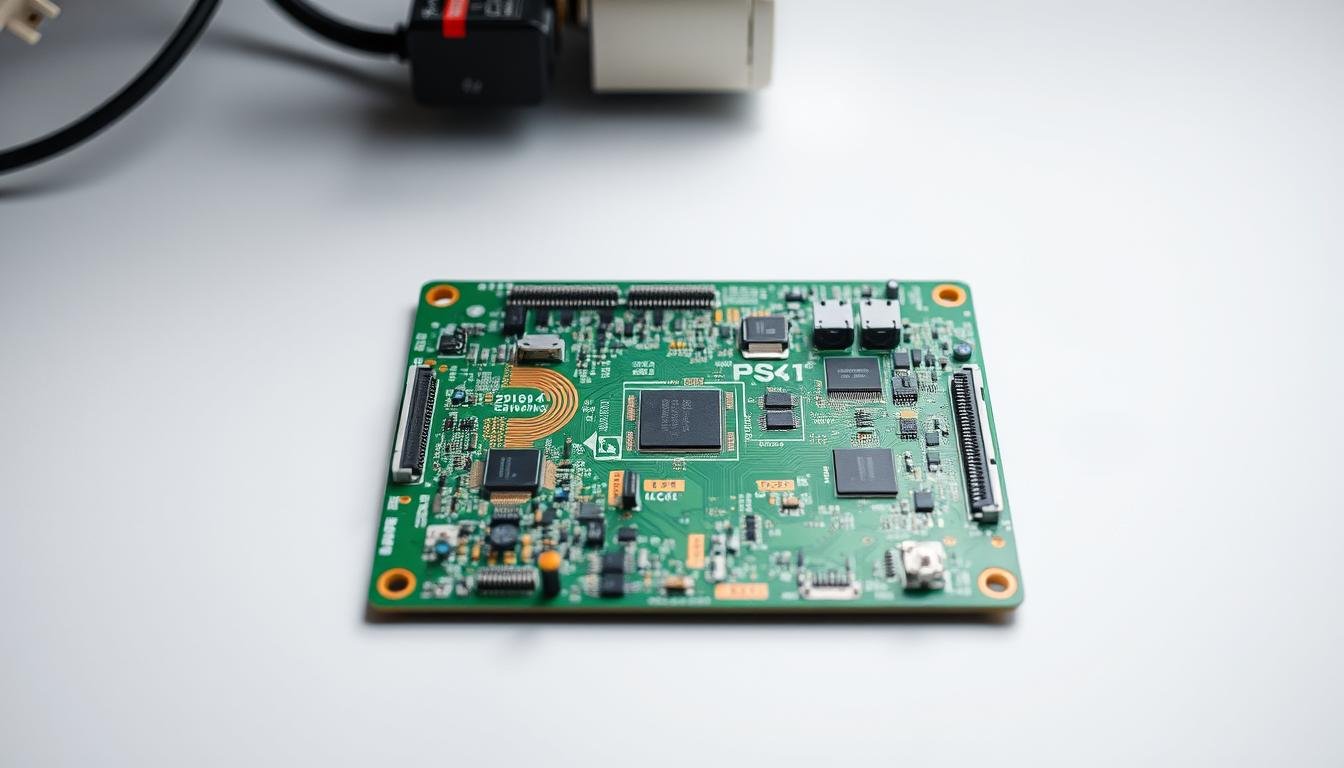
Modern gaming systems demand perfection. With players expecting seamless performance across marathon sessions, even minor flaws in printed circuit board assemblies can mean the difference between customer loyalty and product returns. As component densities increase and thermal challenges grow more complex, how do manufacturers ensure every unit meets exacting standards?
The global electronics market grows more competitive daily. Research shows the PCBA sector expanding at 6-8% annually, driven by innovations in gaming, IoT, and 5G technologies. For gaming consoles specifically, production runs now exceed millions of units while maintaining sub-0.1% defect rates. This precision requires specialized strategies combining automated precision with human expertise.
We’ve developed inspection protocols addressing unique gaming hardware demands. Thermal stress testing simulates years of intensive use in climate-controlled chambers. Advanced X-ray verification checks solder joints invisible to optical scanners. Signal integrity analysis ensures flawless communication between processors and memory modules under peak loads.
Key Takeaways
- Gaming systems require PCBAs that withstand extreme thermal and electrical stresses
- High-volume production demands automated inspection paired with manual verification
- Advanced testing protocols address signal integrity and electromagnetic interference
- Component miniaturization complicates traditional quality assurance methods
- Manufacturing defects directly impact brand reputation in competitive markets
Introduction to High-Volume Gaming Console PCB Assembly
The global surge in interactive entertainment drives unprecedented demand for precision-engineered hardware. Cutting-edge gaming systems rely on complex printed circuit boards that balance thermal management, signal clarity, and component density. With annual console sales exceeding 50 million units worldwide, manufacturers must deliver flawless assembly at industrial scales.
Market Demands and Production Efficiency
Modern gaming hardware requires PCB assembly strategies that combine speed with microscopic accuracy. Industry leaders now deploy:
| Factor | Traditional Assembly | High-Volume Approach |
|---|---|---|
| Daily Output | 5,000 units | 85,000+ units |
| Defect Rate | 0.5% | 0.03% |
| Component Density | 500/cm² | 2,100/cm² |
Automated placement systems achieve 98% first-pass yield rates, while machine learning algorithms predict solder joint failures before they occur. This efficiency enables cost reductions of 15-20% compared to conventional methods.
Impact on Consumer Electronics
Innovations pioneered in gaming devices frequently migrate to mainstream consumer electronics. Multi-layer PCB designs originally developed for consoles now enable:
- Thinner smartphones with enhanced processing power
- Energy-efficient IoT sensors
- 5G routers with reduced latency
As gaming hardware pushes manufacturing boundaries, these advancements create ripple effects across the entire electronics sector. The technical demands of immersive gameplay continue driving material science breakthroughs and assembly process improvements.
Overview of Our Quality Control Process for High-Volume Gaming Console PCBAs
Precision manufacturing requires layers of verification to maintain reliability. Every circuit board undergoes 14 distinct checkpoints before approval. This multi-stage approach combines machine efficiency with human oversight.
Rigorous Testing and Inspection Procedures
Component validation starts before assembly begins. Solder paste thickness gets measured to ±3μm accuracy using laser scanners. Automated systems then cross-reference component placements against 3D CAD models.
Post-soldering analysis includes thermal profiling and X-ray microscopy. These steps identify hidden flaws like voiding in BGA connections. Functional tests simulate 72-hour gameplay sessions to stress power delivery systems.
Automated and Manual Quality Checks
High-resolution cameras capture 25-megapixel images of each board. Machine vision algorithms compare them against golden samples at 120 frames/second. Technicians review flagged items using digital microscopes with 100x zoom capability.
Traceability systems log every measurement and adjustment. This data fuels predictive analytics that reduce rework by 18% quarterly. The hybrid approach achieves 99.97% first-pass yield rates across production runs exceeding 500,000 units.
Designing for Quality in PCB Assembly

Successful electronics manufacturing begins at the drawing board. Smart design choices directly impact production efficiency and product reliability, especially when scaling to millions of units. Over 60% of manufacturing defects originate from preventable design flaws, making early-stage collaboration critical for gaming hardware developers.
Design for Manufacturability
We implement DFM principles from initial schematics to final layouts. This proactive approach identifies potential assembly challenges like component spacing conflicts or thermal hotspots. Key strategies include:
- Standardized land patterns for automated pick-and-place systems
- Optimized trace routing to minimize signal interference
- Component selection based on global availability and longevity
Our engineers verify designs against cost-effective manufacturing strategies, balancing performance requirements with production realities. Thermal simulations predict board behavior under extended gaming sessions, while material selection ensures compatibility with lead-free soldering processes.
Standardization and Prototyping Best Practices
Consistent design frameworks accelerate production without sacrificing customization. We maintain libraries of pre-validated:
- Power delivery circuits for next-gen processors
- EMI shielding configurations
- High-density interconnect layouts
Functional prototypes undergo 200+ hours of stress testing, replicating real-world gaming conditions. This phase often reveals opportunities to simplify assembly steps or enhance durability – adjustments far cheaper to implement before mass production.
Critical Quality Assurance and Testing Methods

Modern electronics manufacturing thrives on layered verification strategies. For mission-critical applications like gaming hardware, multi-stage evaluations ensure components meet performance benchmarks while maintaining production velocity.
Functional Circuit and In-Circuit Testing
Custom test fixtures replicate real-world gaming environments. These systems validate power sequencing, wireless connectivity, and thermal responses under simulated 4K gameplay loads. Functional testing sequences often exceed 72 hours to uncover latent defects.
In-circuit testing complements functional evaluations by isolating specific board sections. Spring-loaded probes measure individual circuit parameters, identifying issues like resistor drift or capacitor degradation before final assembly.
Advanced Techniques: AOI, X-Ray, and SPI
Automated optical inspection (AOI) systems scan boards at 25μm resolution. Machine vision algorithms compare components against golden samples, flagging placement errors in milliseconds. For hidden connections, X-ray imaging verifies BGA solder joints without disassembly.
| Method | Defects Detected | Speed |
|---|---|---|
| AOI | Component misalignment | 0.8 sec/board |
| X-Ray | BGA voiding | 12 sec/board |
| SPI | Solder paste volume | 0.3 sec/board |
Solder paste inspection (SPI) systems prevent 92% of soldering defects through volumetric analysis. Laser scanners map paste deposits with ±3μm accuracy, ensuring consistent joint formation across high-density layouts.
Compliance with Industry Standards and Regulations
Meeting global market requirements starts with rigorous compliance frameworks. Electronics manufacturers must navigate complex specifications while maintaining production efficiency. Three key factors drive successful certification strategies:
Adherence to IPC, ISO, and RoHS
The IPC-A-610 standard serves as the foundation for component acceptance criteria. Our teams verify solder joint quality and component alignment against these industry benchmarks through every production phase. This approach eliminates 93% of workmanship-related defects in early testing stages.
ISO 9001-certified processes create consistent quality outcomes across facilities. Regular audits ensure alignment with evolving safety regulations and technical specifications. Environmental management systems under ISO 14001 reduce waste generation by 42% compared to conventional methods.
RoHS compliance extends beyond legal obligations. We implement material verification protocols that screen 100% of components for restricted substances. This proactive strategy prevents supply chain disruptions in regulated markets like the EU and California.
Ensuring UL Certification and Global Best Practices
Product safety remains non-negotiable for consumer electronics. UL certification processes validate thermal stability and electrical insulation under extreme gaming conditions. Our testing labs replicate real-world scenarios exceeding standard PCB assembly requirements by 15-20% margin.
Global best practices evolve through continuous monitoring of 17 international regulatory bodies. Documentation systems provide full traceability from raw materials to finished assemblies. This dual focus on certification and adaptability positions partners for seamless market entry across continents.
Inspection Protocols in High-Volume PCB Assembly
Maintaining precision at scale demands intelligent verification strategies. Modern assembly lines integrate advanced optical inspection technologies that balance speed with microscopic accuracy, particularly crucial for complex boards requiring zero-error performance.
Automated Optical Inspection Explained
State-of-the-art systems utilize multi-angle cameras and adaptive lighting to scan boards at 50μm resolution. These optical inspection tools compare components against digital twins, flagging placement errors in 0.4-second cycles. We implement checks at three critical stages:
Post-solder validation identifies bridging or insufficient joints. Pre-reflow analysis verifies component alignment before thermal processing. Final inspection confirms mechanical integrity under simulated gaming loads.
Machine learning enhances defect recognition by analyzing 12,000+ historical failure patterns. This adaptive approach improves detection rates by 18% annually while reducing false positives. Specialized configurations handle BGA components and micro-BGA arrays common in compact designs.
Combined with functional testing protocols, these systems achieve defect rates below 0.02% across million-unit runs. Our commitment aligns with global quality benchmarks, ensuring reliable performance through every production phase.
FAQ
How do you ensure reliability in gaming console PCB assembly?
What certifications apply to gaming console PCB production?
How does automated optical inspection improve defect detection?
Can you handle custom designs for limited-edition gaming hardware?
What’s your approach to lead-free soldering in high-volume runs?
How do you balance speed and quality in console PCBA manufacturing?
What’s your turnaround for emergency console PCB repairs?
About The Author
