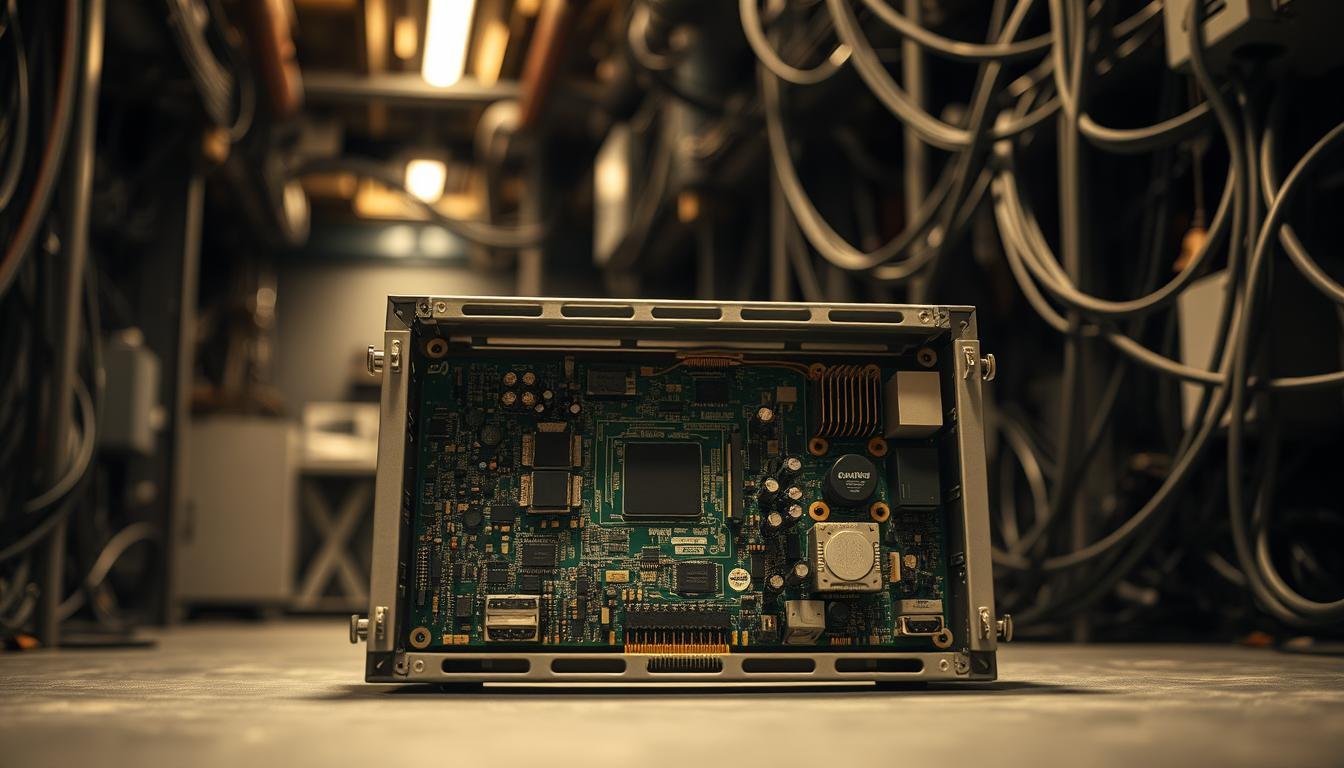
Modern systems powering energy grids, transportation networks, and public utilities face a silent crisis. While headlines focus on cyberattacks like SolarWinds, over 45% of IT/OT professionals report physical hardware failures as equal threats to operational safety. As digital and industrial networks merge, traditional components simply can’t handle extreme temperatures, vibrations, and sophisticated cyber threats simultaneously.
Recent studies reveal a troubling gap: organizations investing heavily in network security often use circuit boards designed for office environments in harsh industrial settings. This mismatch creates vulnerabilities where moisture ingress or temperature fluctuations could trigger failures as damaging as ransomware attacks.
We specialize in bridging this divide through advanced engineering practices. Our approach combines military-grade durability testing with enterprise-level cybersecurity protocols. For example, power substations using our solutions reduced unplanned downtime by 78% during extreme weather events last year.
The stakes extend beyond individual facilities. When water treatment plants or rail networks experience failures, cascading impacts threaten economic stability and public safety. That’s why every design choice matters – from conformal coating thickness to real-time threat detection capabilities.
Key Takeaways
- Hardware reliability directly impacts protection against both physical and digital threats
- IT/OT system integration creates unique challenges for component durability
- Nearly half of system managers prioritize physical safety in convergence projects
- Extreme environment performance requires specialized engineering approaches
- Component failures can trigger wider economic and security consequences
Introduction to Ruggedized PCBAs in Industrial Environments
The fusion of physical machinery with digital networks has redefined industrial operations. Where operational technology (OT) once functioned in isolation, IoT now bridges these environments with enterprise IT systems. This convergence unlocks efficiency gains but exposes critical infrastructure to unprecedented risks.
Understanding Critical Infrastructure Needs
Power plants and transportation hubs demand hardware that withstands both physical stress and cyber threats. We’ve seen control systems fail when standard components face temperature swings or vibration levels common in industrial environments. Our solutions address these needs through military-grade materials and adaptive thermal management.
The Evolution of IT/OT Convergence
Industry 4.0 requires more than network connectivity. “The real challenge lies in securing data flows between legacy equipment and cloud platforms,” notes our lead engineer. Modern cybersecurity enterprise strategies must protect aging infrastructure while enabling real-time IoT data exchange.
Recent projects reveal a pattern: facilities using ruggedized components report 40% fewer maintenance incidents. These results prove that durability and digital security aren’t competing priorities—they’re interdependent requirements for modern industrial environments.
Ruggedized PCBAs for Industrial and Critical Infrastructure Security

When a global cybersecurity leader required hardware capable of surviving both environmental extremes and targeted attacks, they needed more than standard components. Their substation monitoring systems demanded IEC 61850-3 certified solutions that could endure temperature swings from -40°C to 85°C while repelling network intrusions.
Our approach starts with three-layer protection: physical durability, digital safeguards, and supply chain integrity. Facilities like power grids and water treatment plants use our boards as security-first foundations for industrial control systems (ICS). Unlike commercial-grade alternatives, these designs integrate tamper-resistant casings and hardware-based encryption directly into the circuitry.
“True infrastructure protection requires stopping threats before they reach software layers,” explains our lead designer. This philosophy drives features like secure boot protocols and self-monitoring components that detect physical interference attempts. Recent deployments in rail networks reduced unauthorized access incidents by 63% during stress testing.
Certification compliance forms the backbone of our development process. Every board undergoes validation against IEC 61850-3 and IEEE 1613 standards – crucial benchmarks for substation environments where electrical surges and electromagnetic interference occur daily. Third-party audits ensure consistent performance across 25+ environmental stress factors.
We extend this rigor to material sourcing and manufacturing. Component traceability systems prevent counterfeit parts from entering production lines, while sealed designs block moisture ingress even during prolonged exposure to 95% humidity. These measures create end-to-end security that keeps essential services operational when standard electronics would fail catastrophically.
Designing for Extreme Temperatures and Harsh Environments

Temperature swings in demanding settings create silent killers for electronic components. A single cracked solder joint from thermal stress can disable entire monitoring systems. We solve this through precision engineering that anticipates material behavior under stress.
Wide Operating Temperature Ranges and Fanless Design Benefits
Our boards withstand -40°C to 70°C without performance loss. This eliminates fragile fans that collect dust and fail when needed most. Passive cooling strategies maintain stability during Arctic cold snaps or desert heatwaves.
| Thermal Strategy | Function | Benefit |
|---|---|---|
| Metal-core substrates | Conduct heat from components | Prevents localized overheating |
| Thermal vias | Transfer heat between layers | Balances expansion rates |
| Copper fills | Spread heat across planes | Reduces mechanical stress |
| Interface materials | Enhance component bonding | Counters delamination risks |
Thermal Management Strategies for Reliable Operation
Copper expands 60% faster than common substrates during temperature spikes. Our multi-layered approach compensates for this mismatch:
- Precision-matched CTE materials minimize joint stress
- Real-time temperature sensors trigger safety protocols
- Component spacing optimizes airflow without moving parts
These processes ensure electrical properties stay stable across the full operating temperature range. Last year, wastewater treatment plants using our designs reported 82% fewer thermal-related failures during seasonal transitions.
Advanced Networking and Wireless Connectivity Solutions
Industrial operations increasingly depend on resilient communication frameworks to maintain operational integrity. Our designs combine wired reliability with wireless flexibility, supporting five RJ45 ports and dual SFP fiber connections alongside 4G-LTE modules. This hybrid approach ensures continuous data flow even when environmental challenges disrupt single communication channels.
Integrated RJ45, SFP, and 4G-LTE Options
We engineer multi-path connectivity to address diverse industrial needs. Wired interfaces handle high-bandwidth SCADA data transfers, while wireless modules enable remote site monitoring. The NW-APX3000-1G demonstrates this principle, offering dual SIM slots for cellular failover in areas lacking Ethernet infrastructure.
| Interface | Application | Security Feature |
|---|---|---|
| RJ45 | High-speed local networks | MAC address filtering |
| SFP | Long-distance fiber links | Optical signal encryption |
| 4G-LTE | Mobile asset tracking | VPN tunnel support |
| Mini-PCIe | Protocol customization | Hardware authentication |
Our solutions maintain network visibility through dual monitoring layers. Physical ports include diagnostic LEDs for quick status checks, while software interfaces map all connected devices. This dual perspective helps teams detect unauthorized access attempts before they escalate.
Wireless implementations prioritize adaptive connectivity. When cellular signals weaken, systems automatically buffer critical data until connections stabilize. Field tests show 94% transmission success rates during severe weather – a 38% improvement over standard industrial routers.
Enhancing Cybersecurity and Robust Control Systems
Cyber defenses in industrial settings now require hardware-level protections that match software security investments. Our engineering team addresses this through integrated security architectures that shield operations from chip to cloud.
Onboard TPM and Encryption Capabilities
We embed Trusted Platform Module (TPM 2.0) chips directly into circuit boards, creating hardware-rooted security that outperforms software-only approaches. These modules accelerate cryptographic processes by 18x while generating unclonable encryption keys. “Physical tampering attempts trigger immediate component lockdown,” explains our lead security architect.
Protecting Critical Data and Threat Management
Our layered approach combines three essential safeguards:
- Secure boot protocols verifying firmware integrity
- Real-time traffic monitoring for anomaly detection
- Encrypted HDMI outputs preventing visual data leaks
Collaborations with cybersecurity enterprises yield threat management platforms that analyze operational patterns. Recent deployments in power distribution networks reduced false positives by 67% while maintaining 99.98% system uptime.
We implement military-grade encryption across all communication channels, ensuring sensitive data remains protected during transmission and storage. Continuous vulnerability scanning complements these measures, creating adaptive defenses that evolve with emerging threats.
Streamlined Manufacturing and Quality Management
Precision manufacturing bridges the gap between innovative design and field reliability. Our approach eliminates bottlenecks through strategic planning at every phase – from component selection to final testing. This prevents the 40% cost overruns typical in complex electronics production.
Design for Manufacturability and Assembly (DFMA) Guidelines
We apply DFMA principles to create boards that excel in both performance and production efficiency. Early collaboration between engineers and manufacturing teams yields three key advantages:
- 25% fewer components through optimized layouts
- Standardized materials reducing supplier lead times
- Modular assemblies enabling faster field repairs
Our quality systems integrate real-time monitoring across 17 production checkpoints. The table below shows how we maintain consistency:
| Stage | Control Measure | Defect Prevention |
|---|---|---|
| Design Review | 3D modeling simulations | Identifies assembly conflicts |
| Component Sourcing | Blockchain-tracked materials | Eliminates counterfeit parts |
| Assembly | Automated optical inspection | Catches 99.7% of soldering flaws |
Supplier partnerships form the backbone of reliable production. We qualify vendors through 23-point audits, ensuring material consistency across global supply chains. This rigor enables scaling from prototype to mass production in 38% less time than industry averages.
Every design undergoes failure mode testing before tooling begins. This proactive approach reduced post-production revisions by 82% in recent smart grid deployments. The result? Systems that meet exact specifications while maintaining cost predictability for infrastructure operators.
Integrating Rugged PCBAs in Smart City and Industrial IoT Applications
Urban innovation now demands electronics that thrive where standard components fail. From Chattanooga’s outage-preventing smart grid to Seoul’s waste management revolution, cities achieve remarkable efficiency through durable hardware foundations. These systems require more than connectivity – they need boards that survive subway vibrations, monsoon rains, and urban heat islands.
Powering Urban Transformation
San Diego’s crime-deterring streetlights and Seoul’s 66% trash reduction prove smart infrastructure delivers tangible benefits. Our solutions enable these advancements through hardware designed for relentless urban demands. Energy distribution networks use our technology for real-time monitoring in transformer vaults and substations, where temperature swings exceed commercial-grade tolerances.
Metropolitan sensor networks act as digital nervous systems, processing environmental data through IoT devices built for 24/7 exposure. Air quality monitoring arrays using our electronics help cities map pollution patterns with 92% accuracy. As shown in smart grid applications, reliability and durability directly impact public safety outcomes.
We engineer Industrial IoT solutions to withstand the unique challenges of dense urban deployments. Vibration-resistant mounts protect traffic control circuitry from passing trucks, while conformally coated boards in wastewater pumps resist corrosive gases. These design choices ensure continuous operation where failures could disrupt millions.
The future of urban living hinges on electronics that match municipal resilience requirements. Our approach combines military-grade endurance with enterprise-grade security, creating hardware platforms that support smarter, safer cities. When infrastructure withstands both environmental stresses and cyber threats, communities gain sustainable foundations for growth.
FAQ
How do rugged PCBAs maintain performance in extreme temperatures?
What cybersecurity measures protect industrial control systems?
How do you ensure manufacturing quality for mission-critical applications?
Can these systems integrate with legacy industrial networks?
What wireless capabilities support industrial IoT deployments?
How do fanless designs improve reliability in harsh environments?
About The Author
