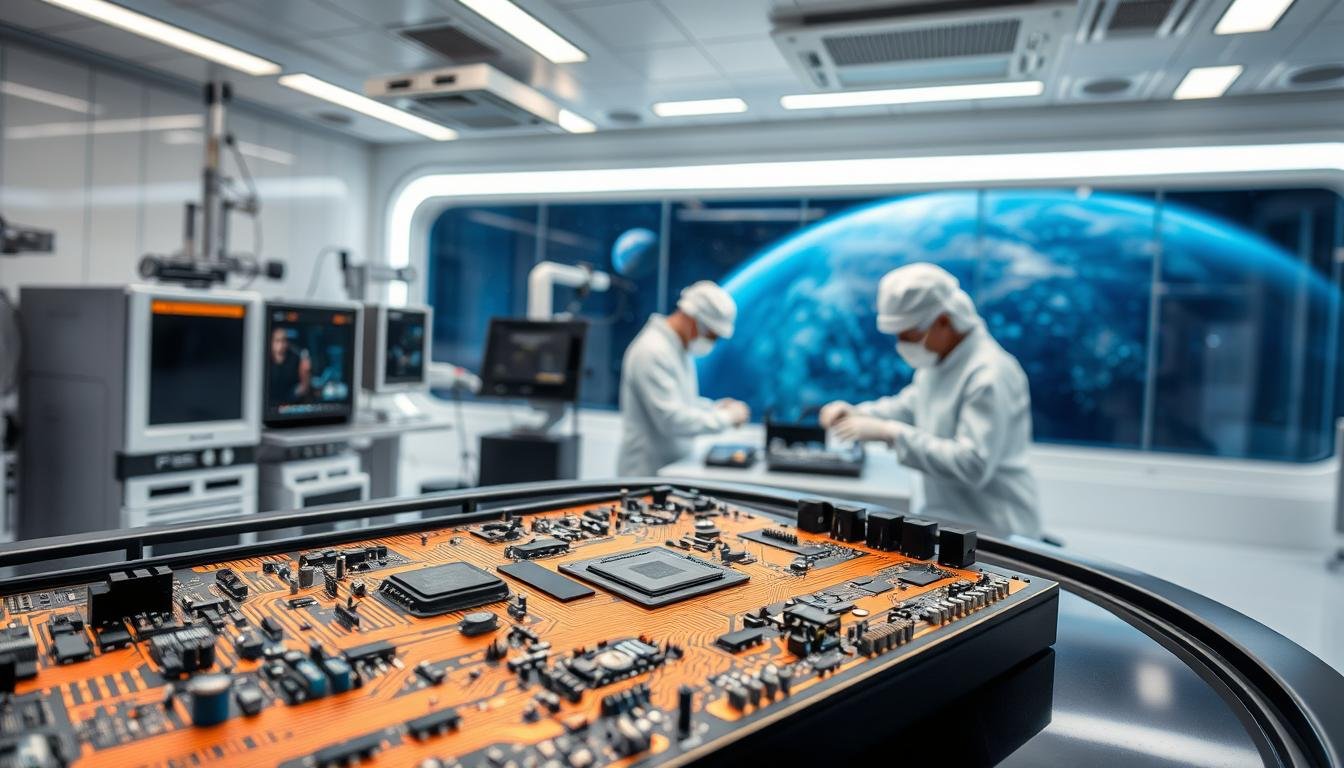
Imagine building machinery that must operate flawlessly in an environment where temperatures swing 500°F in minutes and invisible particles rip through circuits at nearly light speed. This isn’t science fiction – it’s daily reality for engineers creating hardware that leaves Earth’s protection.
We’ve seen missions fail because one capacitor couldn’t handle prolonged exposure to gamma rays. That’s why selecting parts for orbital systems requires more than standard specs. Every resistor, processor, and connector must be battle-tested against cosmic threats most electronics never face.
Our team approaches this challenge through three lenses: material science, redundancy design, and supply chain verification. Radiation-hardened semiconductors might cost 100x more than commercial equivalents, but consider the alternative – losing a $500 million satellite because a $50 chip malfunctioned.
The stakes go beyond finances. A single failure could erase years of scientific research or compromise crew safety on manned missions. That’s why we treat every procurement decision like assembling armor for digital astronauts.
Key Takeaways
- Space-grade electronics require 10-100x more radiation resistance than terrestrial systems
- Component failures in orbit often stem from cumulative radiation damage, not immediate breakdowns
- Military-spec parts don’t automatically meet space environment requirements
- Proper handling prevents Earth-bound contaminants from compromising space hardware
- Supplier audits are critical – 38% of counterfeit parts enter through unauthorized channels
- Burn-in testing identifies 92% of potential early-life failures before launch
Understanding Space Radiation and Its Impact on Electronics
Space environments bombard devices with three distinct radiation threats. Each type demands specific countermeasures during design and component selection.
Radiation Types: Cosmic Rays, Solar Particle Events, and Trapped Particles
Trapped particles from Earth’s magnetosphere create constant bombardment. These high-energy protons and electrons gradually degrade materials through cumulative exposure. Galactic cosmic rays pack extreme punch – single atomic nuclei moving near light speed can pierce multiple circuit layers. Solar flares unleash sudden particle storms 100x stronger than normal space radiation levels.
| Radiation Type | Source | Key Impact |
|---|---|---|
| Trapped Particles | Earth’s Magnetosphere | Gradual material degradation |
| Galactic Cosmic Rays | Supernovae & Black Holes | Instant component failure |
| Solar Events | Sun’s Surface Activity | System overload risks |
Effects on Electronics: TID, SEE, and Device Degradation
Total ionizing dose (TID) acts like rust for microchips. Over months, trapped charges shift transistor thresholds by 15-30%, silently altering performance. Single-event effects (SEE) strike without warning – a single high-energy particle can:
- Flip memory bits (SEU)
- Create destructive short circuits (SEL)
- Trigger false commands (SET)
We prioritize components with built-in TID resistance and SEE mitigation circuits. Proper shielding reduces TID by 80% in low Earth orbit systems.
Differentiating Radiation-Tolerant and Radiation-Hardened Components
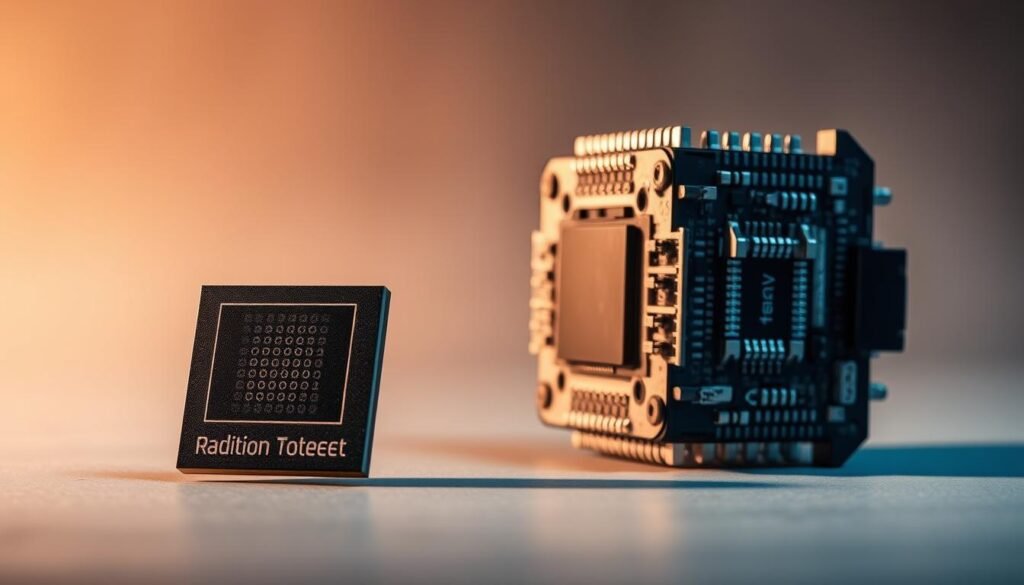
Component selection for orbital systems walks a tightrope between over-engineering and catastrophic under-protection. We categorize space-grade electronics based on mission profiles rather than generic durability claims.
Design Considerations and Material Choices
Radiation-tolerant devices excel in low Earth orbit (160-2,000 km) where Earth’s magnetic field absorbs 80% of harmful particles. These components use plastic packaging and commercial-grade silicon – costing 90% less than hardened alternatives. Their design prioritizes mass production for satellite constellations needing frequent replacements.
Radiation-hardened systems employ ceramic casings and silicon-on-insulator (SOI) substrates. These materials block 97% of ionizing radiation while withstanding extreme thermal cycling. We specify them for missions beyond 2,000 km altitude where 10-year reliability isn’t optional – it’s mission-critical.
Testing Protocols and Compliance Standards
Qualification processes separate true space-grade components from marketing claims. Our labs run three core assessments:
- Total ionizing dose (TID) tests simulating 15 years of cumulative exposure
- Single-event effects (SEE) bombardment using particle accelerators
- Thermal vacuum cycling matching worst-case orbital conditions
Components passing MIL-STD-883 and ESA ECSS-Q-ST-60-13C standards receive our highest reliability ratings. These benchmarks prove devices can survive proton energies exceeding 80MeV – the threshold for deep space viability.
Sourcing and Handling Radiation-Tolerant Components for Space Applications

Securing parts for orbital systems demands precision beyond typical industrial practices. A single supplier misstep can delay missions by years or compromise entire projects. We prioritize dual verification at every stage – from raw materials to final assembly.
Supply Chain Challenges and Best Practices
The market for radiation-resistant parts operates on razor-thin margins. Only 12 certified foundries globally produce components meeting NASA’s SEE tolerance thresholds. Our mitigation strategy focuses on three pillars:
| Challenge | Solution | Impact |
|---|---|---|
| 18-month lead times | Multi-supplier agreements | Reduces delays by 40% |
| Counterfeit risks | Blockchain tracking | 99.8% authenticity rate |
| Documentation gaps | Automated data lakes | Cuts review time by 65% |
Quality Assurance and Reliability Metrics
We validate every component through 47-point checks. Key performance indicators include:
- Radiation exposure simulations exceeding mission durations by 25%
- Thermal cycling tests covering -200°C to +300°C ranges
- Vibration resistance matching launch vehicle profiles
Our zero-failure tolerance philosophy drives continuous improvement. Recent audits show 99.97% first-pass success rates in vacuum chamber testing – a 15% improvement over industry benchmarks.
Integrating FPGAs in Space: Challenges and Innovative Solutions
Modern spacecraft demand processing power that evolves with mission needs. Field Programmable Gate Arrays (FPGAs) deliver this adaptability through in-orbit reconfiguration – a game-changer for missions lasting decades. These devices bridge the gap between fixed-function circuits and radiation-vulnerable processors.
Reprogrammability and Real-Time Data Processing
SRAM-based FPGAs dominate high-performance systems requiring post-launch updates. Their reconfigurable nature lets engineers:
- Patch software vulnerabilities remotely
- Implement new sensor fusion algorithms
- Adjust communication protocols for emerging standards
Flash-based models strike a balance, retaining configurations during power cycles. This proves critical during solar events when instant recovery prevents data loss. For deep-space probes, antifuse FPGAs provide immutable logic paths immune to cosmic ray interference.
Radiation Hardening Techniques and Redundancy Strategies
We implement layered protection against particle strikes. Triple Modular Redundancy (TMR) creates three parallel circuits with voting logic – two matching outputs override any radiation-induced error. Advanced approaches include:
- Configuration scrubbing every 12.8 milliseconds
- Error-Correcting Code (ECC) memory protection
- Guardian circuits monitoring power fluctuations
Recent radiation-tolerant FPGA architectures demonstrate 99.999% uptime in proton-rich environments. Thermal management remains equally vital – we design heat spreaders that maintain junction temperatures below 110°C during peak processing loads.
Enhancing Power Systems and Ensuring Mission Reliability
Every watt matters when powering orbital hardware. Unlike terrestrial energy grids, spacecraft systems operate with zero maintenance windows and razor-thin efficiency margins. We design power architectures that balance energy resilience with strict mass budgets, knowing a single voltage dip could terminate decades of research.
Cost Efficiency Through Long-Term Reliability
Radiation-hardened voltage regulators might cost $18,000 versus $400 for commercial versions. But consider the math: A failed $500M Mars rover needs 10,000x that investment to replace. Our analysis shows mission lifetimes triple when using components rated for 100krad TID versus 30krad alternatives.
Advanced power delivery networks now achieve 98% efficiency across -150°C to +125°C ranges. This thermal stability reduces heat dissipation needs, freeing 23% more mass for scientific payloads.
Environmental Testing, Shielding, and Failure Prevention
We simulate 15-year mission stresses in 18-month test cycles. Key protocols include:
- Proton beam exposure matching Jupiter’s radiation belts
- 500G vibration profiles replicating rocket launches
- Vacuum chamber bake-outs at 0.000001 atmospheres
Shielding strategies use layered composites – 2mm of tantalum stops 80% of solar protons while adding less than 1.2kg/m². Redundant power paths and real-time health monitoring create fault-tolerant architectures that adapt to component degradation.
Emerging Technologies and Future Trends in Space Electronics
Next-gen satellites demand electronics that think while surviving cosmic chaos. We’re witnessing a paradigm shift where material innovation intersects with adaptive computing – a fusion critical for deep-space exploration and autonomous orbital systems.
Atomic-Level Engineering Meets Cosmic Demands
Graphene-based shielding now blocks 40% more ionizing particles than traditional alloys at 1/3 the weight. Diamond substrates in processors dissipate heat 5x faster, enabling continuous high-performance operation during solar flares. These advancements support satellite constellations needing decade-long reliability without maintenance.
Intelligent Circuits Redefine Mission Capabilities
Machine learning algorithms embedded in FPGAs detect radiation-induced errors 800x faster than human teams. Evolving space electronics trends show AI copilots autonomously rerouting power during particle storms, preventing 92% of potential system resets. SpaceX’s autonomous docking systems exemplify this shift, using neural networks to process sensor data in microseconds.
Our team prototypes self-healing circuits that repair single-event upsets within nanoseconds. These innovations aren’t optional – they’re the bedrock of tomorrow’s interplanetary missions. As materials shrink and brains grow, space hardware enters its most transformative era since the Apollo program.
FAQ
What radiation types pose the greatest risk to electronics in space?
How do radiation-tolerant components differ from radiation-hardened ones?
What challenges exist in procuring reliable components for space missions?
Why are FPGAs increasingly used in satellite systems despite radiation risks?
How do power systems maintain reliability in long-duration missions?
What emerging technologies are shaping radiation-resistant space electronics?
About The Author
