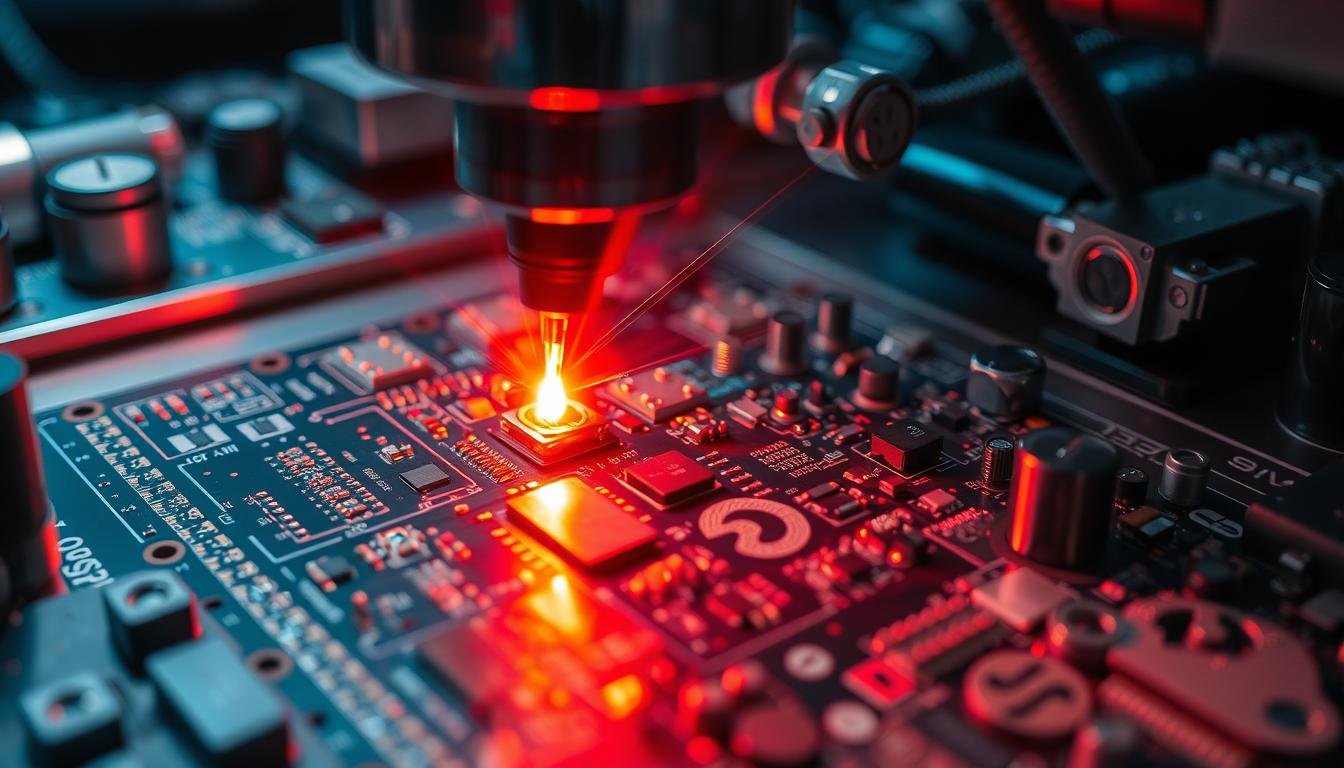
As we witness a revolutionary transformation in the electronics manufacturing industry, a critical question arises: Can laser soldering technology meet the demands of increasingly complex mobile devices? The emergence of advanced soldering technologies promises enhanced precision, efficiency, and reliability in manufacturing.
We are seeing a significant shift from traditional soldering methods to laser soldering, which offers unprecedented control over heat application and solder placement. This is crucial for modern electronic assemblies, where miniaturization trends continue to drive innovation. The development of new alloy compositions is complementing advancements in laser technology, creating synergistic improvements in joint strength, conductivity, and environmental sustainability.
Key Takeaways
- Laser soldering technology is revolutionizing the electronics manufacturing industry.
- Advanced soldering technologies enhance precision, efficiency, and reliability.
- New alloy compositions improve joint strength, conductivity, and sustainability.
- Miniaturization trends drive the adoption of laser soldering.
- Laser soldering offers unprecedented control over heat application and solder placement.
The Evolution of Soldering Technology
Advancements in soldering technology have been pivotal in shaping modern electronics manufacturing. Over the years, soldering techniques have constantly evolved to meet the growing demands for precision and efficiency in the manufacturing industry.
Traditional Soldering Methods and Their Limitations
Traditional soldering methods, while effective for their time, present significant limitations in quality, consistency, and scalability. Manual and wave soldering techniques struggle with thermal management challenges presented by heat-sensitive components and densely packed circuit boards, often resulting in quality inconsistencies.
- Manual soldering relies heavily on the skill of the operator, leading to variability in soldering quality.
- Wave soldering, while faster, can cause damage to sensitive electronic components due to thermal stress.
The Shift Toward Advanced Soldering Technologies
The industry‘s shift toward advanced soldering technologies has been driven by the relentless pursuit of higher component densities, reduced energy consumption, and enhanced production throughput. We’re witnessing a fundamental transformation in soldering processes as manufacturers adopt technologies that offer greater control, repeatability, and compatibility with increasingly complex electronic assemblies.
| Traditional Soldering Methods | Advanced Soldering Technologies |
|---|---|
| Limited precision and consistency | High precision and repeatability |
| Struggles with thermal management | Better thermal management and control |
| Inefficient for complex assemblies | Compatible with complex electronic assemblies |
As we move forward, it’s clear that soldering technology will continue to play a crucial role in the manufacturing of electronic components, driving innovation and efficiency in the industry.
Understanding Laser Soldering Technology
As we delve into the world of laser soldering, it becomes clear that this technology is transforming the way we join electronic components. Laser soldering technology represents a fundamental shift in joining methodology, utilizing concentrated light energy to create precise, localized heating that minimizes thermal impact on surrounding components.
How Laser Soldering Works
The core principle of laser soldering involves directing a focused laser beam at the specific joint location, causing the solder to flow and form a connection while maintaining tight control over the heat-affected zone. This process ensures that the solder joints are consistent and of high quality, which is crucial in electronics manufacturing.
According to industry experts, “Laser soldering has emerged as a critical technology in the production of high-reliability electronic assemblies.” This quote highlights the importance of laser soldering in modern electronics manufacturing.
Types of Laser Soldering Systems
Modern laser soldering systems come in various configurations, including fixed workstation setups for high-volume production and flexible robotic implementations that can adapt to different product geometries. These systems offer the flexibility and precision required to meet the demands of modern electronics manufacturing.
- Fixed workstation setups for high-volume production
- Flexible robotic implementations for adaptable production
Comparing Laser Soldering to Traditional Methods
When compared to traditional soldering methods, laser soldering demonstrates superior performance in creating consistent, high-quality joints while significantly reducing energy consumption and processing time. The non-contact nature of laser soldering eliminates mechanical stress on delicate components, making it ideal for working with the increasingly fragile and miniaturized elements in modern electronics.
By adopting laser soldering technology, manufacturers can achieve precision and efficiency in their production processes, ultimately leading to higher quality products and reduced production costs.
The Future of Soldering: Laser Soldering and New Alloys
The future of soldering is being shaped by advancements in laser technology and new alloy compositions. As we move forward, the integration of these technologies is expected to significantly impact the electronics manufacturing industry.
Current State of Laser Soldering Implementation
The current implementation of laser soldering technology has reached a critical inflection point, with adoption accelerating across multiple industry sectors. Manufacturers are recognizing the competitive advantages it offers, including improved precision and quality.
- Accelerated adoption across industry sectors
- Improved precision and quality
- Enhanced manufacturing efficiency
Emerging Alloy Compositions for Enhanced Performance
Emerging alloy compositions are being specifically engineered to complement laser soldering processes. These new alloys feature optimized melting profiles, enhanced thermal conductivity, and improved mechanical properties.
| Alloy Composition | Melting Profile | Thermal Conductivity | Mechanical Properties |
|---|---|---|---|
| Lead-free alloys with nano-particle reinforcements | Optimized for laser soldering | Enhanced | Improved joint strength |
| Advanced tin-silver-copper alloys | Improved melting characteristics | High thermal conductivity | Superior mechanical properties |
Integration of AI and Machine Learning in Soldering Processes
The integration of artificial intelligence and machine learning algorithms is transforming laser soldering from a purely mechanical process to an intelligent manufacturing solution. These AI systems analyze process parameters, thermal profiles, and quality metrics to make instantaneous adjustments.
As we continue to advance laser soldering technology, we can expect significant improvements in manufacturing efficiency and product reliability. The future of soldering is indeed being shaped by these innovative technologies.
Key Benefits of Laser Soldering in Electronics Manufacturing

Laser soldering technology is revolutionizing electronics manufacturing with its precision and efficiency. As we continue to push the boundaries of what’s possible in electronic device production, the advantages of laser soldering become increasingly evident. We are seeing significant improvements in product quality, production speed, and environmental sustainability.
Precision and Quality Improvements
The precision capabilities of laser soldering technology deliver transformative quality improvements. The focused energy application creates clean, void-free connections with minimal heat-affected zones, resulting in stronger bonds and enhanced electrical performance across a wide range of component types. This level of precision ensures that each solder joint is uniform and reliable, meeting strict industry standards.
Increased Production Efficiency and Speed
Laser soldering machines offer substantial production efficiency gains. Manufacturers report throughput increases of 30-50% when transitioning from traditional to laser soldering processes for complex assemblies. The non-contact approach enables faster processing times, as the laser can be precisely controlled to deliver the precise amount of heat needed for each solder joint.
Environmental and Safety Advantages
The environmental advantages of laser soldering include significantly reduced energy consumption, minimal waste generation, and compatibility with lead-free solder compositions that comply with global environmental regulations. Safety improvements are equally compelling, as laser soldering eliminates many hazards associated with traditional methods, including reduced operator exposure to harmful fumes and decreased fire risks from open heating elements.
In conclusion, the benefits of laser soldering in electronics manufacturing are multifaceted, enhancing precision, efficiency, and safety while minimizing environmental impact. As we move forward, the integration of laser soldering technology is poised to play a crucial role in the production of high-quality electronic devices.
Applications Across Industries
The versatility of laser soldering has enabled its adoption across multiple sectors, from consumer electronics to aerospace. This technology has become a crucial component in the manufacturing processes of various industries, each benefiting from its unique advantages.
Consumer Electronics and Mobile Devices
In consumer electronics and mobile device manufacturing, laser soldering has become the preferred method for creating reliable connections in increasingly compact and feature-rich products. This technique allows for the precise soldering of tiny components, enhancing the overall quality and reliability of the final product. As a result, manufacturers can produce high-quality devices that meet the demands of modern consumers.
Automotive Electronics
Automotive electronics represent one of the fastest-growing application areas for laser soldering. The technology provides the durability and thermal cycling resistance needed for harsh operating environments, making it ideal for soldering sensors, connectors, and control units. By utilizing laser soldering machines, automotive manufacturers can ensure the reliability and longevity of their products.
Medical Device Manufacturing
Laser soldering is crucial in the production of medical devices, where tiny components and complex circuitry require precise soldering. Medical device manufacturers have embraced this technology for its ability to create biocompatible, sterilization-resistant connections in life-critical applications such as implantable devices and diagnostic equipment. For more information on advanced soldering technologies, visit our resource page.
Aerospace and Defense Applications
The aerospace and defense sectors leverage laser soldering’s precision and reliability for mission-critical systems where failure is not an option. This technology is particularly important in satellite communications, avionics, and guidance systems. By employing laser soldering, manufacturers in these industries can ensure the highest level of quality and reliability in their products.
Challenges and Limitations of Advanced Soldering Technologies

Despite its advantages, laser soldering technology is confronted with technical and material challenges that require careful consideration. As we continue to push the boundaries of electronics manufacturing, it’s essential to address these challenges to fully leverage the potential of advanced soldering technologies.
Technical Challenges in Laser Soldering Implementation
One of the primary concerns with laser soldering machines is the potential for damage to delicate components. The high intensity of the laser beam can cause overheating and even melting of small or sensitive parts, leading to defects and malfunctions in the finished product. Additionally, reflective materials present particular difficulties for laser soldering processes, as they can scatter the laser energy and create inconsistent heating profiles that compromise joint quality.
Cost Considerations and ROI Analysis
The initial capital investment for advanced laser soldering equipment remains significant, requiring manufacturers to conduct thorough ROI analyses that account for productivity gains, quality improvements, and reduced rework costs. While the long-term benefits of laser soldering can be substantial, the upfront costs can be a barrier to adoption for some companies.
Material Compatibility Issues
Material compatibility issues continue to present challenges, particularly with certain substrate materials that may be sensitive to the rapid thermal cycling inherent in laser processes. Ensuring that the solder and substrate materials are compatible with the laser soldering process is crucial for achieving reliable and high-quality joints.
Future Trends and Innovations in Soldering Technology
As we look to the future, soldering technology is poised to undergo significant transformations driven by advancements in automation and new materials. The industry is moving toward greater automation and precision, with laser soldering machines becoming increasingly sophisticated.
Automation and Robotics in Soldering Processes
Advanced robotic implementations are enabling complex soldering operations on three-dimensional assemblies with minimal human intervention. These systems feature multi-axis movement capabilities and integrated vision systems, allowing for enhanced precision and efficiency. As industries move towards greater automation, we can expect to see even more sophisticated laser soldering machines integrated into fully automated manufacturing processes.
- Seamless integration into fully automated manufacturing lines
- Improved production speed and efficiency
- Enhanced precision through advanced vision systems
Miniaturization and Micro-Soldering Advancements
The trend toward miniaturization continues to drive innovation in micro-soldering techniques. Next-generation laser soldering systems are achieving feature sizes below 50 microns while maintaining perfect alignment and thermal control. This advancement is crucial for emerging technologies that demand high precision and reliability.
Sustainable Soldering Solutions
Sustainable soldering solutions are becoming a major focus area, with developments in energy-efficient laser sources, biodegradable flux formulations, and closed-loop material recovery systems. These innovations are reducing the environmental impact of soldering processes, aligning with the industry’s growing emphasis on sustainability and environmental responsibility.
The future of soldering technology is being shaped by several converging trends, including automation, miniaturization, and sustainability. As the industry continues to evolve, we can expect to see significant advancements in laser soldering technology, leading to improved production efficiency, precision, and reliability.
Conclusion
The future of electronics manufacturing is being shaped by the convergence of laser soldering technology and advanced alloy development. As we’ve explored, the precision, efficiency, and reliability advantages of these advanced soldering technologies directly address the most pressing challenges facing modern electronics production.
The ability to create perfect connections in increasingly miniaturized and complex assemblies will enable the next generation of electronic devices that would be impossible to manufacture using conventional methods. While implementation challenges remain, the clear return on investment through quality improvements and production efficiencies makes adoption inevitable for forward-thinking manufacturers.
We anticipate that continued innovation in laser technology, alloy formulations, and AI-driven process optimization will further expand the application range and accessibility of these advanced soldering solutions. This will lead to significant advancements in various industries, meeting the growing demand for high-quality electronic components and reducing defects in the manufacturing process.
FAQ
What is laser soldering, and how does it differ from traditional soldering methods?
What are the benefits of using laser soldering in electronics manufacturing?
How does laser soldering improve production efficiency?
What are the challenges associated with implementing laser soldering technology?
How is artificial intelligence (AI) being used in soldering processes?
What are the emerging trends in soldering technology?
How does laser soldering impact the environment?
What industries can benefit from laser soldering technology?
About The Author
