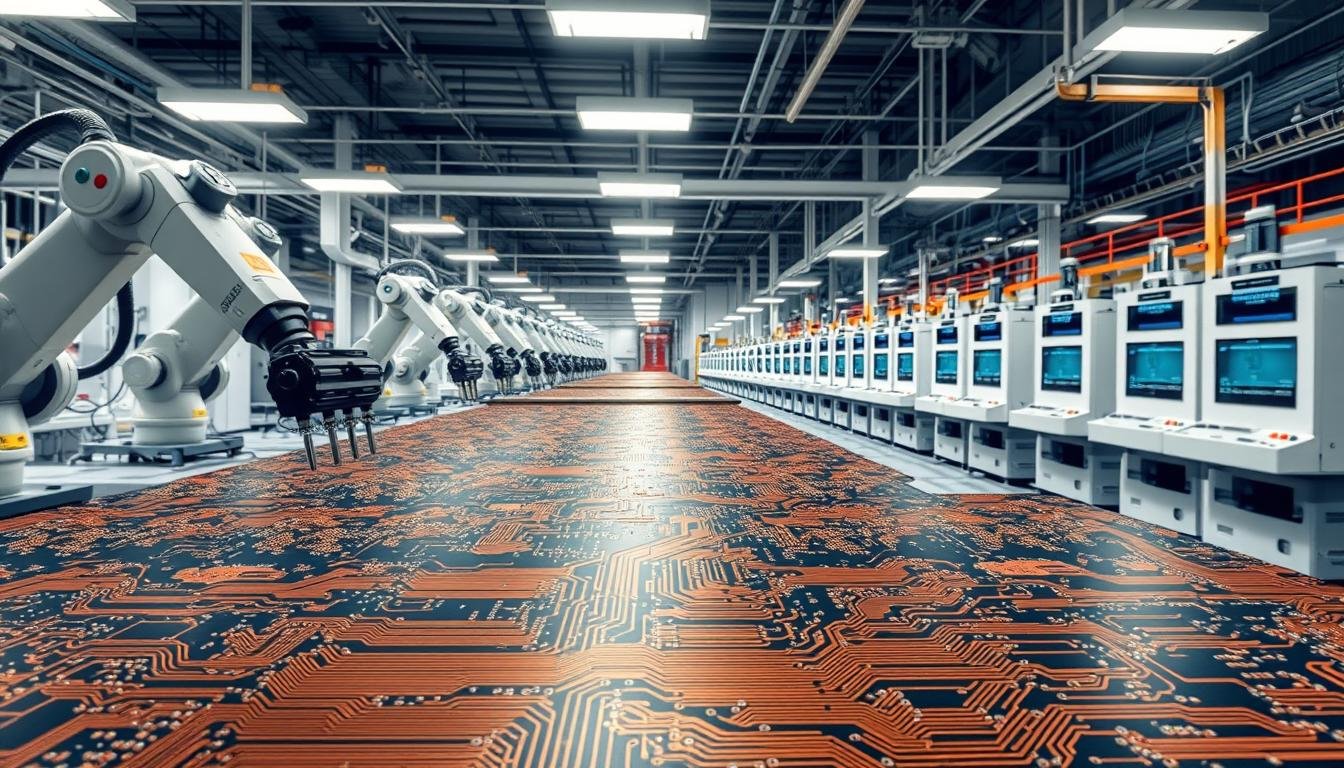
Are delays in PCBA projects costing your business valuable time and resources? In the fast-paced world of electronics manufacturing, timely delivery is crucial. We’ve analyzed numerous PCBA projects and identified the top three factors causing significant delays.
Understanding these common delay factors is essential for electronics manufacturers and OEMs to implement preventative measures. The ripple effects of PCBA delays extend beyond timeline extensions, often resulting in increased costs and strained client relationships.
Key Takeaways
- Identifying the top three reasons for PCBA project delays.
- Understanding the impact of delays on business operations.
- Strategies to mitigate risks in pcb design and assembly.
- Improving on-time delivery rates for complex PCBA projects.
- Establishing reliable timelines and managing stakeholder expectations.
Understanding PCBA Project Timelines and Common Challenges
Effective PCBA project management is crucial for meeting production deadlines and ensuring the quality of electronic devices. We recognize that printed circuit boards (PCBs) form the foundation of virtually all modern electronic devices, serving as both the physical structure and electrical pathway for components.
The Critical Nature of PCBA in Electronics Manufacturing
The PCB represents the heart and soul of any electronic circuit, responsible for the electrical connection between components and the interfacing of the device with the outside world. Even the smallest design error can cause additional delays or costs during manufacturing, or even lead to the malfunction or complete failure of the circuit.
- PCBA projects follow a highly sequential development process, making them vulnerable to cascading delays when issues arise.
- The complexity of today’s PCBs continues to increase with higher component densities and multi-layer designs, introducing additional failure points.
How Delays Impact Production Schedules and Costs
When PCBA delays occur, they rarely impact just the production timeline—they create ripple effects throughout the supply chain, affecting inventory management, cash flow, and customer commitments. Manufacturing process disruptions can increase costs exponentially, with late-stage changes often costing 10-100 times more than those identified early in the design phase.
- PCB failure rates correlate directly with rushed production schedules, as proper testing and quality control procedures may be abbreviated to meet deadlines.
- The electronics manufacturing industry operates on increasingly tight margins, making production efficiency and on-time delivery critical competitive advantages for manufacturers.
Reason #1: Changing Engineering Requirements

Engineering requirement changes are the leading cause of schedule resets and production delays in PCBA projects. Whenever these changes occur, they often necessitate a redesign, typically originating from the schematic. This can lead to adjustments in the core circuitry or PCB build requirements, subsequently affecting the PCB layout.
How Requirement Changes Cascade Through the Design Process
When engineering requirements change, the impact is felt across the entire design process. Modifications introduced after the PCB design phase has begun can trigger a cascade of revisions, affecting every subsequent stage of development. This includes not just the design team, but also component procurement, manufacturing setup, and testing protocols, all of which must be recalibrated.
We’ve observed that even seemingly minor changes can have significant downstream effects. For instance, a change in the power supply requirements can necessitate alterations in the circuit design, which in turn may require adjustments to the PCB layout.
Types of Engineering Changes That Cause the Most Disruption
The most problematic engineering changes typically involve core circuit modifications, power supply alterations, or signal integrity adjustments that affect multiple board sections. These changes can lead to significant redesigns, impacting both the schematic and the PCB layout.
Our analysis shows that such changes account for approximately 40% of all significant delays in PCBA project timelines. The impact extends beyond the design team, affecting component procurement and manufacturing processes.
Strategies to Minimize Mid-Project Requirement Changes
To mitigate the impact of engineering changes, we recommend implementing a formal change control process with stakeholder sign-offs at critical design milestones. This can significantly reduce the frequency of disruptive mid-project requirement changes.
Additionally, thorough initial requirements gathering and comprehensive design reviews before PCB layout begins represent the most effective strategy for preventing costly engineering changes. Creating modular designs with clearly defined interfaces between functional blocks can also help isolate the impact of necessary changes when they do occur.
Reason #2: Component Sourcing and Obsolescence Issues
In the realm of PCBA, component sourcing and obsolescence issues have become a pressing concern, necessitating proactive management strategies. The complexity of modern electronics manufacturing, coupled with global supply chain volatility, has made component availability a critical factor in project success.
The Impact of Component Shortages on Project Timelines
Component shortages have become increasingly prevalent in PCBA projects, with global supply chain disruptions creating unprecedented volatility in availability and lead times. We’ve documented cases where critical component shortages have delayed production by 3-6 months, even when designs were finalized and manufacturing capacity was available. The ripple effects of component issues extend beyond simple substitutions, often requiring circuit redesigns, revalidation testing, and sometimes complete PCB assembly process adjustments.
For instance, a shortage of a specific capacitor required for a power supply circuit can halt the entire production line, leading to significant delays and increased costs. This highlights the importance of having a robust component management strategy in place.
Dealing with Unexpected Component Obsolescence
Component obsolescence presents a particularly insidious problem, as it often occurs without warning and can affect parts that were readily available during the design phase. When reusing old circuitry or working off a company library, continuous reevaluation of component lifecycles becomes crucial. The best time to check for potential obsolescence is at the beginning of the PCB layout by uploading the preliminary BOM to a distributor website.
| Component Type | Obsolescence Risk Factors | Mitigation Strategies |
|---|---|---|
| Specialized ICs | Low demand, manufacturer discontinuation | Identify alternate sources, redesign |
| Passive Components | Supply chain disruptions, price fluctuations | Stock up on critical components, diversify suppliers |
Proactive Approaches to Component Management
Implementing a formal component lifecycle management program can identify at-risk parts before they impact production schedules. Creating approved alternate parts lists during the design phase provides valuable flexibility when sourcing challenges arise during production. The most successful PCBA projects now incorporate supply chain risk assessment as a standard part of the design review process, evaluating both current availability and long-term sourcing stability.
By adopting these proactive strategies, manufacturers can minimize the risk of component sourcing and obsolescence issues, ensuring smoother production and reduced project delays.
Reason #3: Manufacturing and Quality Control Problems

The third major reason PCBA projects experience delays is related to manufacturing and quality control issues, which can be mitigated with proper protocols. Manufacturing and quality control issues represent a significant category of PCBA delays, often occurring after significant time and resources have already been invested in a project.
Incomplete or Inaccurate Manufacturing Files
Incomplete or inaccurate manufacturing files account for approximately 30% of production delays, creating frustrating back-and-forth communications between design teams and fabricators. When manufacturing files are sent to a fabrication house, the CAM operator reviews them to prepare tooling and stencils. If mistakes are found, it generates questions for the designer, delaying production. Each email requires investigation and often demands regenerating files for re-inspection, causing significant delays.
To avoid such issues, implementing automated design rule checks (DRC) and manufacturing rule checks before file submission can dramatically reduce the likelihood of manufacturing issues. This proactive approach helps ensure that manufacturing files are accurate and complete, minimizing the risk of delays.
PCB Manufacturing Defects and Their Consequences
PCB failure during manufacturing can result from numerous factors, including improper design for manufacturability (DFM), inadequate tolerances, or incompatible material specifications. Common manufacturing defects that cause PCB failure include layer misalignment, poor via plating, delamination, and trace width inconsistencies. These defects can be prevented with proper design reviews, emphasizing the importance of design for manufacturability.
- Layer misalignment due to improper registration
- Poor via plating resulting from inadequate process control
- Delamination caused by incompatible material specifications
- Trace width inconsistencies affecting signal integrity
Quality Control Processes That Prevent Production Delays
Quality control processes serve as the last line of defense against defective boards entering assembly. However, they can also introduce delays when problems are discovered late in production. To prevent such delays, establishing clear communication channels between design teams and manufacturing partners early in the development process is crucial. This helps prevent misunderstandings that lead to production delays.
By implementing robust quality control measures, such as thorough inspection protocols and testing procedures, manufacturers can identify and address potential issues before they cause significant delays. This proactive approach to quality control is essential for ensuring the timely delivery of high-quality PCBA products.
Mitigating PCBA Project Delays: Best Practices for Smoother Production
A comprehensive strategy is necessary to tackle the common challenges that lead to delays in PCBA projects. Effective management of PCBA projects requires addressing the primary factors that contribute to delays. By doing so, manufacturers can ensure smoother production and reduce the likelihood of PCB failure.
To achieve this, we recommend implementing a formal design review process that includes multiple stakeholders to catch potential issues before they impact production timelines. Additionally, creating a component management strategy that includes lifecycle analysis and alternative part identification can mitigate sourcing delays. Establishing clear communication protocols between design teams, component suppliers, and manufacturing partners is also crucial.
For more insights on optimizing PCBA processes, visit our resource on top strategies for excellence in PCB assembly. By adopting these best practices, manufacturers can minimize delays and ensure more dependable performance.
FAQ
What are the most common causes of delays in PCBA projects?
How can changing engineering requirements impact PCBA project timelines?
What strategies can be employed to mitigate component sourcing and obsolescence issues?
How can PCB manufacturing defects be prevented?
What quality control processes can prevent production delays in PCBA projects?
How can PCBA project delays be mitigated?
About The Author
