
Imagine an aircraft navigating vast distances without human oversight—delivering medical supplies, monitoring wildfires, or inspecting pipelines. This isn’t science fiction; it’s the reality of autonomous flight. But how do these machines stay reliable when they’re miles beyond human control? The answer lies in an often-overlooked component: the precision-engineered circuitry at their core.
We’ve seen firsthand how advanced electronics enable long-range operations. These systems demand more than off-the-shelf parts. They require aerospace-grade reliability, fail-safe communication links, and compliance with strict aviation standards. Every connection matters when a single malfunction could ground an entire mission—or worse.
From agriculture to disaster response, industries are pushing boundaries. Yet achieving regulatory approval remains a hurdle. Our work as a trusted partner in electronics manufacturing focuses on solving these challenges. By integrating detect-and-avoid technologies and robust data protocols, we help turn ambitious concepts into certified solutions.
Key Takeaways
- Precision circuitry forms the backbone of reliable autonomous flight systems
- Long-range operations require specialized components for navigation and safety
- Regulatory compliance is critical for industry-wide adoption
- Advanced communication systems prevent failures during extended missions
- Collaborative design processes accelerate certification timelines
Understanding Operational Boundaries in Modern Aerial Technology
The next frontier in aerial innovation isn’t altitude or speed—it’s operational range. While traditional visual line sight methods keep pilots tethered to their aircraft’s immediate vicinity, new capabilities redefine what’s possible. Three frameworks govern these advancements: direct observation, extended oversight, and fully autonomous systems.
Breaking Down Flight Categories
Visual line sight (VLOS) operations require constant unaided visibility—like watching a helicopter during rescue missions. Extended versions use observers with binoculars for slightly broader coverage. True innovation emerges when aircraft operate entirely beyond human perception, relying on satellite networks and collision-avoidance tech.
This shift unlocks unprecedented potential. Emergency responders can survey disaster zones spanning multiple counties. Energy companies monitor pipelines crossing remote terrain. Each application demands specialized hardware capable of maintaining connections over vast distances.
Why Range Matters
Traditional methods limit drones to areas within 500 meters. Moving beyond visual line constraints removes geographical barriers while improving efficiency. One agricultural survey mission could cover 10,000 acres instead of 500. Delivery networks bypass traffic congestion entirely.
We design electronics to meet these challenges head-on. Redundant communication systems prevent signal loss. Precision navigation modules ensure centimeter-level accuracy without ground supervision. Every component undergoes stress testing for mission-critical reliability.
Regulatory Landscape for BVLOS Drone Systems in the United States

Navigating airspace regulations requires more than technical expertise—it demands a roadmap through evolving compliance standards. The Federal Aviation Administration (FAA) maintains strict oversight for unmanned aircraft, particularly for missions extending past human observation. Two pathways dominate this space: Part 107 waivers and Part 135 certifications.
FAA and Part 107/135 Regulations
Standard commercial activities under Part 107 prohibit flights beyond unaided vision. Operators seeking expanded capabilities must either:
| Pathway | Use Case | Key Milestone |
|---|---|---|
| Part 107 Waiver | Short-term missions | Demonstrate collision avoidance tech |
| Part 135 Certificate | Delivery networks | Prove system redundancy |
Zipline’s 2022 certification for medical deliveries showcased the potential of fixed-wing platforms. Similarly, Matternet’s M2 became the first non-military aircraft to achieve full type approval. These successes highlight the importance of hardware meeting aviation-grade reliability thresholds.
International Regulatory Perspectives
While the U.S. focuses on case-by-case approvals, other regions take varied approaches:
- European Union: Centralized certification through EASA
- Canada: Special Flight Operations Certificates
- Japan: Priority on urban delivery frameworks
We help teams align their technical designs with region-specific requirements. This includes documentation support for safety cases and failure mode analyses critical for approval processes. Global harmonization efforts continue to shape best practices, but localized compliance remains essential for market entry.
Technical Components of BVLOS Drone Operations
The true enablers of long-distance unmanned missions lie in two critical areas: intelligent guidance mechanisms and uninterrupted information exchange. These elements work in tandem to maintain safety and precision when human oversight isn’t physically possible.
Modern guidance architectures combine multiple technologies for fail-safe operation. High-accuracy positioning modules work with motion sensors to create real-time 3D maps of a craft’s surroundings. This fusion allows immediate course corrections during weather changes or unexpected obstacles.
Key components include:
- Multi-frequency GNSS receivers for centimeter-level positioning
- Inertial measurement units that track movement without external signals
- Onboard processors executing 100+ decision algorithms per second
Data Link and Connectivity Solutions
Maintaining constant communication requires robust transmission systems. We design multi-path networks that automatically switch between cellular, satellite, and RF links based on signal strength. This redundancy prevents blackout zones during extended missions.
“The difference between success and failure often comes down to milliseconds in data latency. Our systems prioritize mission-critical telemetry above all else.”
These technologies enable operators to monitor battery levels, adjust flight paths, and receive real-time sensor data through wireless communication protocols. Dual encryption layers protect against cyber threats while maintaining transmission speeds under 50ms.
The Role of Autonomous Systems and GPS in BVLOS Operations
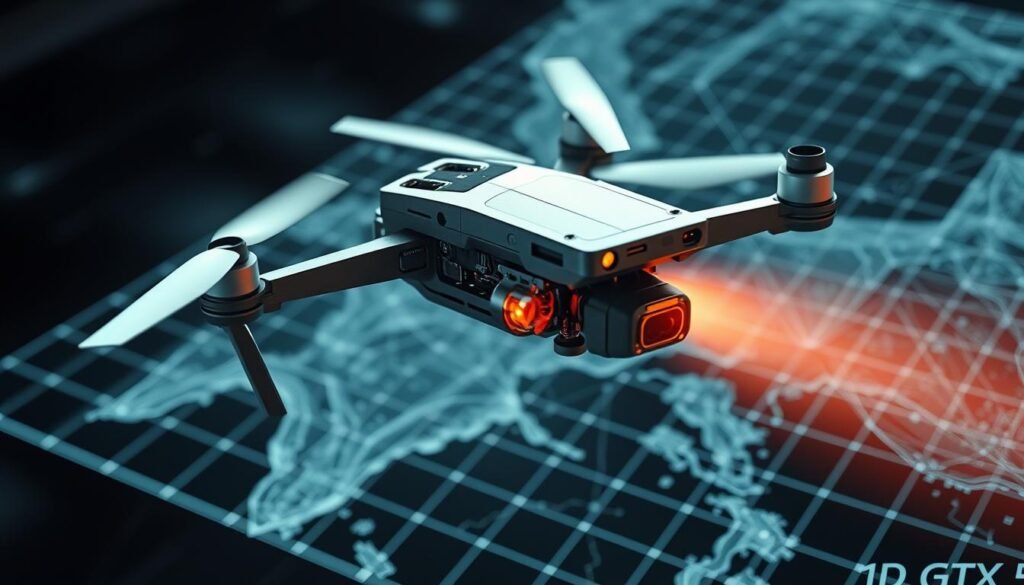
At the heart of unmanned aerial innovation lies a critical question: How do machines navigate vast distances with pinpoint accuracy? The answer combines self-governing navigation and satellite-based positioning technologies working in perfect harmony.
Modern aerial platforms rely on decision-making algorithms that process multiple data streams simultaneously. These frameworks enable course corrections for wind shifts, battery management, and emergency protocols—all without human input. Redundant sensors create fail-safes, ensuring continuous operation even when individual components face interference.
One breakthrough involves adaptive route planning. Machines now recalculate paths mid-mission based on live weather updates or airspace restrictions. This capability proves vital for missions spanning hundreds of miles where manual oversight isn’t feasible.
Satellite Positioning Precision
Centimeter-level accuracy isn’t optional for beyond-line-of-sight applications. Dual-frequency GNSS receivers paired with real-time kinematic corrections achieve this through ground station networks. Post-processed kinematic methods further enhance positional data for mapping and surveying tasks.
We design circuitry that integrates these technologies while minimizing signal latency. Our approach includes:
- Multi-constellation satellite support for global coverage
- Anti-jamming firmware for signal integrity
- Thermal-stable oscillators maintaining timing precision
Recent advancements in navigation tech demonstrate how tightly coupled GPS and flight control systems enable reliable long-range missions. By building redundancy into every layer—from power supplies to data transmission—we help ensure these aerial platforms operate safely at scale.
Integration of Detect-and-Avoid Systems in Drone Safety
The silent guardians of autonomous flight aren’t pilots—they’re sensor arrays working in perfect sync. Modern detect-and-avoid solutions combine multiple technologies to create digital sentries that never blink. These systems process thousands of data points per second, identifying threats from all directions.
Multilayered Threat Detection
Radar modules operating at 76-77 GHz frequencies detect moving objects up to 3 kilometers away. Infrared cameras track heat signatures through smoke or fog. LiDAR maps static obstacles with millimeter precision, while ADS-B receivers monitor air traffic positions in real time.
We design these components to work as a unified safety network. Our approach ensures consistent performance across temperature extremes and electromagnetic interference. When a delivery craft encounters unexpected birds or power lines, the system triggers evasive maneuvers before human operators register the threat.
Recent advancements in multi-sensor integration demonstrate how machines achieve situational awareness surpassing human capabilities. By combining short-range optical sensors with long-distance radar, autonomous craft navigate complex environments safely. These innovations make large-scale operations in shared airspace not just possible—but practical.
FAQ
What advantages do BVLOS operations offer over traditional drone flights?
How does FAA Part 107 differ from Part 135 for BVLOS approvals?
What technical components are critical for compliant BVLOS systems?
How do autonomous systems enhance BVLOS safety?
What role do detect-and-avoid systems play in FAA compliance?
What industries are adopting BVLOS for routine operations?
How do operators demonstrate BVLOS safety to regulators?
What’s required to obtain a BVLOS waiver under Part 107?
About The Author
