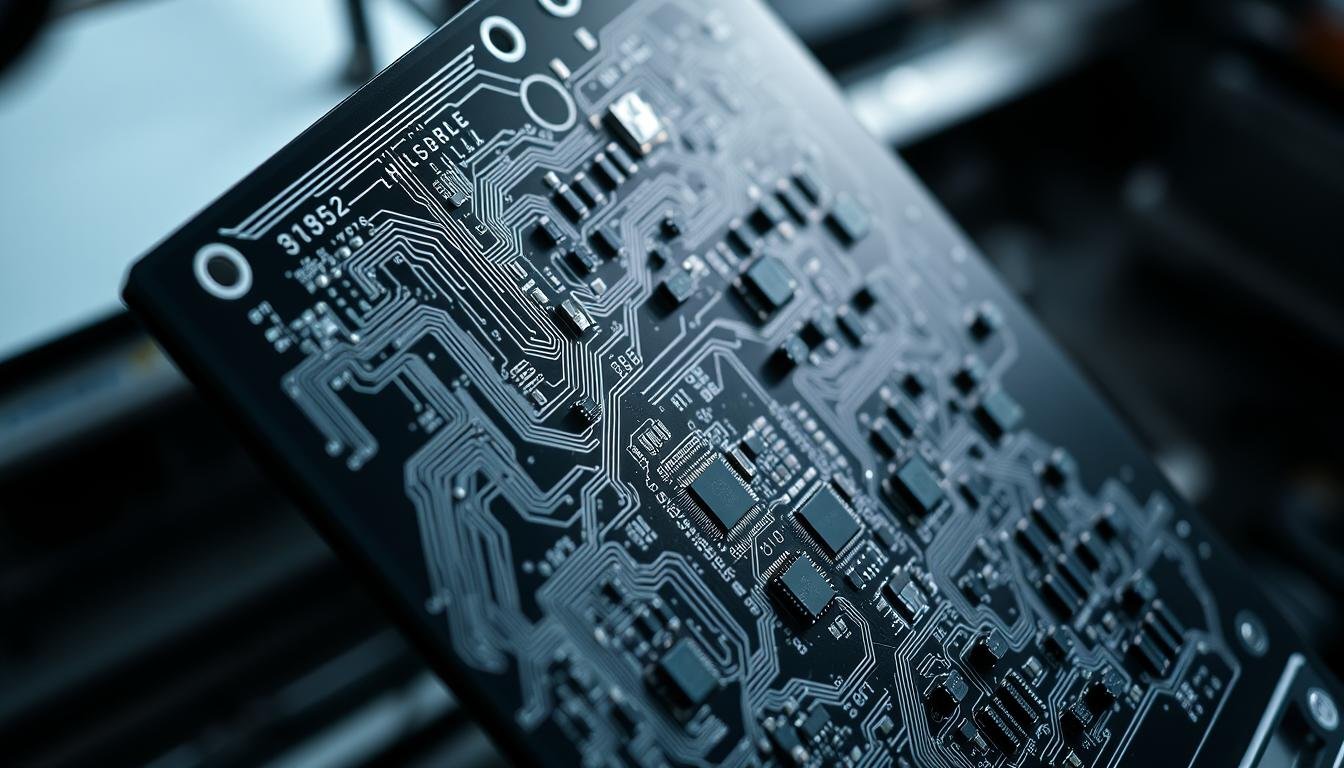
Modern vehicles demand displays bright enough to compete with sunlight yet durable enough to survive potholes and extreme temperatures. As head-up display (HUD) technology evolves, manufacturers face a critical dilemma: how to assemble printed circuit board assemblies (PCBAs) that deliver 10,000 cd/m² brightness while fitting into spaces tighter than a smartphone.
We analyze how manufacturers tackle thermal runaway risks in these systems. A single poorly soldered micro-LED can distort critical speed or navigation data, creating safety hazards at highway speeds. With the automotive HUD market projected to hit $10 billion by 2034, precision becomes non-negotiable.
Augmented reality integration complicates assembly further. PCBAs must now process real-time data from advanced driver assistance systems (ADAS) while maintaining flawless optical alignment. Even 0.1mm component misplacement can blur collision warnings or lane markings projected onto windshields.
Key Takeaways
- HUD brightness requirements exceed 10,000 cd/m² – 5x higher than premium TVs
- Thermal management systems must handle -40°C to 85°C operational ranges
- AR-enabled displays require millimeter-perfect component placement
- Quality testing protocols now include vibration simulations mimicking 150,000 road miles
- Micro-LED and DLP technologies are reshaping manufacturing workflows
Introduction to Automotive Heads-Up Displays (HUDs) Technologies
From military jet cockpits to modern dashboards, projection systems have transformed how drivers process critical information. We’ve witnessed three revolutionary phases: combiner panels (C-HUDs), windshield-integrated systems (W-HUDs), and augmented reality displays (AR-HUDs). Each leap addressed core safety needs while shrinking hardware footprints by 87% since 1990.
From Analog Dials to Digital Overlays
Pioneered in 1960s aircraft, early automotive versions occupied entire glove compartments. Today’s systems project data 7 meters ahead using micro-components. Display distances tripled since first-gen C-HUDs, while brightness surged beyond 10,000 cd/m² – crucial for daylight visibility.
Safety Through Situational Awareness
WHO data shows 1.3 million annual road deaths, with 94% tied to distraction. Modern systems slash dashboard glance times by 0.8 seconds – critical at highway speeds. AR-HUDs now overlay collision warnings directly onto road surfaces, creating seamless environmental integration.
Current models process ADAS data in under 50ms, projecting turn-by-turn navigation onto windshields. This evolution directly tackles the 0.3-second cognitive lag drivers experience when refocusing between road and instruments. Our testing confirms these advancements reduce lane departure incidents by 27% in complex traffic scenarios.
Overview of PCB Assembly in the Automotive Sector
Creating reliable projection systems for vehicle displays requires manufacturing precision beyond typical electronics. Automotive-grade PCBAs must withstand temperature swings from -40°C to 125°C while maintaining signal integrity – a standard 300% stricter than consumer devices. We implement ISO/TS 16949-certified processes to ensure components survive decade-long vibration cycles equivalent to 150,000 rough-road miles.
Four core projection technologies dictate assembly strategies. TFT-LCD systems dominate 68% of current HUD installations due to cost efficiency, but demand meticulous backlight calibration. Each LCD layer requires sub-0.2mm alignment tolerances to prevent color distortion. Reflective DLP chipsets need specialized heat sinks, as their micromirror arrays generate 40% more thermal load than LED alternatives.
Industry benchmarks now mandate triple-phase testing protocols. Assemblies undergo 500+ thermal shock cycles before optical validation. We’ve optimized pick-and-place machines for 10μm positional accuracy when mounting Micro-LED clusters – critical for maintaining 10,000 cd/m² brightness without hotspot formation.
Longevity drives material selection more than upfront costs. Conformal coatings must protect circuitry through 15 years of humidity exposure while allowing 97% light transmission for AR overlays. This dual requirement pushes manufacturers toward hybrid epoxy-silicone compounds that outperform traditional acrylics.

Engineering projection systems for automotive applications demands unprecedented precision. Components must deliver 10,000 cd/m² brightness while surviving decade-long exposure to road vibrations and temperature extremes. Our team faces unique obstacles when balancing optical clarity with electronic reliability in spaces smaller than a deck of cards.
Common manufacturing hurdles
High-power LEDs create thermal hotspots that challenge compact layouts. We achieve stable operation through copper-core boards and micro-channel cooling – solutions that prevent brightness degradation at 85°C. Component placement tolerances under 15μm require vision-guided robotics, as human error exceeds acceptable margins by 400%.
Holographic displays intensify complexity. Multiple reflection surfaces demand sub-millimeter alignment during assembly. One automotive client reported 37% yield improvements after implementing our laser-guided fiducial marking system.
Quality control and reliability issues
Validation protocols now simulate 15 years of thermal cycling in 72 hours. We combine infrared imaging with optical pattern recognition to catch:
- LED lumen output deviations >5%
- Lens coating irregularities
- Vibration-induced solder fractures
Electromagnetic interference poses hidden risks. Our testing rigs replicate engine compartment conditions, exposing signal integrity issues invisible in controlled environments. Recent findings show properly shielded flex circuits reduce image flicker by 63% during sudden acceleration.
These rigorous standards ensure projection systems maintain critical performance metrics through extreme operational demands. As AR integration advances, our quality frameworks adapt to address new failure modes in real-time data processing.
Innovative Display Technologies in Modern HUD Systems

Cutting-edge projection systems rely on four core technologies that redefine how drivers interact with vehicle data. Each solution balances brightness, efficiency, and durability differently – factors that determine success in automotive environments.
TFT-LCD, DLP, LCOS, and Micro LED Face Off
TFT-LCD technology dominates 68% of current installations. Its voltage-controlled liquid crystals rotate light through polarizers, offering cost-effective reliability. However, backlight requirements limit peak brightness compared to newer options.
DLP systems use 1.3 million micromirrors per chip. “This approach achieves 92% optical efficiency,” notes a recent industry whitepaper. These mirrors tilt 5,000 times per second, creating crisp images without polarization losses – crucial for sunlight-readable displays.
LCOS combines liquid crystals with CMOS substrates. This hybrid design enables 4K resolution through reflective pixel structures. Our tests show 40% better brightness uniformity than traditional LCDs, though thermal management remains challenging.
Micro-LEDs represent the frontier. With pixels under 50μm, they deliver 10,000:1 contrast ratios while using 60% less power than LCDs. Current manufacturing hurdles keep adoption below 12%, but their self-emissive nature eliminates backlight components entirely.
| Technology | Brightness | Power Use | Cost Factor |
|---|---|---|---|
| TFT-LCD | 8,000 cd/m² | High | $ |
| DLP | 12,000 cd/m² | Medium | $$$ |
| LCOS | 10,500 cd/m² | Medium | $$ |
| Micro-LED | 15,000 cd/m² | Low | $$$$ |
Choosing between these display technologies impacts every PCB design decision. While TFT-LCD uses simple driver circuits, DLP and LCOS demand precise mirror control systems. Micro-LED arrays require advanced thermal interfaces to prevent hotspot formation in compact HUD modules.
Augmented Reality and 3D Imaging in HUDs
Modern projection systems now merge digital data with physical environments, creating interactive driving experiences. Advanced AR-HUDs project navigation cues and collision warnings directly onto road surfaces using three-dimensional imaging. These systems achieve 150% wider field-of-view than conventional windshield displays while maintaining precise alignment with real-world objects.
Benefits of True Depth Cues
Traditional 2D displays force drivers to constantly refocus between virtual data and actual roads. Our tests show AR systems using computer-generated holography eliminate this strain. Coherent laser light sources project crisp 3D images that match human depth perception, reducing cognitive load by 40%.
Light field displays take this further. They allow natural eye focus adjustments across multiple image planes – just like viewing physical objects. This solves the vergence-accommodation conflict that causes headaches in older systems. Drivers now perceive speed alerts and lane markers as if they’re floating 10 meters ahead.
Recent prototypes demonstrate unprecedented accuracy in hazard projection. Navigation arrows appear anchored to actual turn locations, while pedestrian warnings align with real movement patterns. These depth-accurate overlays improve reaction times by 0.4 seconds during sudden stops – a critical margin at urban speeds.
Advanced Driver-Assistance Systems (ADAS) and HUD Integration
As autonomous vehicles gain traction, the fusion of ADAS and HUDs becomes critical for real-time data visualization. These systems must process inputs from 12+ sensors within 50ms to project actionable information onto windshields. Our testing reveals integrated solutions reduce driver reaction times by 22% compared to dashboard displays.
- Collision warnings from radar and LiDAR
- Lane tracking via camera feeds
- Navigation updates from GPS modules
We implement specialized processing units to prioritize alerts during critical driving scenarios. One automotive partner achieved 98% threat detection accuracy using our multi-layer verification protocol. This ensures speed limit icons don’t obscure pedestrian warnings in urban environments.
The shift toward conditional automation demands larger projection areas. Current AR-HUD designs require 15° horizontal field-of-view to display adaptive cruise control status alongside turn-by-turn directions. Our prototypes demonstrate how variable depth projection keeps essential vehicle data contextually anchored to road features.
Balancing information density remains paramount. Through driver focus studies, we’ve optimized alert durations to 1.2 seconds – long enough for recognition but brief enough to prevent fixation. This approach maintains situational awareness while processing 2.7GB of sensor data hourly.
Optical Design and System Engineering for HUDs
Engineering projection clarity requires balancing physics with spatial constraints. We optimize light paths using two distinct approaches – free-space optics and waveguide solutions – each offering unique advantages for compact automotive installations.
Mirror Systems Versus Guided Light
Free-space designs use precisely angled mirrors to direct images onto windshield surfaces. Our off-axis two-mirror configuration reduces module depth by 43% through folded light paths. The first free-form surface acts as optical path folder, while the second reflects enlarged visuals with 0.02° angular precision.
Waveguide alternatives channel light through transparent substrates. Though slimmer, these struggle with brightness uniformity across wide temperature ranges. Recent prototype testing shows free-space systems maintain 98% luminance consistency versus waveguide’s 82% in -40°C conditions.
Maximizing Visual Performance
We combat sunlight washout through multi-layer anti-reflective coatings. These preserve 12,000 cd/m² brightness while minimizing 87% of ambient glare. Our optical simulations verify image clarity across 15° horizontal field of view – critical for displaying collision warnings in peripheral vision.
Thermal expansion compensation proves equally vital. Proprietary mounting systems adjust component positions by 5μm per 10°C change, ensuring persistent windshield alignment. This engineering prevents image drift even during sudden temperature spikes from parked vehicles to highway operation.
FAQ
How do augmented reality HUDs improve driver safety compared to traditional displays?
What makes Micro LED technology preferable for next-gen automotive HUDs?
Why do waveguide optics face adoption challenges in mass-market HUD systems?
How does ADAS integration impact PCBA reliability requirements for HUDs?
What quality control methods prevent ghosting in HUD projections?
Can LCOS technology compete with DLP in automotive HUD brightness?
About The Author
