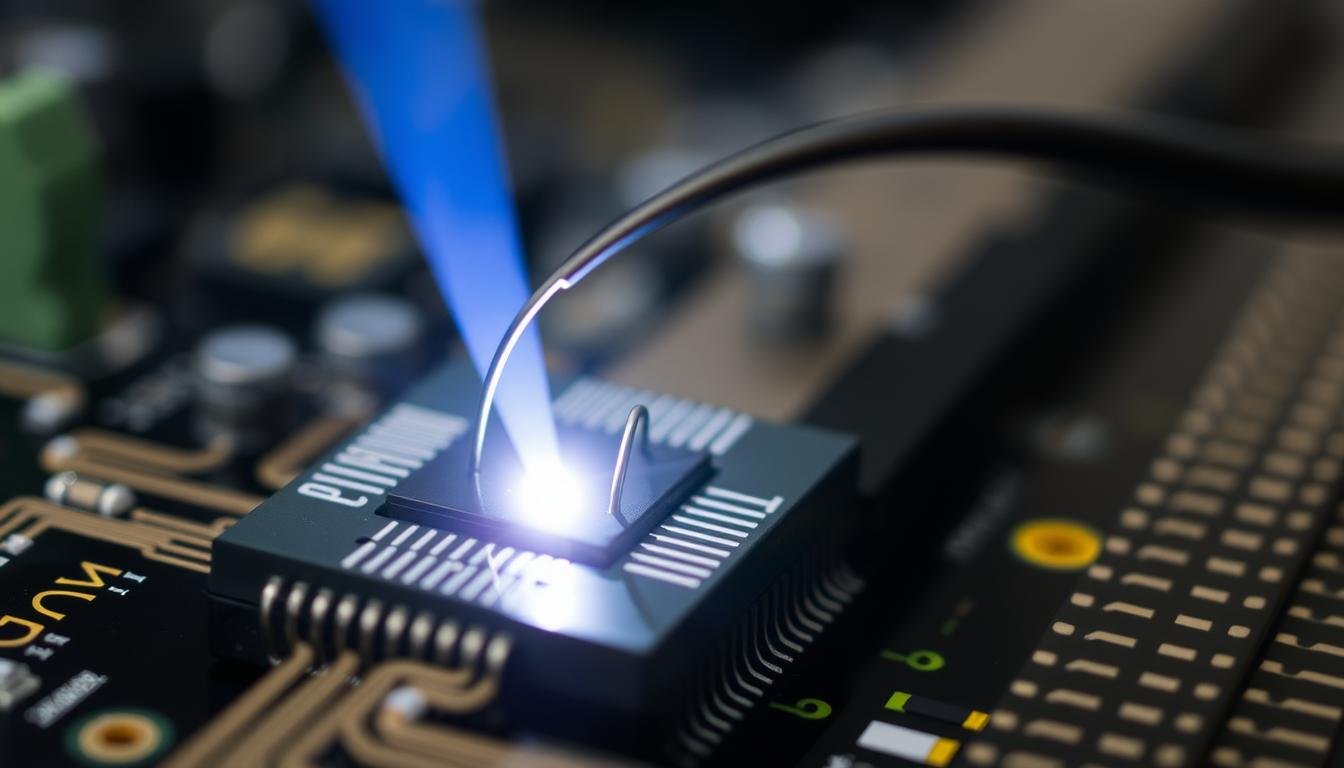
Can the reliability and performance of modern electronics be achieved without a robust connection between the semiconductor die and the printed circuit board (PCB)? The answer lies in wire bonding technology, a critical component in Chip-on-Board (COB) assemblies. We will explore how wire bonding creates reliable interconnections in compact, high-performance designs.
Wire bonding has been the dominant method for connecting semiconductor dies to package lead frames and circuit boards, particularly in COB technology. This method accounts for 75-80% of first-level interconnections in the microelectronics industry, providing unmatched reliability and cost efficiency.
Key Takeaways
- Understanding the fundamental principles of COB technology and wire bonding.
- Recognizing why wire bonding remains the preferred method for interconnections.
- Discovering how wire bonding services enable compact, high-performance designs.
- Learning about the wire bonding process, materials, and applications.
- Understanding the cost considerations for wire bonding in electronic manufacturing.
Understanding Wire Bonding Technology for COB Applications

In the realm of electronics manufacturing, wire bonding plays a pivotal role in COB technology, ensuring reliable connections. We will delve into the specifics of wire bonding, exploring its significance in COB assemblies.
What is Chip-on-Board (COB) Technology?
Chip-on-Board (COB) technology involves directly mounting a semiconductor die on a printed circuit board (PCB). This approach eliminates the need for individual packaging of the chip, reducing size and increasing performance. COB technology is commonly used in applications where space is limited, and high reliability is crucial.
The Wire Bonding Process Explained
The wire bonding process involves creating electrical connections between the COB assembly and the PCB using thin wires. This is achieved through a combination of heat, pressure, and ultrasonic energy. The wire bonding process requires precision to ensure reliable connections.
Materials Used in Wire Bonding
The selection of appropriate wire bonding materials is crucial for ensuring optimal performance, reliability, and cost-effectiveness in COB assemblies. The three primary materials used are gold, aluminum, and copper. Gold wire is valued for its superior conductivity and corrosion resistance, while aluminum and copper offer cost-effective alternatives. The choice of wire material affects not only the manufacturing process but also the long-term reliability of the COB assembly under thermal cycling and environmental stress.
We compare the three primary wire materials used in bonding applications, explaining their unique properties and ideal use cases. The interaction between the wire material and the substrate surface finish significantly impacts bond quality and reliability. Techniques such as Aluminum Wedge Wire Bonding and Gold Ball Wire Bonding are utilized, with the latter often paired with surface finishes like ENIG or soft gold plating to enhance performance.
Types of Wire Bonding Services for Chip-on-Board Assemblies
The world of wire bonding for COB assemblies encompasses a range of services, each designed to meet specific requirements. At our facility, we offer a variety of wire bonding techniques to cater to the diverse needs of our clients.
Gold Ball Wire Bonding
Gold ball wire bonding is a widely used technique in COB assemblies, known for its reliability and versatility. This method involves creating a ball bond using gold wire, which is then connected to the chip and the substrate. We utilize gold ball wire bonding for a range of applications, benefiting from its high level of precision and durability.
Aluminum Wedge Wire Bonding
Aluminum wedge wire bonding is another technique we employ, particularly for applications requiring high-frequency and high-reliability connections. This method uses aluminum wire and a wedge bonding tool to create strong, durable bonds. Our aluminum wedge wire bonding services are designed to meet the stringent requirements of various industries.
Heavy Wire Bonding for Power Applications
For power applications, we utilize heavy wire bonding, which involves using thicker wires to handle higher currents. This technique is essential for devices that require robust electrical connections. Our heavy wire bonding services enable the production of reliable, high-power devices.
Ribbon Bonding and Specialized Techniques
Beyond traditional wire bonding, we offer specialized interconnection techniques like ribbon bonding and stud bumping. Ribbon bonding, for instance, provides superior current-carrying capacity and reduced inductance, making it ideal for RF and high-frequency applications. Our customizable gold ribbon bonding capabilities can be tailored to specific design requirements and electrical performance needs.
We also provide stud bumping services with wire diameters ranging from 0.7 to 2.0 mils (18-50 microns), which create the foundation for advanced flip chip attachment processes. Our specialized bonding techniques include thermosonic and thermocompression flip chip processes with gold stud bumps, offering higher connection density and improved electrical performance.
Applications and Industries Using Wire Bonding COB Technology
Wire bonding COB technology has numerous applications across various industries, transforming the way electronic devices are manufactured. We utilize wire bonding in diverse sectors, leveraging its reliability and performance to meet the evolving demands of modern electronics.
Consumer Electronics Applications
In consumer electronics, wire bonding COB technology is pivotal for creating compact, high-performance devices. We see its application in smartphones, tablets, and wearables, where it enables efficient signal transmission and power delivery. Our wire bonding services support the development of sleek, feature-rich consumer products that meet the demands of modern users.
Automotive and Power Electronics
The automotive sector relies on wire bonding for various applications, including power electronics and sensor systems. We provide wire bonding services that cater to the stringent requirements of the automotive industry, ensuring high reliability and durability. Our solutions support the development of advanced driver-assistance systems (ADAS) and electric vehicle (EV) components.
LED and Optoelectronic Applications
Wire bonding is crucial in LED and optoelectronic devices, facilitating the connection of delicate components. We offer specialized wire bonding services that enhance the performance and lifespan of LEDs and other optoelectronic devices. Our expertise supports the development of high-brightness LEDs, laser diodes, and other photonic components used in various applications.
3D Integrated Circuits and Advanced Computing
In 3D ICs, wire bonding is vital for connecting vertically stacked semiconductor dies. We support the development of 3D ICs with high-density interconnections, enabling advanced computing applications that require maximum processing power in minimal space. Our wire bonding services facilitate innovations in artificial intelligence processors, high-bandwidth memory, and other cutting-edge computing applications, pushing the boundaries of semiconductor packaging technology. For more information on wire bonding in modern applications, visit Altium’s resource page.
| Industry | Application | Benefit of Wire Bonding |
|---|---|---|
| Consumer Electronics | Smartphones, Tablets, Wearables | Compact Design, Efficient Signal Transmission |
| Automotive | Power Electronics, Sensor Systems | High Reliability, Durability |
| LED and Optoelectronics | LEDs, Laser Diodes, Photonic Components | Enhanced Performance, Longer Lifespan |
| Advanced Computing | 3D ICs, AI Processors, High-Bandwidth Memory | High-Density Interconnections, Maximum Processing Power |
Cost Considerations and Advantages of Wire Bonding Services
To make informed decisions about your electronic manufacturing strategy, it’s essential to understand the cost implications of wire bonding for Chip-on-Board (COB) assemblies. The cost of wire bonding is influenced by several variables, including the type of material used, the complexity of the application, and the production volume.
Material costs play a significant role, with gold wire bonding being the most expensive option. However, copper and aluminum offer more cost-effective alternatives. The cost of wire bonding machines also varies widely depending on their level of automation, ranging from tens of thousands to hundreds of thousands of dollars.
- Understanding the cost factors and advantages of wire bonding services is crucial for optimizing your electronic manufacturing strategy.
- Production volume significantly affects wire bonding economics, with high-volume production benefiting from cost reductions through process optimization.
- COB designs can be more cost-effective than using standard packaged chips, especially in high-volume production.
By understanding these factors and leveraging the advantages of wire bonding, including design flexibility and proven reliability, you can achieve a cost-effective solution for your COB assemblies. Our expertise helps you navigate the trade-offs between initial costs and long-term reliability, ensuring the best overall value for your specific application.
FAQ
What is the primary advantage of using Chip-on-Board (COB) technology in electronics manufacturing?
How does the wire bonding process work, and what materials are typically used?
What are the different types of wire bonding techniques used in COB assemblies?
What are the key considerations when selecting a wire bonding material?
How does flip chip technology compare to traditional wire bonding in COB assemblies?
What are the typical applications and industries that use COB technology with wire bonding?
What are the cost considerations when using wire bonding services for COB assemblies?
How can I ensure the quality and reliability of wire bonding services for my COB assemblies?
About The Author
